


Announcing Final PhD thesis defense seminar: Mohit Mahey (Eric Patterson Lab)
April 8, 2026 1:00PM - 2:00PM
Mohit Mahey
"Understanding site of action of indaziflam and resistance"
Mechanism of poa annua to indaziflam"
Date: April 8th, 2026
Time: 1:00 pm
Room: PSM 271
Members of the Examining Committee and their Department:
- Dr. Eric Patterson - Plant, Soil and Microbial Sciences
- Dr. Peter Lundquist - Biochemistry & Molecular Biology
- Dr. Timothy Miles - Plant, Soil and Microbial Sciences
- Dr. Miranda Haus - Department of Horticulture
- Dr. Daniel Woldring - Chemical Engineering and Materials Science
ABSTRACT
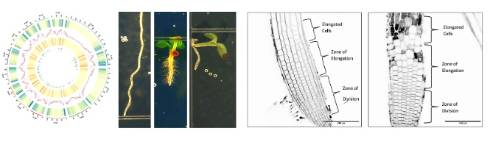
Indaziflam, a group 29 herbicide is a promising weed control, having broad spectrum activity across the monocots and dicots, high residual activity in soil and low application rate, providing an effective control of weeds. Understanding the site of action is an important step in developing better herbicides, the ecological impact and biological pathways being affected. Poa annua or annual bluegrass, a notorious cosmopolitan weeds, is the first reported weed with evolved herbicide resistance to indaziflam. Indaziflam, being one of few viable options available to control this weed in turfgrass, the resistance development poses a serious threat to sustainable management. This dissertation focuses on understanding the site of action of indaziflam, along with the extend of its activity across non-plant species. Additionally, this research explores the resistance mechanism of Poa annua to indaziflam by using transcriptome analysis of resistant and susceptible population and further exploring a candidate gene. The affinity pull-down with indaziflam as a bait, on the root lysates of Arabidopsis thaliana, and Oryza sativa led to identification of 50 and 33 proteins respectively, enriched in indaziflam-beads. The largest and most enriched group of proteins in both A. thaliana and O. sativa were involved in the clathrin mediated endocytosis, Golgi vesicle-mediated transport and intra-Golgi vesicle-mediated transport. Further analysis, with confocal microscopy with FM4-64 revealed indaziflam does not target the clathrin-mediated endocytosis as known endocytosis inhibitor, dynasore. Moreover, the unique effects on root phenotyping as compare with wortmannin, along lack of synergistic phenotype, provide the evidence that indaziflam might targets exocytosis process or Golgi-ER retrograde transport. Further testing of indaziflam on non-pant species, provide evidence that indaziflam does not inhibit growth of fungal species tested, or algae, but have strong inhibition on early plants, Marchantiophyta, suggesting indaziflam affects a protein or pathway specific to the plants. Poa annua transcriptome analysis led to identification of a CYP450 gene, with consistent upregulation of the expression across all resistant populations tested. The CYP81A91_A identified as a target belongs to a CYP 81 family which has been reported in literature to be involved in imparting herbicide resistance in weeds. The heterologous transformation of the CYP81A91_A in A. thaliana with generation of three independent insertion lines which were selfed till T4 stage. The transformed lines, did not provide resistance to indaziflam suggesting, suggesting lack of phase 2 metabolism genes in transformed lines required for resistance. The lines however, provided resistance to herbicide simazine, with one transformed line imparting 250% times tolerance as compared to control. The findings in this dissertation provide valuable insights in the site of action of indaziflam and resistance mechanisms in Poa annua that can be used for development of effective herbicide resistant management strategies

 Print
Print Email
Email