


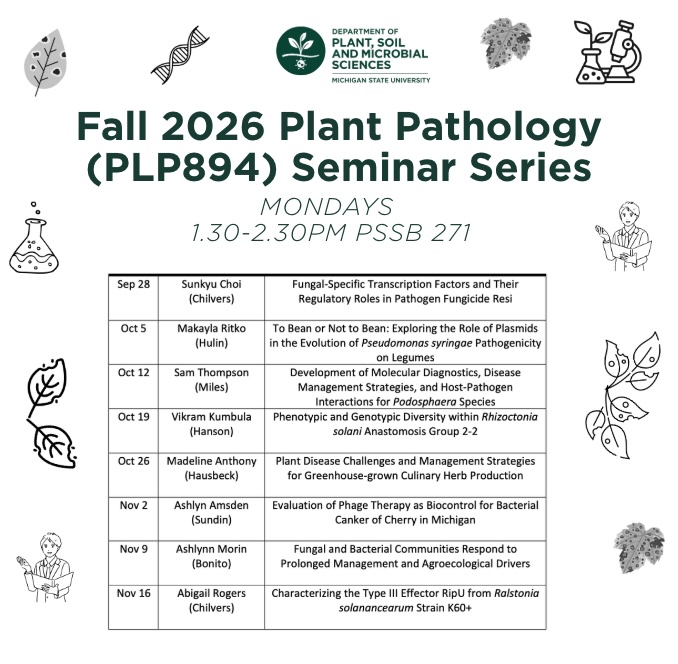
Fall 2026 Plant Pathology (PLP 894) Seminar Series featuring Makayla Ritko
October 5, 2026 1:30PM - 2:30PM
This and every Monday in PSSB 271
To bean or not to bean: Exploring the role of plasmids in the evolution of Pseudomonas syringae pathogenicity on legumes
Makayla Ritko
Bacterial plant pathogens are able to evolve rapidly and threaten global food sources. Mobile genetic elements, such as plasmids, enable bacteria to gain new traits which can lead to an increase in virulence. The bacterial pathogen Pseudomonas syringae (Ps) can infect over three hundred species of plants, though individual Ps strains vary in their host range. This project focuses on phylogroup 2b, which contains important pathogens of legumes. Closely related Pseudomonas syringae pv. syringae (Pss) and Pseudomonas syringae pv. pisi (Ppi) will be used to explore the role of plasmids in virulence. Pss is shown to have a wide host range including a variety of legumes and few plasmids, while Ppi has many plasmids and is restricted to pea species. Pss and Ppi provide an ideal system to study the role of plasmids in bacterial evolution. Comparative genomics will be used to describe plasmid differences in a collection of Pss and Ppi strains. Following the identification of unique genes on plasmids, the function of the novel XopAD plasmid-encoded effector in Ppi will be assessed for its impact on virulence. We will then assess if such plasmid variations are due to inherent compatibility differences between Pss and Ppi by establishing a cloning system to examine their ability to take up natural plasmids. This research will explore the vital role of plasmids in bacterial pathogenicity to better understand pathogen evolution. Due to the prevalence of plasmids in bacterial pathogens, this work will provide knowledge that is critical to environmental and public health.


 Print
Print Email
Email