


Fall 2026 Plant Pathology (PLP894) Seminar Series featuring Vikram Kumbala
October 19, 2026 1:30PM - 2:30PM
PSSB 271
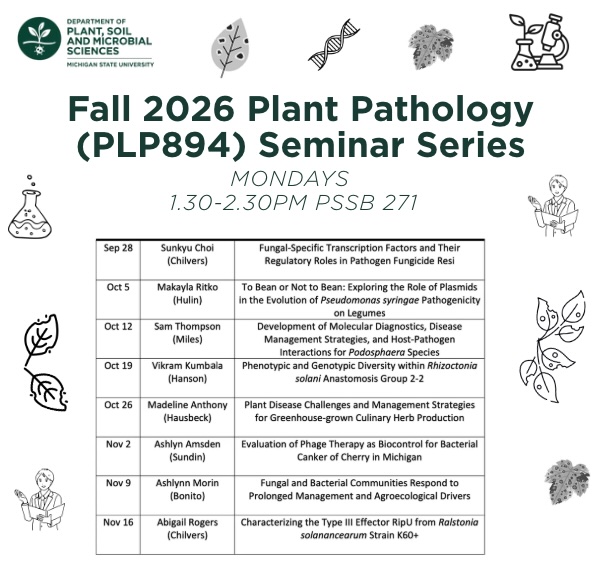
"Phenotypic and genotypic diversity within Rhizoctonia solani Anastomosis group 2-2"
Phenotypic and Genotypic Diversity Within Rhizoctonia solani Anastomosis Group 2-2 (AG 2-2)
Vikram Kumbala¹, Douglas H. Minier¹, Thomas R. Goodwill2, and Linda E. Hanson1,2
¹Michigan State University and 2USDA-ARS, East Lansing, MI
Abstract
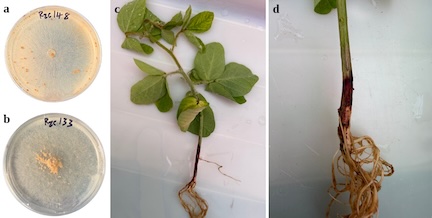
Rhizoctonia solani AG 2‑2 is a soilborne fungus that can be a pathogen of several crops, including sugar beet, soybean, dry bean, and corn, causing damping-off or root rot. Rhizoctonia solani is a species complex, divided into at least 13 anastomosis groups (AGs) identified based on hyphal fusion. AG 2‑2 has been divided into several subgroups relating to symptoms, hosts, and temperature response. However, molecular studies have shown that at least two of these subgroups, AG 2‑2IIIB and AG 2‑2IV, are not monophyletic. A recent multigene phylogeny and a microsatellite analysis both placed AG 2‑2 isolates into two genetic lineages, provisionally named BR and PR. One showed additional subgroups, tentatively splitting “BR” into BRa and BRb. We hypothesized that these genetically distinct groups would relate to some of the morphological variability previously reported in AG 2-2. The current study evaluated whether these genetic groups differ in cultural traits and in virulence on soybean. Eighteen isolates (six per genetic subgroup) were assessed for radial growth, colony morphology, and sclerotial traits on malt extract agar (MEA), corn meal agar (CMA), and tryptic soy agar (TSA). All tests used two replicates per run and each test was conducted twice. PR isolates grew significantly faster than BR isolates on MEA and CMA in both runs (P ≤ 0.00026), whereas BRa and BRb did not differ. No significant difference was detected on TSA. Colony morphology, including colony texture and sclerotial traits such as distribution and clustering of sclerotia, also exhibited potential group-level patterns. To determine whether these traits could predict genetic group, 16 additional isolates of unknown genetic group were evaluated and compared, then identified to genotype. Sclerotial traits matched the genetic group for all isolates that produced sclerotia, and radial growth rate matched for 13 of 16 (81%). Virulence was evaluated in greenhouse assays at the soybean seedling and adult-plant stages. In both assays, individual isolates differed significantly in virulence, but virulence did not differ by genetic group. On adult plants, disease was low, but the most virulent isolates were consistent between runs. Overall, sclerotial characteristics and radial growth rate may help distinguish the proposed AG 2‑2 genetic groups. Virulence on soybean was not related to genetic group, which fits with finding similar levels of all groups on soybean. Ongoing and planned work includes an additional greenhouse run on soybean, virulence testing on radish, quantitative measurement of colony density, and testing of additional isolates of unknown genetic group to support which cultural traits might predict genotype.
All seminars in this series:

 Print
Print Email
Email