Assessment of physically effective fiber in cattle finishing diets
 Print
 Email
The physical characteristics, in addition to the chemical characteristics, contribute to the ability of fiber to maintain rumen pH and health.

Cattle and other ruminants are uniquely designed with the ability to digest the fibrous plant cell wall of forages. However, the inclusion of forages in finishing diets is often kept at a low concentration (<12% of diet dry matter) due to the lesser digestibility and energy density that typically result in lesser average daily gain (ADG) compared with grains. Other factors such as cost per unit of energy, storage, processing, and sorting of diets, including forages, present additional economic and operational challenges that pose barriers for forage inclusion in finishing diets.
Feedlot cattle can grow well on grain-based diets with little forage inclusion. However, lengthy feeding periods of grain-based diets with little forage may compromise digestive health (including the liver) and eventually ADG of feedlot cattle. Researchers have been searching for the minimal requirements of fiber in cattle finishing diets while still maintaining health and growth.
The chemical components contributing to the incompletely digestible components of feeds include neutral detergent fiber (NDF) and acid detergent fiber (ADF), while a part will remain undigested (undigestible fiber). However, feedstuffs and diets with similar fiber concentrations can still differ in ADG, feed intake, rumination, ruminal pH and the occurrence of digestive disorders for beef cattle. David Mertens, Founder and CEO of Mertens Innovation and Research LLC, proposed effective NDF (eNDF) as the fiber's ability to maintain milkfat production and animal health. Further refinement of eNDF led to the development of the term physically effective NDF (peNDF), which is defined by the physical characteristics of the fiber in feedstuffs, such as particle size, and how well it stimulates rumination and the establishment of a floating mat of digesta in the rumen.
The physical size of feed particles is important for ruminant digestion as feed particles must be reduced to a small enough size to pass from the reticulorumen to the rest of the digestive tract. The size reduction of consumed feed particles occurs when cattle ruminate, thus chewing their cud. Chewing provides additional saliva that can help buffer the ruminal pH and help mitigate durations of low ruminal pH that contribute to ruminal acidosis and other digestive disorders.
A vertical sieving technique was developed to sort diets and individual feedstuffs by particle size, leading to the development and refinement of the Penn State Particle Separator (PSPS). The PSPS consists of four stackable boxes containing sieves of 19, 8, and 4 mm. Finer particles, such as grains, are collected on the solid surface of the bottom box. The 4 mm sieve is intended to represent the threshold size of particles leaving the reticulorumen. Estimated peNDF consists of the percentage of feed particles remaining in the upper three boxes (> 4 mm) multiplied by the NDF% of the diet. The NDF% of the diet can be determined from a feed sample collected and sent for nutrient analysis testing at a commercial laboratory. While there are some factors that may influence the accuracy of the peNDF estimate using this technique, it offers producers a relatively easy method for assessing physically effective fiber that can be done on farm.
Researchers have been working to determine the optimum amount of peNDF required in cattle finishing diets. However, this has led to variable peNDF recommendations for finishing diets based on the evaluation criteria selected by the researchers. From an evaluation of 8 feedlot research studies containing diets with a peNDF ranging from about 3 to 25%, Mertens determined ADG was optimized at 15.3% peNDF and differed very little from 12 to 18% peNDF. Mertens also reported that the optimum peNDF to minimize liver abscesses was about 22% and 25% to maximize feed intake. In contrast, Fox and Tedeschi recommend that finishing diets should contain 7 to 10% peNDF based on the diets’ ability to keep the rumen above an average pH of 5.7 to maintain feed intake. It is important to note that both these studies calculated peNDF using a 1.18 mm sieve rather than the 4 mm sieve used today, thus, these peNDF recommendations would likely be slightly lower than when using the updated PSPS.
Some researchers have used a threshold of 180 min per day at a ruminal pH of 5.5 or less to be indicative of a bout of ruminal acidosis. Using this threshold, they observed a greater prevalence of ruminal acidosis with increasing feed intake and advancing days on the finishing diet. More recent research, across three studies (1, 2, 3) from the University of Saskatchewan, has demonstrated that increasing dietary peNDF reduces the amount of time ruminal pH spends under a pH of 5.5 (an indication of ruminal acidosis) per day. A linear regression of these three research studies reached an average ruminal pH of less than 5.5 for 180 min per day when dietary peNDF was 9.5% (Figure 1). This result falls within the range reported by Fox and Tedeschi using the updated 4mm sieve. Thus, it demonstrates the importance of peNDF in controlling ruminal pH and reducing the likelihood of digestive upsets.
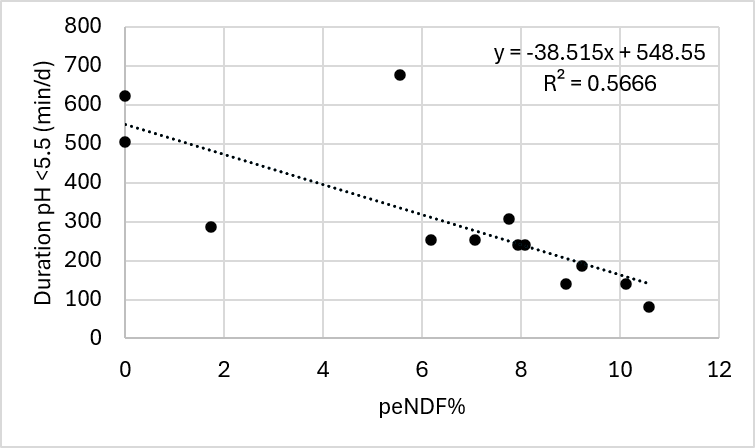
Overall, determining peNDF of diets can be an effective practice to assess the amount of fiber needed in cattle finishing diets to maintain proper rumen health for sustained feedlot performance during long feeding durations. If you have questions about measuring the peNDF of the diets fed to cattle on your operation, you can reach out to Jerad Jaborek (jaborekj@msu.edu). For more information on beef cattle, reach out to the Michigan State University Extension Beef Team or check out their website for the latest educational articles.