


Buckshot in beef?
 Print
Print Email
EmailAsk them at the slaughter plant what the big quality problems are with cattle and sooner or later in that discussion you’ll hear about shotgun pellets adulterating the beef. Quality assurance of beef and good stockmanship mean never shooting at cattle.
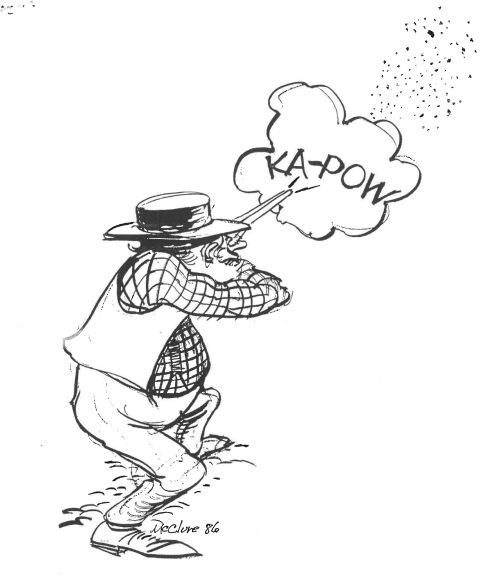
“Dang bulls out there fighting!” Clancy muttered to himself and anybody within hearing distance, which was only his dog, Oscar. “I’ll teach them to fight instead of what I’ve got them out there for!” And with that, he pulled the trigger on the shotgun. Sure enough, the bulls, wounded with enough pellets to make them stop and assess the damage, stopped fighting and wandered around the pasture. Oscar looked up, then went back to sleep.
I suppose that might be called remote management, but while it was quick and efficient, it has a cost. Slaughter plants report that shotgun pellets are still a problem in cattle carcasses. Buckshot and birdshot continue to adulterate beef according to USDA and the FDA, and when found, entire animals can be condemned. That is a big loss, especially when cattle are high priced.
Clancy drove his pickup truck around the back side of the pasture where the ravine starts. He wanted the cattle to move out of the ravine, which was thick with brush but not much grazing. He couldn’t get in there to chase them, and by the looks of things, Oscar had less interest. That’s why Clancy always carried his shotgun in the truck. A few well-placed shots would get the cattle moved out of there. Shooting into the brush, Clancy figured that the cows would get a little sting, like touching a hot fence, but wouldn’t be hurt too much.
When beef containing shot goes through a grinder, pellets can be sheared into many tiny, hard-to-detect fragments, requiring the disposal of that beef and additional beef that is not adulterated as a safety precaution. Processing downtime has an even higher cost. Every slaughter plant surveyed in the 2022 National Beef Quality Audit reported issues with buckshot/birdshot, and despite the majority using metal detectors and X-ray machines, half of them reported receiving consumer complaints. Consumers don’t want to find metal in their burger or roast!
Getting cattle to load on the truck had never been a good day at Clancy’s. His setup was poor at best; he didn’t get anyone to help him, and Oscar had long ago ceased to be effective. So, although he really didn’t like to fire a round of birdshot to get cattle on the truck headed for the slaughter plant, he used this as a “last resort.” After all, he was tired.
In each situation, Clancy went with the easy answer rather than the work of working cattle. The bulls should have been acclimated to one another before breeding season, or maybe he could have applied a maternal bovine appeasing substance (mBAS) to the head of each one before he put them together. It may not be the total answer, but they might be more mellow.
Hard areas of the farm or ranch should be fenced off. If the ravine is the water source, he could have developed a water source that fits the pasture set-up. He should have anticipated the problem areas and handled them ahead of time.
Clancy could have prepared his facility better for loading cattle, and if he was the only one loading a trailer, he should have made sure that his set-up was set up for success.
The fact that buckshot and birdshot in beef is still a problem is surprising. Really, it is about being too lazy to do the job right. How often has that described many of us? How often have we grabbed a tool like a cattle prod, or perhaps a shotgun, when good animal handling practices would have been the best choice? How often have I looked in the mirror, and Clancy looked back at me?
Now is the time to put away the tools that are counterproductive for quality beef, and to put the “man” back in management!