Devendra Chalise winner of awards from the Beard, Rieke and the Olsen foundations
 Print
Print Email
EmailJames B. & Harriet Beard Endowed Graduate Fellowship, the Paul Rieke Turfgrass Endowed Graduate Assistantship, and the Billy M. Olsen Endowed Fund in Turfgrass Sciences and Landscape Horticulture
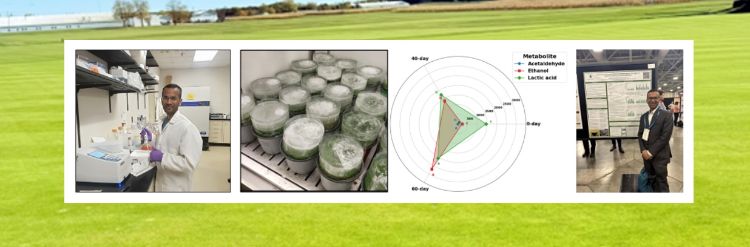
Devendra Chalise’s path into plant science started early, rooted in the terraced farms of Galkot, Baglung, Nepal. Those years helping his family manage crops sparked a curiosity that eventually blasted him through agricultural studies in Nepal, a master’s degree at the University of Georgia, and now into his fourth year as a Ph.D. student in Crop and Soil Sciences at Michigan State University.
As an undergraduate, Devendra dove deep into field and survey studies that built a strong foundation in data collection, lab work, and statistical analysis. His time at University of Georgia expanded that experience, placing him on large interdisciplinary teams working across agronomy, physiology, remote sensing, and crop modeling. Those projects led to several peer-reviewed publications and established him as an emerging researcher with broad scientific reach.
His diverse research ranges from cotton physiology and turfgrass winter stress responses to UAV-based imaging, cuticular wax biology, anaerobic metabolism, and plant responses to ice encasement. This breadth has helped bring his work into multiple scientific communities and journals. Along the way, he has stayed active in peer review, conference presentations, and professional organizations, earning recognition including 3rd place in the Bayer Graduate Student Research Pitch Competition and an Editor’s Choice Award from the Journal of Agronomy and Crop Science.
At MSU, Chalise is supported by several competitive awards, including the Plant, Soil, and Microbial Sciences Endowed Graduate Assistantship in Turfgrass (twice), the Billy M. Olsen Endowed Fund, the Chris Stiegler Travel Award and Fellowship, and a Graduate Research Assistantship in Dr. Emily Merewitz-Holm’s lab. These awards have supported his research, travel, and professional development—support he says reflects the strong community within the MSU PSM department and turfgrass program.
Chalise’s current project centers on how cool-season turfgrasses survive winter stresses, especially ice encasement—one of the biggest causes of winterkill in northern climates. He investigates stress pathways such as anaerobic metabolism, antioxidant activity, reactive oxygen species dynamics, and cuticular wax changes in species like perennial ryegrass, annual bluegrass, and creeping bentgrass. Alongside this physiological work, he is developing rapid viability assessment tools using dye-based assays, laser scanning confocal microscopy, and spectrophotometry to help turf managers determine survival quickly after ice melt.
Looking ahead, Devendra plans to pursue a postdoctoral position focused on plant stress physiology and longer-term hopes to become a faculty member leading research on plant resilience and sustainable agricultural systems, toward his ultimate goal: to bridge fundamental science with practical solutions.