Dirt to Glass 2026: Re-centering Michigan wine on quality, farming and a shared future
 Print
Print Email
EmailDirt to Glass 2026 brings growers, winemakers, researchers and industry leaders together to define quality from the soil to the glass.
Michigan wine is at an important crossroads. The industry has built energy, visibility and consumer interest, and many wineries have become creative and successful in attracting visitors through tasting-room experiences, branding, events, agri-tourism and several seasonal attractions. These activities can be useful, and they may help bring people to the property, but they cannot become a substitute for the foundation of a serious wine region: high-quality grapes grown with intention, transformed into high-quality wines with identity, consistency and purpose.
Mature wine regions understand that reputation is built through discipline as much as creativity. As Klaus Gasser, commercial director of Cantina Terlano, explained during his presentation at Dirt to Glass Conference (DTG) in 2024 as invited speaker about the strict quality protocols used by one of Italy’s most respected winery, “Not all growers and winemakers are pleased with strict rules, but they know they will be rewarded with quality if they adhere to them.”
At this stage, Michigan cannot afford to confuse winery traffic with reputation or entertainment with quality. The long-term future of the industry will not be built only by finding new ways to sell wine, but by producing wines that deserve to be recognized beyond the tasting room. That requires a renewed commitment to vineyard excellence: understanding where vines are planted, why specific cultivars belong in specific sites, how soils influence vine performance, and how farming decisions affect fruit composition and wine character.
Michel Chapoutier, one of the leading voices of the Rhône Valley and head of Maison M. Chapoutier, has long argued that terroir is not only a matter of geology or climate, but also of human responsibility and decision-making. As he reminds us, “The terroir is the soil, the climate and the human.” This is precisely the point for Michigan: place becomes meaningful only when people understand it, farm it intentionally, and translate it into wines with clarity and identity.
This is the moment for Michigan to do what mature wine regions around the world have already done: map its vineyards, understand its American Viticultural Areas in greater detail, connect soil maps with vine performance and wine quality, and evaluate cultivars in relation to terroir rather than convenience or easiness. It is time to move from general descriptions of place to measurable knowledge of place, soil texture, drainage, rooting depth, slope, exposure, water-holding capacity, canopy behavior, ripening patterns, fruit chemistry and sensory expression. The example of Cantina Terlano presented at 2024 DTG conference is particularly relevant here because it shows how a relatively small region can become internationally respected through concentration, discipline and a precise understanding of place.
As Klaus Gasser has said, “Like with the wine, the region is small but the quality is concentrated.” That is an important lesson for Michigan: limited acreage does not have to mean limited ambition, but it does require focus, standards, and a shared commitment to quality.
DTG 2026 is built around that challenge. It asks the industry to return to the essential question: what makes Michigan wine better, more consistent and more recognizable? The answer will not come from marketing alone. It will come from connecting site, soil, vine, fruit, wine and market into one disciplined conversation. That is the work of a serious wine region, and that is the work DTG is designed to advance.
Why Dirt to Glass matters now
DTG was created to reconnect the Michigan grape and wine industry with the fundamentals of quality. The name itself is a reminder that wine is not only a beverage, a label or a sales experience. Wine is the final expression of a chain of decisions that begins in the soil and moves through the grapevine, the fruit, the cellar, the glass, and the market.
The 2026 program is built around the theme of efficiency, but efficiency does not mean shortcuts. In this context, efficiency means making better decisions with better information. It means using soil knowledge, vineyard data, canopy management, cultivar choice, biological indicators, pruning systems and sensory feedback to produce grapes and wines with greater consistency and greater purpose. Efficiency means reducing wasted inputs, wasted labor and wasted opportunities while improving quality, sustainability and economic resilience.
This year’s conference is therefore not simply a list of presentations. It is a two-day sequence with a clear logic. Day 1 asks what quality means, how it can be measured, how it connects to economic development, and whether the market rewards better decisions. Day 2 takes those questions into the vineyard, where participants can see soil pits, canopy structure, precision tools, biological indicators, and vineyard management systems in action.
Day 1: Rebuilding the logic of quality
The educational program begins with “Foundations for the Future: Upgrading the Architecture of Michigan’s Grape and Wine Industry,” led by Amanda Danielson of Intentional Agriculture. This opening session frames DTG as a platform for reflection and direction. Since 2021, the conference has become a place where Michigan growers, winemakers, Michigan State University Extension educators and researchers, and industry partners can ask not only what has been achieved, but what still needs to be built. The goal is to invite participants to engage not as passive listeners, but as co-creators in the future of Michigan wine.
The next session, “One State, One Strategy: Michigan Wine as Economic Development,” with Warren Call of Traverse Connect, expands the conversation beyond the vineyard and winery. Michigan wine is part of a larger economic system that includes agriculture, tourism, rural development, regional branding, hospitality, and land stewardship. However, economic development built around wine must be anchored in product credibility. Wine can bring people to a region, but only quality can make that reputation durable.
That quality conversation becomes explicit in “Assessing and Enhancing Grape and Wine Quality,” presented by Nick Dokoozlian, PhD, of E. J. Gallo. This session anchors the conference in a practical reality: quality must be defined, measured, and repeatedly achieved. A wine region cannot build reputation on isolated successes or occasional favorable vintages. It must understand which vineyard and winery decisions consistently improve fruit composition, wine chemistry, sensory expression, and consumer perception. For Michigan, this is a critical step toward becoming a more mature and competitive wine region.
The program then moves to sustainability and measurable vineyard performance through “Enhancing Vineyard Sustainability through Carbon Farming Efficiency,” presented by Bruno Basso, PhD, of Michigan State University. This session helps move soil and carbon from broad values into operational tools. Soil health, carbon, and sustainability are not abstract ideas; they influence water dynamics, nutrient cycling, vine resilience, and long-term vineyard productivity. The value of this session is that it connects sustainability with efficiency and measurement. If Michigan wants to farm better, it must also learn how to measure whether its practices are working.
That scientific framing transitions into real-world grower decision-making through the panel “Precision, Performance and Place: Refining Vineyard Practices in Pursuit of Stronger Regional Identity.” Moderated by Joe Herman, with Dave Bos, Andy Fles, Jon Hinkelman, Tomas Moreno Jr. and Derrick Vogel, this session puts Michigan growers and producers at the center of the discussion. The panel will report what actually works under Michigan conditions and how vineyard decisions translate into wine quality and regional identity.
This is one of the most important conversations in the program because regional identity cannot be invented only through branding. It must be grown. It must come from sites, soils, cultivars, vineyard systems, harvest decisions, and winemaking choices that consistently produce wines with recognizable character. Precision and performance are therefore not just technical words; they are tools for understanding place.
The program then turns to cultivar strategy through “Improving Vineyard Efficiency through the Adoption of PIWI Grapevines,” with Diego Barison and Tom Plocher. In a humid cool-climate region, disease pressure remains one of the greatest challenges to economic and environmental sustainability. Disease-resistant grapevines offer potential benefits, including reduced spray needs, improved efficiency, and greater resilience. But DTG frames the issue correctly: adoption must be evaluated through both vineyard performance and wine quality. The question is not only whether PIWI grapevines can grow in Michigan, but whether they can contribute to wines that meet the region’s quality ambitions.
After lunch, the program makes the accountability connection that every wine industry must face: does the market reward better decisions? The tasting panel “What Quality Commands: What Decisions Yield Better Wines and Does the Market Pay for It?” moderated by Tim Godfrey of Lake Michigan College, brings wine evaluation and market reality into the technical conversation. This session asks whether better vineyard and winery decisions translate into greater value, stronger demand, and clearer market positioning.
This discussion is essential because quality cannot remain an internal conversation. It must be recognized by consumers, buyers, retailers, sommeliers, distributors, restaurants and the broader market. If Michigan wants to grow its reputation, the industry must understand not only how to produce better wines, but how to communicate why those wines matter and why they deserve attention.
The program then returns to long-term vineyard performance through “Efficiency-Driven Vineyard Management Systems,” presented by Jacopo Miolo of Simonit and Sirch. This session connects vine architecture, pruning, canopy structure, and management choices to outcomes that matter across seasons: vine health, consistency, longevity, labor efficiency, and fruit quality. In a region where winter injury, disease pressure, labor constraints, and site variability all matter, vineyard systems must be designed with long-term performance in mind.
Day 1 closes with two sessions that define DTG as more than an event. “Dirt to Glass, and Back Again,” led by Paolo Sabbatini, PhD, Michigan State University Department of Horticulture, is designed to ensure that the conference does not end as a collection of good ideas. This session asks the industry to help define what matters next: which topics need deeper attention, which speakers and field activities should be considered in future years, which questions need research, and which practices need validation in Michigan vineyards. The quality of DTG will ultimately be measured by the quality of industry engagement behind it.
The final session, “One State, One Future: Research, Innovation and the Discipline to Matter,” delivered by Doug Gage, PhD, vice president for research and innovation at Michigan State University, reinforces the central message of the conference. Progress in a grape and wine industry does not come from isolated breakthroughs. It comes from a shared system that turns questions into evidence and evidence into practice. A united Michigan grape and wine industry should interact with Michigan State University in exactly this way: by identifying the constraints that matter most, helping shape research priorities, participating in field validation, and adopting practices that are measured, tested, and relevant to Michigan conditions.
Day 2: From concept to canopy
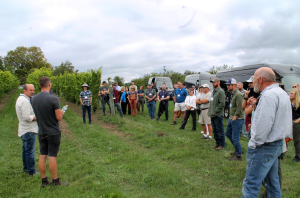
If Day 1 defines the questions and the framework, Day 2 brings them into the vineyard. The 2026 field program takes participants across four vineyard sites on Old Mission and Leelanau Peninsulas, where the same themes explored in the educational program are brought to life in commercial vineyard blocks. The purpose of Day 2 is not simply to observe demonstrations. It is to walk vineyards, ask real questions, challenge assumptions, and compare practices under Michigan conditions.
At Lone Silo Vineyard, the session “Digging Deeper: Exploring Vineyard Soils from the Pit to the Root Zone” begins where quality often begins: below ground. Larry and Sandy Tiefenbach will guide participants through soil pits excavated across vineyard blocks, highlighting soil horizons, structure, root distribution, clay-dominant soil characteristics, drainage, rooting depth, vine vigor and water retention under seasonal stress.
Andrew Backlin of Modales Wines will connect vineyard soil characteristics with wine style through a guided tasting of wines produced with grapes from the site. This session shows why Michigan needs to move beyond general statements about terroir. Soil must be observed, described, mapped, and connected to vine performance and wine outcomes. A soil pit is not just an educational tool; it is a reminder that every vineyard block has a physical foundation that shapes water availability, root development, canopy behavior, ripening, and ultimately the wine.
At Leelanau Cellars, the session “Life Beneath the Vines: Understanding Soil Biology and Its Role in Vineyard Efficiency” expands the soil conversation from physical structure to biological function. Alexa Kipper, Christie Lee Apple and Marcel Lenz will present soil health data and discuss microbial activity, soil respiration, organic matter dynamics, aggregate stability, nutrient cycling, water availability, vine vigor and resilience to environmental stress. Participants will also see field-based soil assessment tools used to evaluate biological activity and overall soil function.
This session helps translate “soil health” into something practical. Soil biology is not simply a concept to mention in sustainability language. It is a living system that influences nutrient release, water movement, vine balance, and resilience. Cover crops, compost applications, and reduced soil disturbance are not isolated practices; they are part of a biologically informed approach to vineyard efficiency.
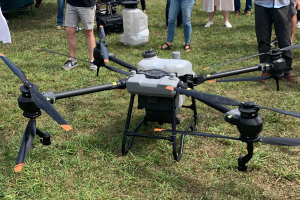
At Shady Lane Cellars, the session “Seeing the Invisible: Managing Vineyard Variability for Improved Efficiency” focuses on precision viticulture. Rich Price of Michigan State University Extension and Kasey Wierzba of Shady Lane Cellars will demonstrate how satellite and drone-derived imagery can be used to evaluate vine vigor, canopy development, and spatial variability. Using multispectral imagery and vegetation indices such as NDVI, participants will examine how remote sensing can support targeted interventions and improve management precision.
The value of precision viticulture is not the image, the map or the technology by itself. The value is the decision that follows. Michigan vineyards are variable, and variability can either be ignored, guessed at, or managed. This session shows how data can help growers move from average-block thinking to site-specific action: where to adjust canopy management, where to modify inputs, where to investigate soils, where to change harvest strategy, and where to improve consistency.
At Black Star Farms, the session “From Pruning to the Vineyard Floor: Hands-On Techniques for Efficient Vineyard Management” connects pruning, canopy management, vineyard floor practices, and mechanization into one integrated system. Jacopo Miolo, together with Jen and Ben Bremer of Agrivine and Mike Deshaf of the Michigan Grape Society, will demonstrate pruning, shoot positioning, leaf removal, crop load management, under-vine cultivation and mechanization strategies such as the Clemens Radius.
This session reinforces that vineyard efficiency is never only one operation. Pruning affects canopy architecture. Canopy architecture affects microclimate. Microclimate affects disease pressure, fruit composition, and wine quality. Vineyard floor management affects soil conditions, vine vigor, water dynamics, and labor requirements. The goal is not simply to work faster; it is to build vineyard systems that are more balanced, more durable, and more capable of producing high-quality fruit over time.
Why the 2026 program matters
The logic of DTG 2026 is clear. Day 1 asks Michigan to define quality, measure it, connect it to economic value, and align around future priorities. Day 2 asks participants to test those ideas in vineyards, where quality is built and where adoption begins. Together, the two days are designed to move Michigan beyond fragmented conversations and toward a stronger, more disciplined industry culture.
This matters because Michigan wine cannot build its future only through tasting-room entertainment, tourism, branding, or simplified sales strategies. Those may bring people to the property once, but they will not build lasting reputation unless the wines consistently justify attention. As Paul Draper of Ridge Vineyards in California has reminded the wine world, “People who love wine see a connection to the earth.” That connection is exactly what Michigan must strengthen if it wants wines that are not simply sold but remembered.
The future of Michigan wine depends on growers and wineries recommitting to the difficult work of quality: better site evaluation, better soil mapping, better vineyard systems, better cultivar decisions, better use of technology, better sensory evaluation, and better alignment between research and industry needs. Zelma Long, one of California’s most influential winemakers and winegrowers, expressed the same principle clearly: wines “have to be well made and they have to come from really high-quality grapes.” There is no shortcut around that truth.
Mature wine regions understand that identity is created by the relationship between cultivar, site, people and time. Bruno Giacosa, one of the great voices of Piemonte and of Barolo, described traditionalist philosophy as making wines that “strongly convey the varietal properties of a grapevine and its terroir.” That statement is highly relevant to Michigan.
The question is not whether Michigan should imitate Piemonte, Burgundy, the Rhône Valley, or California. The question is whether Michigan is ready to define its own “native” logic of quality: which cultivars belong where, which vineyard practices reveal place, and which wines can speak with a recognizable regional voice. This is the essence of the DTG message.
DTG is not just a conference. It is a yearly opportunity for Michigan to ask whether it is becoming more serious, more coordinated, and more intentional as a wine region. The 2026 program makes that question explicit: if the industry wants stronger identity and greater recognition, it must return to the fundamentals: high-quality grapes, high-quality wines and the shared discipline to connect the two.
Registration
Registration is open for the Dirt to Glass annual conference, Aug. 20–21, 2026, in Traverse City, Michigan. Growers, winemakers, vineyard managers, winery owners, students, educators, industry partners and market-facing professionals are encouraged to participate in the educational program, field visits and tasting opportunities designed to connect Michigan wines with benchmark thinking from other regions.