Don't trust the calendar: Why trapping matters during unusual weather
 Print
Print Email
EmailWith highly variable spring weather and cool nights, pest activity is not following predictable patterns, underscoring the importance of scouting.
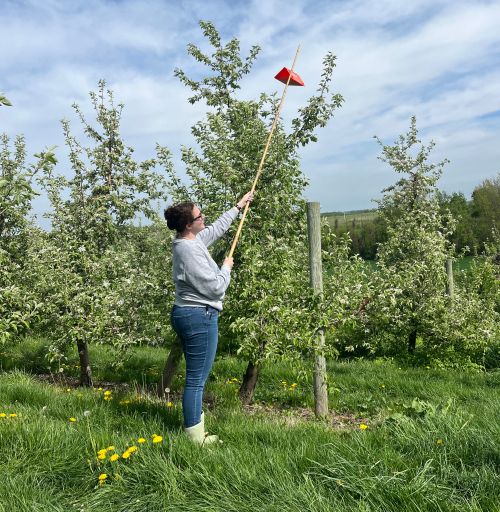
Michigan State University researchers and Extension educators run annual trapping networks around Michigan fruit production regions to keep an eye on key apple pests such as codling moth, oriental fruit moth and San Jose scale. Pheromone traps are an important tool to track activity and evaluate pest pressure for these orchard pests. Trap data can greatly improve decision making for timing insecticide applications.
One of the main uses for pheromone-baited traps is to set a biofix used in insect development models. Getting an accurate biofix requires setting up traps early enough to determine when sustained flight activity starts. While Michigan State University’s Enviroweather provides estimated biofix dates for many pests, these estimates may not always reflect conditions at individual farms. Unusual weather patterns, localized microclimates and pest pressure, or the distance between a farm and the nearest weather station can all affect the accuracy of estimated biofix dates.
Using a trap-based biofix specific to your farm whenever possible will improve the accuracy of degree-day models and help ensure that key pest life stages are predicted more reliably, leading to more effective management decisions throughout the season. The importance of field verification has become particularly apparent this season. The 2026 default codling moth biofix on Enviroweather for Sparta was nearly a month earlier than the first sustained trap captures observed in orchards.
When crop stage and pest activity don't align
After a volatile spring with many cool days, scouts and researchers are noticing that the progression of tree growth stage is not always aligning with expected pest development and/or activity timing. For example, we often think of codling moth flight first occurring near petal fall. However, this year in the Fruit Ridge area near Sparta, we had no codling moth flight observed until about May 17, which was roughly a week or more after apple petal fall depending on variety. In northwest Michigan, codling moth biofix was observed on May 26, which co-occurred with bloom.
This mismatch between tree stage and expected pest activity can have serious implications for traditional management timings. Some growers choose to apply ovicidal or larvicidal materials at 100 growing degree days (GDD) after codling moth biofix to target both obliquebanded leafroller larvae and codling moth eggs. In many years, this application timing occurs shortly after petal fall. However, this season, petal fall in Sparta occurred before sustained codling moth flight, creating a mismatch between crop stage and pest development.
One explanation for this could be cool nighttime temperatures. The Sparta Enviroweather station reported average nighttime temperatures during May at ~51 degrees Fahrenheit, which is below temperatures generally associated with strong codling moth flight activity (<60 F). This mismatch can result in insecticide applications being made too early or too late relative to pest development, potentially reducing control. Products with longer residual activity (e.g., diamides) may provide greater flexibility during seasons when pest development and crop phenology are poorly synchronized.
Codling moth activity can also vary substantially among orchards within the same growing region. In southeast Michigan, some scouts recorded codling moth captures as early as April 28, several weeks before sustained catch was consistently observed elsewhere in the region. Codling moth may also emerge briefly and then stop flying before sustained activity and egg laying begins.
These examples highlight why growers should avoid relying solely on regional reports, default biofix dates or calendar-based assumptions. Checking traps more than once per week, especially when establishing a biofix, is recommended whenever possible. More frequent observations can improve biofix accuracy and help ensure management actions are timed appropriately.
Frequent trap checks matter
The importance of accurate biofix determination was illustrated in one northwest Michigan orchard where a grower planned to use Rimon at the recommended timing of 100 GDD after biofix. Following bloom, warm temperatures accelerated degree-day accumulation rapidly, and if traps had only been checked on a weekly schedule, the optimal application window would have been missed. Because camera traps allowed for more frequent monitoring, biofix was identified sooner at this farm and the application window recommended by the pest model was more accurate.
When pest activity does not align with expected seasonal patterns, model predictions based on estimated biofix dates become less reliable. Growers must be careful not to rely too heavily on estimated biofix dates based on GDD accumulations. Visual confirmation in the field is important to verify biofix dates and models. Models and weather data are valuable decision-support tools, but they cannot replace trapping, scouting and direct field observations. Periods of unusually warm, cool, wet, dry or highly variable weather can alter biological responses in ways that are difficult to predict. Model outputs should be used as a guide and supplemented with field observations and local expertise whenever possible.
A recent study led by researchers from Michigan State University and Ohio State University, including members of Julianna Wilson's tree fruit entomology program at MSU, found that the Enviroweather default codling moth biofix was about five to seven days earlier than the trap-based codling moth biofix, while the Cornell NEWA model estimated biofix about 10 days later. These estimated biofix dates generated from GDD data do not align with what we are seeing in traps, and inaccurate estimations for biofix can translate into premature or late recommendations for pesticide applications from the codling moth model, potentially reducing codling moth control efficacy.
The study also highlights how camera traps may be a useful tool for getting the most accurate biofix dates, as they allow for time-sensitive trap monitoring remotely. Read the entire study.
This all serves as a good reminder on why we scout and use GDD to time our sprays, not the calendar!
Michigan State University Extension has more information on codling moth control recommendations and trapping best practices.
This work is supported by the Crop Protection and Pest Management Program (grant no 2024-70006-43569) from the USDA National Institute of Food and Agriculture. Any opinions, findings, conclusions, or recommendations expressed in this publication are those of the author(s) and do not necessarily reflect the view of the U.S. Department of Agriculture.