FCCP publishes article assessing the economic tradeoffs of various forest management activities to enhance carbon sequestration efforts in Pennsylvania and Maryland
 Print
Print Email
EmailFCCP researchers published an article in Forest Policy and Economics on economic tradeoffs between carbon and timber management in mid-Atlantic forests, showing that diversified management strategies can balance economic and ecological goals.
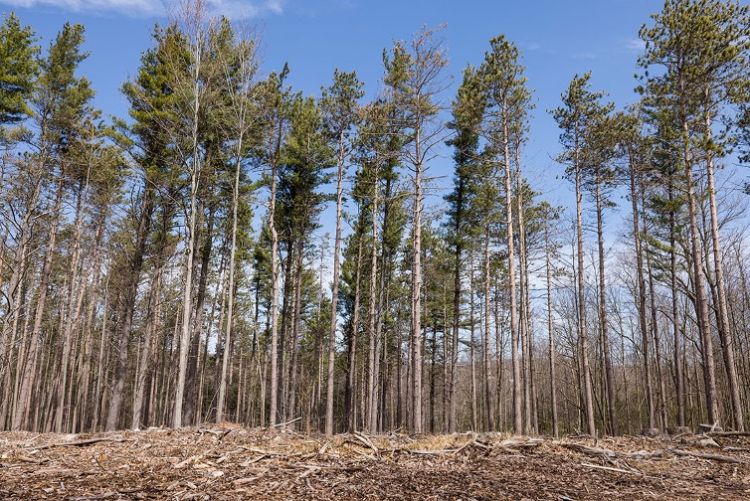
Together with the forest economics and resource management (FERM) lab in the department of forestry at Michigan State University, FCCP researchers including FCCP director Dr. Chad Papa and former associate director Dr. Kylie Clay, published a new study in the journal of Forest Policy and Economics investigating the financial tradeoffs between various forest management strategies as compared to a business-as-usual (BAU) simulation to better understanding shifting incentives for climate-smart forest management.
Using forest ecosystem and harvest wood product results modeled in Papa et al (2023), the FCCP team estimated the net present value (NPV), the difference between the present value of cash inflows and outflows over a period of time, across a range of scenarios looking at the price of timber, additional management costs incurred from carbon specific strategies, and the potential change in revenue from the sale of carbon credits instead of timber. The study assessed varying pricing for carbon credits and discount rates (which enables the comparison of money today versus the future) to understand potential economic incentives to support or inhibit climate-smart forest management.
The study found that certain carbon management strategies outperformed the NPV of the BAU simulation; however, a higher price of carbon is needed to offset increases in management costs and account for the opportunity cost of differing management strategies. The results show that incorporating multiple management strategies simultaneously produced the best balance between economic and ecological goals, suggesting that actively managing forests with diverse prescriptions potentially produces superior benefits for both climate mitigation and forest productivity. These findings underscore the importance of active management and collaboration among policymakers, foresters, and stakeholders to optimize forest carbon benefits while maintaining ecological and economic balance.
Read the full study here: