From knowledge to reputation: Building the future of Michigan wine
 Print
Print Email
EmailA vision of research and innovation explains why Dirt to Glass matters and why Michigan must evaluate its research investments with scientific rigor, collaboration and foresight.
Several years ago, I had the opportunity to attend the annual conference of the American Society for Enology and Viticulture. That year, the Society’s prestigious Merit Award was presented to Roger Boulton, PhD, distinguished professor emeritus of viticulture and enology in the Department of Viticulture and Enology at the University of California, Davis. His award presentation, later published as “Discovery, Innovation, and the Role of Research,” made a lasting impression on me. Rather than discussing research simply as a collection of experiments or technical results, Boulton offered a compelling analysis of how wine regions develop, sustain and expand their scientific and technical capacity over time, and why that capacity ultimately shapes their ability to innovate, compete and mature as an industry.
What struck me most was the relevance of his argument far beyond California. Boulton challenged the wine industry to think about research as an investment in intellectual capital: the people, knowledge, scientific infrastructure, technologies and professional relationships that allow a wine region not only to solve today’s problems, but also to anticipate the questions it will face decades from now. Reading his article again today, I believe its message is particularly timely for Michigan and provides an important framework for understanding the purpose and long-term value of the Dirt to Glass (DTG) conference.
Boulton’s central argument is that research does much more than produce experimental results. It builds the intellectual capital of an industry: the combined knowledge, professional expertise, technologies, research infrastructure and relationships that allow growers, winemakers, scientists and institutions to understand problems, develop solutions and adapt to change. Universities occupy a particularly important position in this process because research simultaneously creates new knowledge and develops the people who will carry that knowledge into the industry. Graduate students, postdoctoral researchers, technicians, Extension specialists and faculty members do not simply complete projects. They build expertise and professional networks that remain valuable long after an individual experiment ends.
This framework provides a powerful way to understand the purpose of DTG. The conference is not simply an annual meeting at which technical information is presented. It is part of the long-term infrastructure through which Michigan builds the scientific knowledge, professional relationships and critical thinking required to become a more consistent, competitive and recognizable wine region.
The real capital of a wine region
When people hear the word “capital,” they often think of land, equipment, buildings or financial resources. Those assets are essential, but Boulton asks the wine industry to recognize another form of capital that is less visible and equally important. Intellectual capital includes three closely connected dimensions. 1) Human capital consists of knowledgeable and experienced people: growers, winemakers, researchers, students, technicians, consultants and industry leaders. 2) Structural capital includes the systems through which knowledge is organized and applied: laboratories, research programs, analytical methods, databases, technologies, production protocols and decision-support tools. 3) Relationship capital develops through professional networks, partnerships and the exchange of information among universities, businesses, growers, wineries, associations and public agencies
Boulton emphasizes that these dimensions are interdependent. Human capital is particularly important because knowledgeable people are needed to create, interpret and use structural and relationship capital. Research is one of the most effective ways to strengthen all three at the same time. A vineyard project, for example, may provide recommendations about crop load, canopy management or cultivar performance. At the same time, it may train a graduate student, improve a laboratory method, strengthen collaboration with a commercial vineyard and generate the scientific foundation for a larger project. The value of research therefore extends well beyond a final report, a field day or a single dataset. It builds the capacity of a region to continue asking better questions.
Research is a system, not an isolated trial
Scientific progress is sometimes described as though one strong idea, and one research grant were enough to solve an industry problem. Effective research depends on an interconnected system. Boulton describes research effectiveness as the combined product of researcher capacity, the quality of scientific interactions, staff support, facilities, analytical power and the ability to process experimental samples. Because these components function together, a serious limitation in any one of them can reduce the effectiveness of the entire research program. A meaningful vineyard study may require carefully maintained experimental plots, appropriate treatment replication, repeated physiological measurements, fruit and wine analyses, trained personnel, statistical expertise and several years of climatic variation. Harvesting fruit is only one small part of the process. The reliability of the conclusions depends on the quality of the experimental design, the precision of the measurements, the continuity of the work and the ability to interpret results within the biological and economic realities of commercial vineyards.
This is why serious wine regions cannot rely only on isolated demonstrations or short-term projects. They need trained people, functioning laboratories, long-term datasets, graduate education and sustained collaboration between scientists and industry. Research capacity cannot be assembled instantly when a crisis appears. It must be built, maintained and directed with a long-term vision. Agricultural research is particularly vulnerable to reactive thinking because the urgency of a problem often depends on the conditions of a single season. A severe drought may suddenly generate strong interest in irrigation, water-use efficiency and drought-resilient vineyard management. Yet the arrival of a dry year should not be what prompts us to begin studying those questions. Likewise, a cool, wet and humid season may bring cluster rot and disease management to the top of the industry’s priorities, but that is not the moment when a research program on sour rot should be conceived from the beginning. By then, the opportunity to provide scientifically validated answers for that season has largely passed.
The same principle applies to winter injury, spring frost, new pests and diseases, labor shortages, changing cultivar suitability and emerging technologies. Some years these issues may appear less urgent, but their temporary absence does not make the underlying research question less important. Research priorities cannot simply follow the weather, the most recent harvest or the problem that happens to be most visible at the time funding decisions are made. Vineyard research often requires multiple seasons precisely because environmental variability is part of the system we are trying to understand. A dry year, a wet year and an apparently “normal” year are not competing research priorities; together, they are the observations needed to understand how vineyards respond across the range of conditions Michigan will experience.
This is where Boulton’s argument becomes particularly important. He cautions that research programs guided primarily by current majority opinion may already be 5 to 10 years behind the scientific frontier and argues that those responsible for directing research must think closer to the innovator and early-adopter end of the spectrum. The purpose of a strong research program, therefore, is not simply to respond efficiently when a problem becomes obvious. It is to recognize emerging problems early enough to develop the people, experiments, datasets and solutions before the industry urgently needs them. As Louis Pasteur reminded scientists more than 170 years ago, “In the fields of observation, chance favors only the prepared mind.” For Michigan viticulture, the same principle applies: the purpose of research is not to run after the next problem, but to ensure that when it arrives, the knowledge needed to confront it is already being developed.
Discovery does not automatically become practice
One of the most important lessons in Boulton’s article is that scientific discovery and commercial adoption occur on very different timelines. A promising research result does not move immediately from an experimental vineyard or laboratory into every commercial operation. It must first be validated, interpreted, communicated and demonstrated. In some cases, it must also be converted into equipment, software, analytical services or management protocols that growers and wineries can realistically use.
Boulton identifies two major barriers in this progression. The first is the commercialization gap. A useful discovery may exist, but no company or organization may yet be prepared to develop the technology, service or business model required to make it accessible. The second (and most limiting one) is the adoption gap. Even when an innovation is commercially available, people adopt it at different rates. Innovators and early adopters may respond quickly, while most of the industry may require years of evidence, demonstration and practical experience. Boulton notes that adoption by half of the potential users can require 10 to 15 years, while widespread adoption may take 20 to 30 years. The research supporting an innovation may have begun many years before the technology or practice became commercially visible.
The history of viticulture provides remarkably clear examples of the distance between discovery and adoption. Plant-based irrigation scheduling using stem water potential has been available to grape growers for more than three decades, yet its adoption has remained limited in part because technical interpretation. Precision viticulture began mapping within-vineyard variability in the late 1990s, but more than 25 years later many vineyards are still managed uniformly. Partial rootzone drying was developed in the 1990s and demonstrated substantial potential to improve vineyard water-use efficiency, yet it never achieved the commercial penetration that its scientific promise might have suggested. Disease forecasting models for grape powdery mildew have also existed since the mid-1990s, while the adoption of decision-support systems remains incomplete. Perhaps most strikingly, fungus-resistant wine-grape cultivars or PIWI introduced approximately 30 years ago can greatly reduce pesticide requirements, yet they still occupy only a small fraction of vineyard acreage in many established wine regions.
Also, cool-climate viticulture offers particularly clear examples of Boulton's adoption gap. Delayed pruning has been known for decades to postpone grapevine budbreak and potentially reduce exposure to spring frost, yet it remains a selective management strategy rather than a universal practice because timing and labor requirements complicate its implementation. Differential thermal analysis has allowed scientists to quantify grapevine bud cold hardiness since the 1980s, yet only recently have decades of physiological data been converted into grower-accessible models capable of predicting cultivar-specific winter-injury risk from weather data. In each case, the scientific concept existed long before widespread implementation. The difficult part was (and remains) transforming biological understanding into a system that is reliable, affordable and practical enough for growers to adopt.
These examples reinforce Boulton's central point: the bottleneck is often not discovery itself. It is the long, difficult movement from discovery to validation, from validation to confidence, and from confidence to widespread adoption. That is precisely the space in which a conference such as DTG can have its greatest impact.
Researching 2040 before it arrives
The vineyard practices that may be needed in Michigan vineyards in 2040 cannot all be developed in 2039. Research on climate resilience, cultivar adaptation, labor efficiency, disease management, vineyard longevity, mechanization and sensory quality must begin before these issues become urgent for the entire industry. A region that waits until a problem is universally recognized has already lost valuable time. This is particularly true in perennial crops such as grapevines, where establishing a vineyard is a long-term investment and where meaningful research often requires several growing seasons before reliable conclusions can be drawn.
Climate provides perhaps the clearest example. The Great Lakes Integrated Sciences and Assessments program, a collaboration between the University of Michigan and Michigan State University and funded by the National Oceanic and Atmospheric Administration, projects that average annual temperatures across the Great Lakes region will rise approximately 3 to 6 degrees Fahrenheit (1.7 to 3.3 degrees Celsius) by 2050. At the same time, the region is not simply becoming uniformly warmer or drier. Annual precipitation across the Great Lakes region in the U.S. has already increased approximately 14% since 1951, while precipitation is increasingly concentrated in intense events. The amount of precipitation falling during the heaviest 1% of storms increased by about 42% in the Midwest between 1958 and 2016, and by mid-century the number of days receiving more than 2 inches of precipitation is projected to increase by roughly 37% to 46% across the Midwest and Northeast.
For vineyards, this apparent contradiction, more total precipitation but potentially greater periods of water stress between rainfall events, is exactly why research must look beyond the conditions of a single season. Yet a wet summer could easily make drought research appear less urgent to someone evaluating priorities only through the experience of the current growing season. The opposite is equally true: one severe dry year should not suddenly be the moment when Michigan begins asking fundamental questions about irrigation, rootstocks, soil water-holding capacity, canopy demand and vine water-use efficiency. Those experiments need to be running before the dry year arrives.
Disease pressure illustrates the same principle from the opposite direction. A humid season may suddenly place Botrytis bunch rot, sour rot and canopy management at the top of every grower's concerns. But disease research cannot begin after the epidemic is already visible. Botrytis, for example, responds strongly to the interaction between temperature and moisture. Compact-clustered cultivars important to Michigan, including Pinot Noir, Chardonnay and Riesling, can create humid fruit-zone microclimates that further increase the risk of bunch rots. Understanding cultivar susceptibility, cluster architecture, canopy interventions, fungicide timing and pathogen biology therefore requires experiments across wet, dry and intermediate seasons, not research priorities that appear and disappear with the weather.
Climate adaptation also cannot be reduced simply to preparing for warmer summers. Warmer winters can accelerate the loss of grapevine cold hardiness and promote earlier budbreak, potentially increasing exposure of developing tissues to damaging spring frosts. Michigan vineyards must therefore prepare simultaneously for warming, frost risk, extreme winter events and increasingly variable precipitation. These are precisely the kinds of interactions that require long-term cultivar, site and management studies rather than responses developed after the next damaging freeze.
Labor and mechanization require the same foresight. Vineyard operations such as pruning, shoot positioning, canopy management and harvest are highly time-sensitive; they cannot simply be postponed until labor becomes available. Mechanization, however, cannot be adopted intelligently by simply purchasing a machine after labor becomes scarce. Training systems, vineyard architecture, row spacing, canopy configuration, fruit quality and economics all must be considered together, often years before equipment is introduced.
This is exactly why research priorities cannot be determined by only asking, “What was our biggest problem this year?” A dry year will make water the dominant concern. A wet year will make disease the priority. A polar vortex will bring cold hardiness to the forefront. A labor shortage will suddenly make mechanization urgent. But a research portfolio that moves back and forth with each season will continually arrive late.
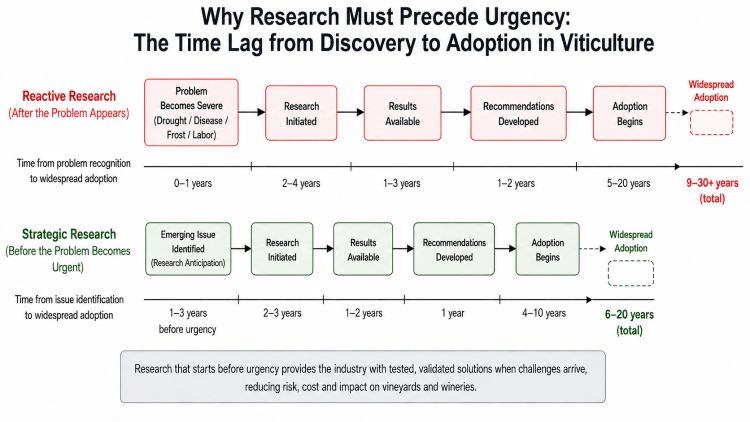
Boulton's analysis makes the time problem even more consequential. He notes that research must precede commercialization and adoption, and that widespread adoption of an innovation can require 20 to 30 years. Research programs must therefore be judged not only by their ability to address today's most visible problem, but also by whether they are building the knowledge and capacity that the industry is likely to need 10 or 20 years from now. That is the difference between reactive research and strategic research (Figure 1). Reactive research asks what went wrong last season. Strategic research asks what Michigan growers and winemakers will need to know before the next challenge becomes unavoidable. Computer scientist and pioneering researcher Alan Kay expressed the principle elegantly: “The best way to predict the future is to invent it.” For Michigan, that means we should not wait for 2040 and then ask how to manage the vineyards we have inherited. The research decisions we make today will help determine which vineyards, and which wine region, we have in 2040.
Dirt to Glass connects discovery with adoption
DTG operates within the critical space between scientific discovery and commercial implementation. Researchers may generate new knowledge, but that knowledge must be discussed with the growers, winemakers, consultants and industry leaders who will evaluate and apply it. At the same time, scientists need to understand the observations, limitations and priorities emerging from commercial vineyards and wineries.
For these reasons, DTG is co-created with Michigan growers, winemakers, researchers, Extension specialists, consultants and industry organizations. One of its priorities is to bring national and international experts into that conversation, not to replace Michigan expertise, but to provide external benchmarks that help challenge assumptions, broaden perspectives and evaluate Michigan’s practices, priorities and ambitions against experience from other wine regions. DTG is not imported expertise with Michigan as the audience. It is a Michigan-led platform that uses outside expertise to benchmark, challenge and pressure-test the region’s knowledge, priorities and decisions.
That distinction is essential. Outside speakers can show how other regions approach cultivar selection, vineyard design, disease management, mechanization, grape chemistry, wine production and market development. Michigan participants can then determine which ideas are relevant, which require adaptation and which may not be appropriate for the state’s environmental and economic conditions. Through technical presentations, structured discussion and field-based learning, the conference helps move knowledge through a progression: 1) discovery, 2) interpretation, 3) demonstration, 4) adaptation and 5) adoption.
Moreover, DTG strengthens human capital by expanding the knowledge of growers, winemakers, students and researchers. It contributes to structural capital by introducing analytical methods, management protocols and emerging technologies. It builds relationship capital by connecting people and institutions that may later cooperate on research projects, commercial demonstrations and extension programs. The conference is therefore not only transferring information. It is strengthening the system through which Michigan develops and applies knowledge.
A conference for today’s problems and tomorrow’s questions
Industry conferences are often expected to focus on immediate concerns. That is appropriate, but it is not sufficient. Boulton cautions that research priorities determined only by majority opinion may already be several years behind the scientific frontier. The people responsible for guiding and funding research must therefore be forward-looking enough to consider questions before they are recognized as urgent by most of the industry. For DTG, this means balancing immediate usefulness with long-term vision. Michigan growers and winemakers need practical information they can apply today. They also need opportunities to evaluate emerging issues before those issues become crises. Climate variability, cultivar-site compatibility, labor availability, vineyard mechanization, disease-resistant cultivars, advanced grape and wine chemistry, sensory identity and changing consumer expectations may not affect every Michigan business in the same way today. Nevertheless, they will influence the future competitiveness and identity of the region.
A forward-looking conference does not claim to predict the future perfectly. Instead, it develops the intellectual and professional capacity needed to recognize change, evaluate new information and respond intelligently when conditions evolve. This is particularly important in viticulture, where climatic, biological, technological and market changes often occur faster than research systems can respond if the necessary expertise and infrastructure are not already in place. As Nobel Prize-winning physicist Dennis Gabor wrote, “The future cannot be predicted, but futures can be invented.” DTG embraces that principle: its role is not simply to describe where Michigan wine is today, but to help the industry build the knowledge, relationships and critical thinking required to influence where it goes next.
Research investment is regional development
Boulton compares wine research investment with investments made by corporations, agricultural industries and competing wine-producing countries. His analysis suggests that wine research has often been funded at levels well below those expected for an industry of comparable economic value. He highlights the Australian grape and wine research model, historically supported by an industry levy combined with government funding. The result was not simply a collection of disconnected projects, but a coordinated and sustained investment in research capacity, technical expertise and innovation.
Michigan operates within a different economic and institutional structure, but the underlying lesson remains relevant. Research is not an expense separate from regional development. It is one of the mechanisms through which regional development occurs. Investments in vineyard research, wine analysis, graduate education and extension build the capacity to address foundational questions: Which vineyard practices improve fruit composition while protecting vine health and economic sustainability? How can wineries produce more consistent wines across highly variable seasons? Which chemical and sensory characteristics distinguish Michigan wines? How can measurable grape and wine quality be translated into recognizable market value? These questions cannot be answered through promotion alone. They require sustained research, careful measurement and collaboration among disciplines.
Moreover, for Michigan, this underscores the importance of bringing all the state’s grape and wine associations together around a shared research agenda. Rather than each organization identifying priorities and supporting projects independently, associations can have far greater impact by pooling financial resources, using those combined funds to jointly decide which research questions deserve sustained investment. Just as importantly, deciding research priorities together forces the industry to move beyond individual interests and consider what will strengthen Michigan wine as a whole. A coordinated financial strategy can support larger, longer and more scientifically rigorous projects, while also creating the continuity needed to train students, maintain research infrastructure and generate knowledge that benefits growers and wineries across regions and organizations. The goal should not be to erase the identity or priorities of individual associations, but to recognize that Michigan’s research capacity will remain limited as long as there is fragmentation. The strongest path forward is to combine resources into a shared research fund large enough to support ambitious multi-year projects and give the industry the opportunity to shape its own research future.
From attention to reputation
Michigan wine has generated consumer interest, visitor traffic and considerable energy around local production. These achievements matter. They bring people to vineyards and wineries and create opportunities for businesses and rural communities. However, attention and reputation are not the same. Attention can be generated through an attractive tasting room, a successful dinner event or an effective marketing campaign. Reputation develops more slowly. It is earned when the quality and consistency of the product support the promises made about the region. That consistency depends on knowledge. It requires an understanding of the relationships among climate, soil, site, cultivar, vineyard management, fruit composition, winemaking and sensory expression. It also requires trained people and institutional capacity capable of continuing to learn as environmental and economic conditions change. Tourism, hospitality, events and branding are valuable parts of Michigan’s wine industry. They bring consumers to the property and provide essential revenue. But they cannot substitute for cultivar-site matching, disciplined farming, analytical capability and measurable wine quality.
The responsibility of reviewing Michigan research
Building intellectual capital requires strong research proposals, but it also requires an equally strong process for evaluating them. Reviewers of Michigan grape and wine research projects must be technically prepared, forward-looking and willing to recognize the limits of their individual expertise. Modern research proposals often cross disciplinary boundaries. A single project may involve viticulture, plant physiology, pathology, soil science, engineering, enology, sensory science, economics and market analysis. No individual reviewer can be expected to possess equivalent expertise in every area. When a proposal extends beyond the reviewers’ technical knowledge, seeking assistance from scientists should not be viewed as a weakness. It is an essential part of a rigorous and responsible review process. Independent scientific input can help determine whether the experimental design is appropriate, whether the proposed methods can answer the research questions and whether the expected outcomes are realistic.
Research priorities can fall behind the scientific frontier when they are shaped only by familiar perspectives of the reviewers, immediate concerns or majority opinion. That warning is particularly relevant when evaluating innovative or interdisciplinary proposals. New ideas may appear unfamiliar precisely because they extend beyond established practices. Michigan cannot afford a review process in which viticulture, enology, plant pathology, engineering, economics, sensory science and marketing operate in separate silos. Research problems in vineyards and wineries are interconnected, and the process used to evaluate them must reflect that complexity. The strongest decisions will come from reviewers who communicate across disciplines, challenge their own assumptions and seek additional scientific expertise when necessary. A rigorous review process does not simply rank proposals. It protects the credibility of research investment and helps ensure that limited resources are directed toward projects with sound methods, meaningful objectives and long-term value for the industry.
That credibility also requires accountability. Reviewers should be prepared not only to defend their decisions, but also to acknowledge openly and publicly when subsequent evidence shows that an assessment or judgment was wrong. Changing a position when the evidence changes is not a loss of credibility; refusing to do so is. Scientific progress depends on the willingness to question our own conclusions, recognize errors and revise judgments in light of better evidence. The same standard should apply to those entrusted with evaluating and prioritizing research. As Nobel Prize-winning physicist Richard Feynman famously reminded us “The first principle is that you must not fool yourself, and you are the easiest person to fool.”
Research priorities require engagement, not just paperwork
For a mature wine region, deciding research priorities and allocating funding should not end with the submission of a two-page summary report at the conclusion of a project. That approach reduces research to a transaction: funds are awarded, experiments are conducted, a document is delivered and the process starts again. Stronger model treats research as an ongoing partnership between the industry and the scientists doing the work. Industry representatives and funding organizations should remain engaged throughout the life of a project, not to interfere with scientific independence, but to understand how the research is progressing, what difficulties are emerging, what the data are beginning to show and whether new questions are developing.
That engagement can take many forms: annual or semiannual meetings with principal investigators; visits to experimental vineyards and wineries while treatments are actually being applied; discussions with graduate students and technical staff collecting the data; review of preliminary results before final recommendations are written; workshops in which growers and winemakers help interpret the practical significance of the findings; and field demonstrations where the industry can see, question and critically evaluate treatments under commercial conditions. This interaction becomes even more important for multi-year projects. A three- or five-year study on cultivar adaptation, winter injury, vineyard floor management or mechanization should not disappear from view until the final report arrives. The people who helped define the research priority should know whether the experiment experienced unusual weather, whether a treatment failed, whether unexpected results emerged or whether the original hypothesis needs to be reconsidered. They should also understand the difference between an interesting first-year observation and a conclusion sufficiently validated to justify a commercial recommendation.
Likewise, researchers should hear directly from growers and winemakers when a treatment is technically successful but economically unrealistic, too labor intensive, difficult to mechanize or incompatible with commercial winery requirements. Those conversations often produce the most valuable outcome of a project: the next, better research question. A mature research system should therefore create a continuous loop: 1) industry priority, 2) research design, 3) experimentation, 4) interim discussion, 5) field validation, 6) interpretation, 7) commercial relevance and 8) new research question.
The final report still matters, but it should document a process of engagement rather than substitute for it. A two-page summary can tell the industry what was done; it cannot replace seeing the experiment, questioning the methods, discussing the data with the scientists, understanding uncertainty and deciding together what should happen next. If Michigan wants to build a mature wine research culture, funding research must mean more than purchasing results. It must mean building a sustained intellectual relationship between those who ask the questions, those who investigate them and those who ultimately have to use the answers.
As Selker and Wilkins wrote when describing broadly engaged team science, “From inception through completion and dissemination of results, research must have input from intended partners, participants, and beneficiaries.” To become a mature Michigan wine region, that principle is particularly important: the organizations that help establish research priorities and provide the funding should remain intellectually engaged with the researchers throughout the process, not to direct the science, but to understand it, challenge it, learn from it and help determine the next question.
DTG builds the region Michigan wants to become
The most important outcomes of DTG may not always be immediately visible. A presentation may initiate a conversation. That conversation may lead to a commercial demonstration. The demonstration may reveal a new research question. That question may support a graduate student, a multiyear experiment or a collaboration among growers, wineries and scientists. Several years later, the resulting knowledge may influence decisions across the state. This progression is gradual, but it is how intellectual capital grows.
Boulton’s article reminds us that research, commercialization and widespread adoption develop over years and often decades. Building a credible wine region therefore requires patience, continuity and a willingness to invest in questions whose full value may not be immediately apparent. DTG cannot eliminate the long interval between discovery and adoption, but it can make that process more connected, deliberate and effective. Its value lies not only in transferring information, but also in strengthening the people, scientific knowledge, institutional relationships and critical review processes required to guide Michigan wine research.
Michigan’s future as a serious wine region will depend on the quality of the research it supports and, on the rigor, openness and scientific depth with which that research is evaluated. Reviewers must be prepared to work across disciplines, consult qualified scientists when needed and resist making decisions from within isolated professional or institutional silos. A mature wine region is not defined only by what it produces today. It is also defined by the quality of the questions it is willing to ask, the rigor with which it searches for answers and its collective capacity to prepare for what comes next. As Albert Einstein reminded us, “The important thing is not to stop questioning. Curiosity has its own reason for existing.”
There is an equally important lesson on the other side of Boulton’s argument: innovation should not be confused with acceleration at any cost. Michigan has little to gain by shortening the research-to-adoption process if the shortcut means implementing practices before their biological consequences, economic costs and long-term effects are adequately understood. In cool-climate viticulture, decisions made quickly can remain embedded in a vineyard for decades. Highly complex or overly permanent training systems, for example, appeared efficient and sophisticated when they are introduced in Michigan several decades ago, but they became liabilities when severe winter injury required rapid trunk or cordon renewal.
Similarly, the repeated year-after-year use of chemical weed control as the primary strategy for vineyard floor management in Michigan vineyards may have provided effective short-term suppression and a visually clean under-vine area, but prolonged reliance on a narrow range of herbicide modes of action altered weed-community composition, increased selection pressure for herbicide-resistant biotypes, reduced surface cover and soil protection, and disrupted soil biological communities, including components of the soil microbiome. In this context, short-term operational efficiency may come at the expense of longer-term agroecosystem resilience, soil function and fruit quality. The same caution applies when cultivars are planted before sufficient site-specific evaluation, when mechanization is introduced without first adapting vineyard architecture, or when large pruning cuts and permanent structures are created without considering the decades-long consequences for trunk disease and vineyard longevity.
These examples do not argue against innovation, they argue for better innovation. Strategic research should certainly accelerate the movement of useful discoveries toward growers, but it must not eliminate the validation that tells us where, when, how and for whom a practice works. A technology imported from another region, a new training system, a chemical solution or a promising management practice should not become a statewide recommendation simply because it is new or appears to solve an immediate problem. It should first survive scientific testing, economic evaluation and Michigan conditions. In a perennial crop expected to remain in the ground for 20, 30 or more years, the fastest route to progress is rarely the shortcut. It is doing the work early enough that, when adoption occurs, the industry can move forward with evidence rather than having to spend the next decade correcting yesterday’s decisions.
As John Wooden put it, “If you don’t have time to do it right, when will you have time to do it over?”