Grand Rapids area apple maturity report – September 2, 2026
 Print
Print Email
EmailStorms brought much needed rain to the region.
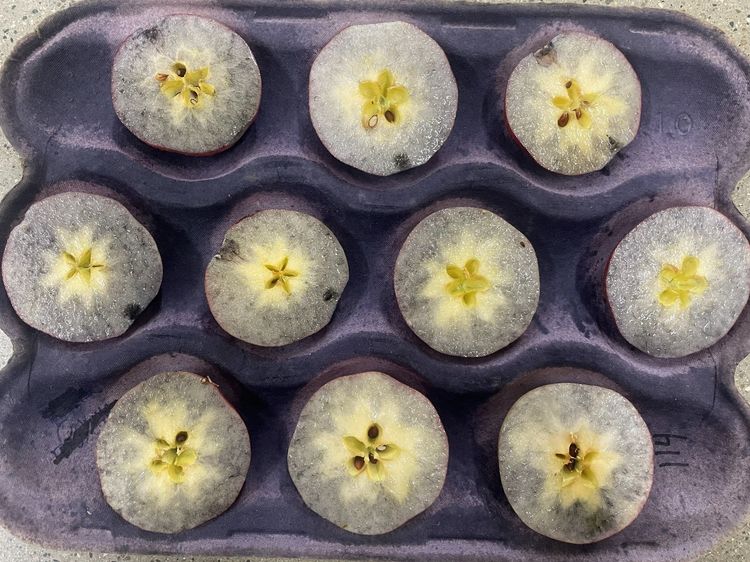
Apple maturity testing will occur weekly for the Grand Rapids/Ridge region beginning now through the end of harvest. Reports will be sent out every week following the Michigan State University Extension fruit team apple maturity calls on Wednesday mornings.
In the Grand Rapids Ridge region, Gala, SweetTango and Royal Red Honeycrisp are being harvested this week. Brookfield and Buckeye strains of Gala and Honeycrisp are mature this week. Some Belding area farms about a week ahead and have done first pick on some of these varieties.
How to read maturity tables
Each week, an apple maturity report will be provided and will include average values for several apple samples for varieties nearing maturity. Maximum and minimum values are included in tables below for the highest and lowest individual fruits evaluated for each, to give a full spectrum of maturity. Samples included in the reports have been untreated with ReTain or Harvista, unless otherwise noted. Samples were collected from 2-5 locations in across Kent and Ottawa County.
For more information about apple maturity testing, review these resources compiled by the MSU Extension tree fruit team.
- Predicted apple harvest dates for 2026 from MSU.
- More information on harvest management tools and timings can be found in this article.
- Guidelines from MSU to check for apple maturity in your own orchard, including specific pressure and starch recommendations by variety.
- New starch charts for evaluating apple maturity in Michigan from Michigan State University
- Predicting apple maturity and starch chart from Cornell University.
- Starch chart for Honeycrisp Apples developed by Washington State University.
Harvest
Apple harvest has begun on a few early varieties like Wildfire Gala, Premiere Honey crisp and Maia. The Predicted harvest date for Gala is Aug. 25, so maturity sampling should have already begun or start now. Double check prediction dates and PHIs before applying Retain and Harvista.
Maturity information for the Grand Rapids/Ridge Region
Gala
Gala fruit were sampled from four locations in Kent and Ottawa County this week. Samples in the table below are for Brookfield, Buckeye and Ultima. Red color is at 80%. Background color is yellow at 1.1. Fruit firmness is at 19 lbs. of pressure. Starch is an average of 3.6. Sugars are an average of 10.85 Brix.
|
Collection Date |
Fruit Weight (g) |
Red Color (%) |
Background color (5-1) |
Firmness (lbs) |
Starch (1-8) |
Soluble Solids (°Brix) |
|
Aug 18 |
291(309-279) |
78 (99-45) |
1.9 (4-1) |
21.1 (26-18) |
1.5 (3-1) |
9.5 (11-8) |
|
Aug 24 |
325.25 (349-302) |
74.525 (100-40) |
1.85 (3-1) |
20.555 (22.8-17.7) |
1.95 (4-1) |
9.85 (10.3-9.6) |
|
Sep 1 |
382.5 (400-362) |
80 (100-40) |
1.1 (2-1) |
18.955 (24.2-16.3) |
3.6 (7-1) |
10.85 (11.2-10.2) |
Gala
Gala fruit were sampled from eight locations in Oceana County on Aug. 31. Samples in the table below are for Brookfield, Gale, and Pacific Gala. Fruit at one site was treated with ReTain. Average red color was similar to last week and is 86.6%, and background color is yellow at 1.4. Fruit firmness is lower than last week with an average of 19.7 lbs of pressure. Starch is an average of 2.5. Fruit is mature at some sites and would be ready for harvest for long-term storage. Sugars improved with an average of 11.1 Brix. Average fruit diameter is 2.87 in.
|
Collection Date |
Fruit Weight (g) |
Red Color (%) |
Background color (5-1) |
Firmness (lbs) |
Starch (1-8) |
Soluble Solids (°Brix) |
|
Aug 18-19 |
131 |
61.5 |
3.6 |
21.4 (28.1-18.8) |
1.4 (2-1) |
9.6 (11-8.8) |
|
Aug 25 |
143 (181-89) |
84.7 (100-50) |
1.6 (4-1) |
21.4 (27.8-16.9) |
1.9 (3-1) |
10.6 (12-9.2) |
|
Aug 31 |
169 (192-130) |
86.6 (99-40) |
1.4 (3-3) |
19.7 (23.9-16.6) |
2.5 (7-1) |
11.1 (12.2-9.6) |
In some Gala blocks as well as in Golden Delicious I am noticing leaf yellowing followed by a leaf drop. I began seeing it last week. This is a physiological disorder that causes the leaves to develop brownish blotches, followed by chlorosis or yellowing of the leaves, and then defoliation.
Honeycrisp
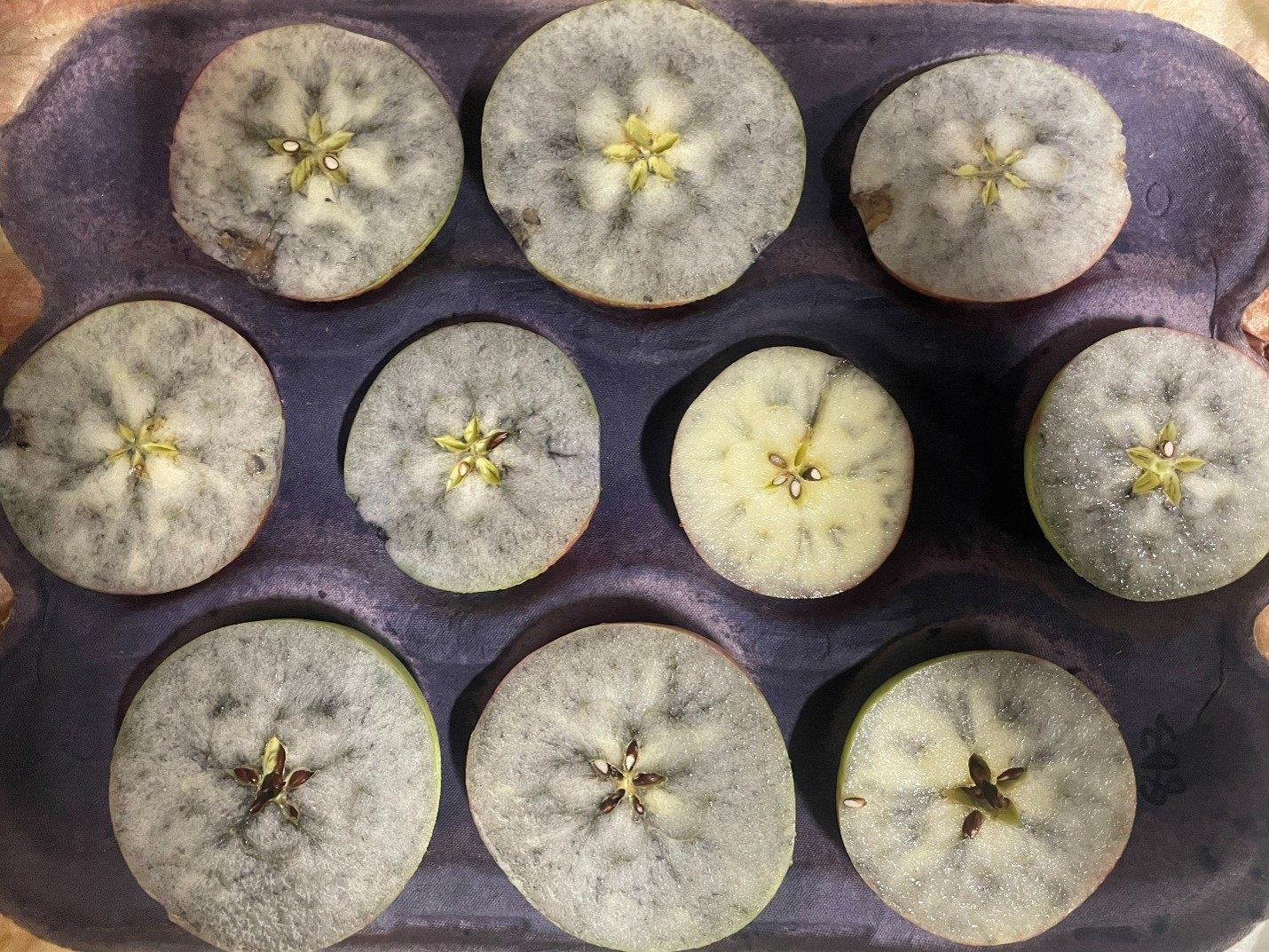
Fruit were sampled from four locations in Kent and Ottawa County. Red color is at 56%. Background color is light green, and much of the fruit picked would be ready for storage. Average pressure is 15 lbs, and starch rating averaged at 3.6. Sugars are at 11.9 Brix.
Bitter pit development on fruit has been observed in multiple locations. Fruit that are high risk or are more susceptible to bitter pit development may be in blocks with younger trees, high-risk rootstocks, high-vigor trees, or low crop loads. Large fruit are also more susceptible to bitter pit development than small fruit. High bitter pit-risk fruit should be cooled quickly to the recommended 38 F storage temperature, as conditioning will exacerbate bitter pit. High risk fruit should be marketed as soon as possible. Fruit intended for longer storage should be pre-conditioned, with recommended conditions of 50 F (room temperature) for 5-7 days.
|
Collection Date |
Fruit Weight (g) |
Red Color (%) |
Background color (5-1) |
Firmness (lbs) |
Starch (1-8) |
Soluble Solids (°Brix) |
|
Aug 18 |
366 (444-310) |
90 (90-10) |
4.17 (5-3) |
19.56 (24-16) |
2.3 (6-1) |
10 (12-8.4) |
|
Aug 24 |
395.75 (454-371) |
56 (90-25) |
3.5 (5-2) |
17 (23.7-12.7) |
3 (8-1) |
11.15 (12-10.4) |
|
Sep 1 |
449 (485-400) |
59.67 (90-52) |
4.03 (5-3.7) |
15.28 (18.4-14.72) |
3.63 (7-3.4) |
11.93 (12.1-0) |
Fuji
Fruit were sampled from three locations in Kent and Ottawa County. Red color is at 48%. Background color is light green, and fruit are still immature. Average pressure is 20 lbs, and starch rating averaged at 1.2. Sugars are at 9.8 °Brix.
|
Collection Date |
Fruit Weight (g) |
Red Color (%) |
Background color (5-1) |
Firmness (lbs) |
Starch (1-8) |
Soluble Solids (°Brix) |
|
Sep 1 |
340 (340-293) |
47.5 (90-35) |
4.7 (5-4) |
20.38 (23.4-18.5) |
1.2 (1-1) |
9.8 (9.8-9) |
Apple maturity sampling parameters
- Color % = the visual percentage of red color from 0 to 100; range is of all fruits tested. Indicates surface area covered in red and intensity of red color.
- Background color: 5 = Green, 1 = Yellow; range is of all fruits tested.
- Firmness in pounds pressure = measured with a Güss Fruit Texture Analyzer; range is of all fruits tested.
- Starch For Honeycrisp: will typically be rated using the standard Michigan State University starch scale (1-8). However, a separate starch chart for Honeycrisp Apples developed by Washington State University (scale 1-6) also exists.
- Brix = % sugar measured with Atago PAL-1 Pocket Refractometer
Looking for more? View Michigan State University Extension’s Apple page for regional reports throughout the state and additional resources.
|
Suggested firmness and starch index levels for long-term and shorter-term controlled atmosphere (CA) storage by variety. |
|||||
|
Variety |
Firmness (pounds)* |
Starch Index* |
|||
|
Short CA |
Mid-CA |
Long CA |
Mature |
Over mature |
|
|
McIntosh |
14 |
15 |
16 |
5 |
7 |
|
Gala |
16 |
17 |
18 |
3 |
6 |
|
Honeycrisp |
15 |
16 |
17 |
3.5 |
6 |
|
Empire |
14 |
15 |
16 |
3.5 |
6 |
|
Early Fuji |
16 |
17 |
18 |
3 |
7 |
|
Jonagold |
15 |
16 |
17 |
3.5 |
5.5 |
|
Jonathan |
14 |
15 |
16 |
3.5 |
5.5 |
|
Golden Delicious |
15 |
16 |
17 |
3 |
6.5 |
|
Red Delicious |
16 |
17 |
18 |
2.5 |
6 |
|
Idared |
14 |
15 |
16 |
3.5 |
6 |
|
Fuji |
16 |
17 |
18 |
3 |
7 |
|
Rome |
15 |
16 |
18 |
3 |
5.5 |
|
Brix Guide |
Low |
Fair |
Good |
Excellent |
|
All varieties |
Less than 11 |
11 |
12 |
13 |
|
Honeycrisp |
Less than 12 |
12 |
12 |
Greater than 14 |