MSU global biotechnology symposium highlights power of partnerships, innovation, capacity building to address challenges
 Print
Print Email
EmailMSU’s College of Agriculture and Natural Resources hosted a global symposium exploring how agricultural biotechnology, innovation and partnerships can help address food security, climate change and other challenges facing agriculture.
Feeding a growing global population while adapting to climate change is one of the defining challenges facing agriculture today. Around the world, farmers, researchers and policymakers are searching for ways to produce more food sustainably while responding to mounting environmental and production challenges.
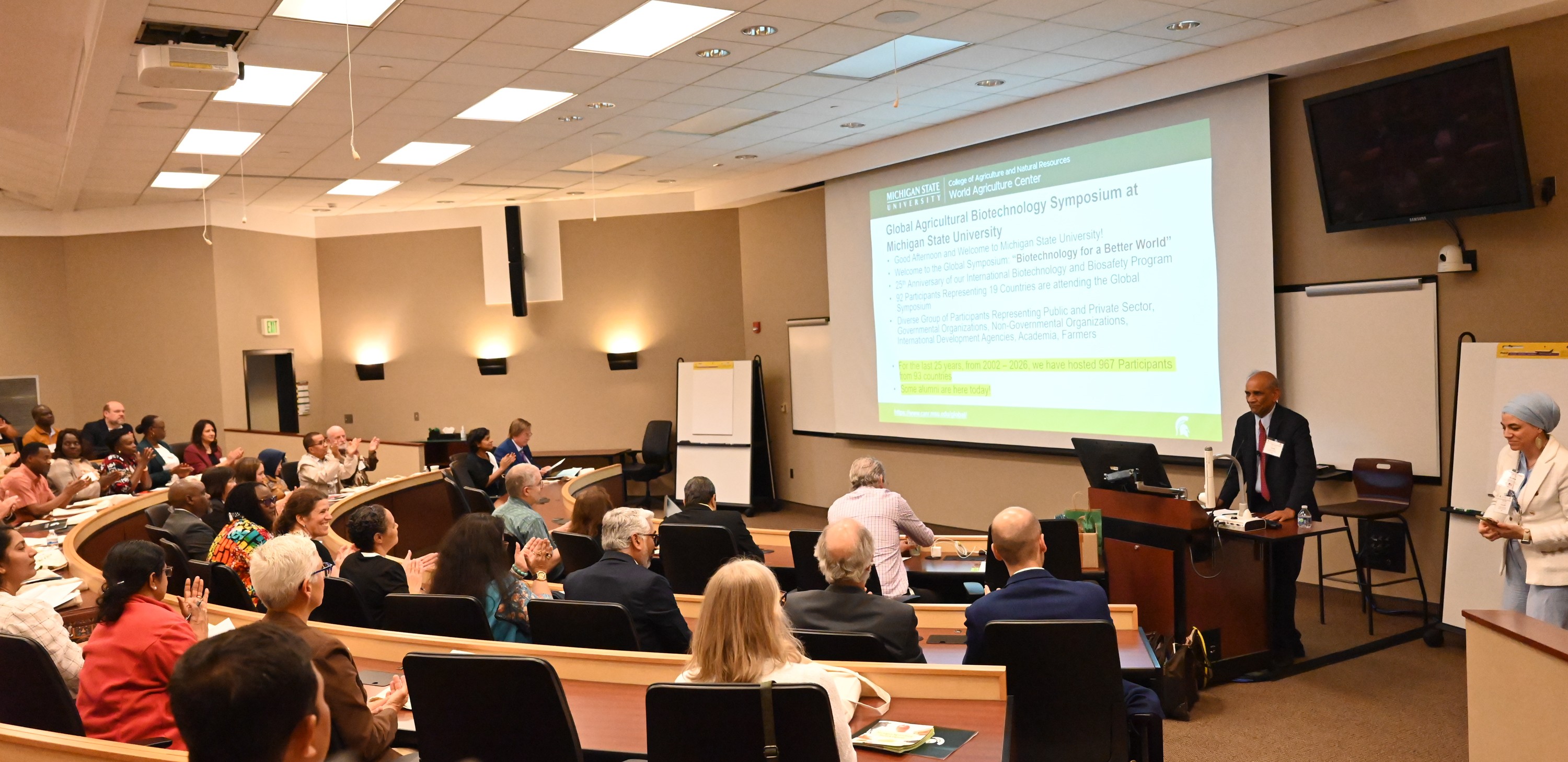
Those challenges, and the role innovation can play in addressing them, were at the center of the Global Agricultural Biotechnology and Biosafety Symposium, hosted Aug. 2-5 by Michigan State University's College of Agriculture and Natural Resources (CANR) as part of the 25th anniversary of CANR's International Agricultural Biotechnology, Biosafety and Technology Transfer Short Course.
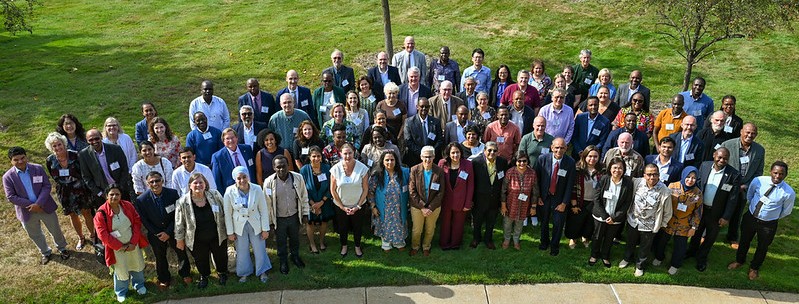
The symposium brought together nearly 100 participants from 18 countries, representing research, industry, government and farming, to explore how innovation can help address some of agriculture's most pressing challenges.
Yet one message surfaced repeatedly throughout the week: the future of agriculture will depend on more than scientific breakthroughs alone. The ability to share knowledge, build partnerships and strengthen capacity around the world will be just as important as the technologies themselves.
For Karim Maredia, Ph.D., professor, associate dean and director of the World Agriculture Center at MSU, that mission has guided the program for more than two decades.
"This is the 25th anniversary of our International Ag Biotech Program," Maredia said. "We started in 2002, and over 25 years we have trained more than 900 stakeholders from more than 90 countries."
Today, that network is applying lessons learned through the program in regions around the world.
Meeting agriculture's growing challenges
A common challenge underpinned discussions throughout the week: agriculture is being asked to do more with less.
Dr. Leena Tripathi, director of genetic innovation at the International Institute of Tropical Agriculture, said that feeding a growing population has become increasingly complicated by environmental pressures that are already affecting crop production.
"The biggest problem in front of all of us is how to feed the growing population," Tripathi said. "Climate change is affecting crops and we are seeing more emerging diseases and pests because of changing temperatures and rainfall patterns."
Shared examples of gene editing, biotechnology and artificial intelligence illustrated how researchers are developing crops better equipped to withstand emerging challenges.
Dan Jenkins, vice president for corporate affairs at Pairwise, said agriculture must adapt to challenges that are changing faster than ever.
"What’s changed is how quickly these challenges are evolving and our ability to keep up with them," Jenkins said. "We need every available tool if we’re going to meet the demands of a changing climate and a growing population."
Case studies and research examples demonstrated how technologies such as gene editing and AI can accelerate crop improvement while complementing traditional breeding approaches. However, no single technology will solve agriculture's challenges on its own. Tripathi and others noted that success depends on pairing innovation with effective delivery systems and farmer adoption.
From innovation to impact
Whether the focus was regulation, product development or adoption, a consistent theme emerged: innovation only creates meaningful impact when it reaches farmers and the communities they serve.
Aster Beyene of Bayer Crop Science said both regulatory readiness and public understanding are essential to ensuring new technologies benefit farmers.
"If you don't have a functional regulatory system, then these innovations and products will not be able to reach farmers," Beyene said. She added that farmers, consumers and regulators all need opportunities to better understand the technologies being introduced and the value they may provide.
Subray Hegde of the U.S. Department of Agriculture's Animal and Plant Health Inspection Service said many of the tools needed to address agricultural challenges already exist.
"The technology is available," Hegde said. "What we need is to understand the real agricultural problems and make sure these technologies are being used to solve the problems farmers actually face."
Building capacity through connection
Beyond the technical sessions, participants repeatedly emphasized the value of learning from colleagues working in different sectors and regions of the world. Attendees represented the full agricultural innovation pipeline, from discovery through on-farm adoption, offering a rare opportunity for cross-specialty conversations to explore challenges from diverse perspectives.
Viola Katherine Gamboa of the Philippines Bureau of Plant Industry said that hearing from such a diverse group of experts helped broaden her understanding of the global landscape of biotechnology.
"Even though the science is universal, the way we approach it and use it is very country- and context-specific," Gamboa said. "We have the same problems, but to a different degree, and it's very enlightening to understand how others solve their problems."
Her observation reflected a broader realization that surfaced throughout the week: while agricultural systems vary widely, many of the challenges confronting them do not.
"It makes you feel like you're a part of a bigger picture," Gamboa said. "You're not just solving your own problems. You can solve them with someone else and share the burden."
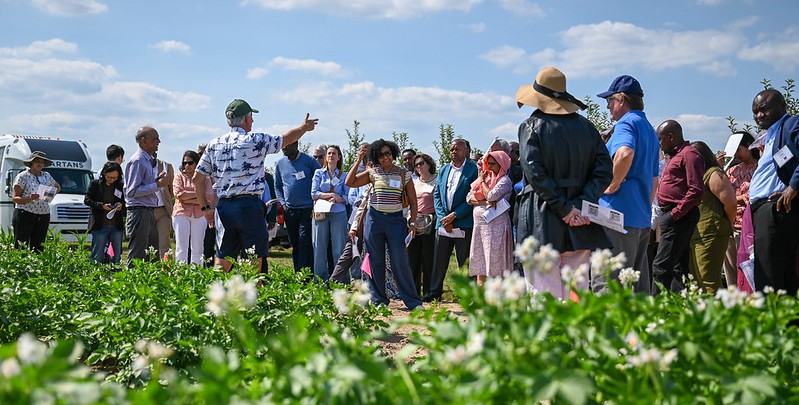
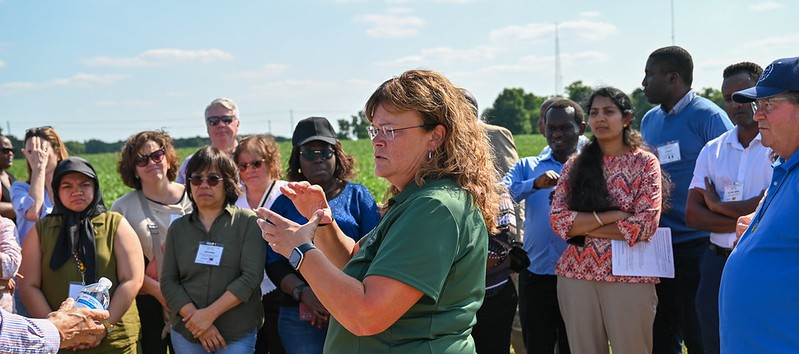
The symposium's collaborative spirit extended into the field through tours of MSU research facilities, visits to potato and sugar beet biotechnology field trials and meetings with Michigan farmers to see firsthand how innovation is being applied in agricultural production systems.
Eric Magembe of the International Potato Center said the experience helped participants better understand how innovations move through research, regulatory review and deployment to farmers. Those lessons, he said, can help inform biotechnology efforts and capacity-building initiatives in their home countries.
Looking ahead
While the symposium marked 25 years of international biotechnology programming, attention remained fixed on the challenges and opportunities ahead.
The week paired conversations about technological advances with a broader question: how to ensure those innovations ultimately reach farmers. Addressing that challenge requires more than new technology. Long-term progress depends as much on collaboration as innovation.
For Maredia, those priorities reflect the broader role MSU can play in building innovative partnerships towards addressing global agricultural challenges.
"These kinds of events are taking our land-grant mission and making it more global, more world-grant," Maredia said. "This is an excellent example of sharing our experience and our knowledge while building global knowledge partnerships. No one can do it alone. The real question is how we continue to work together over the next 25 years to make sure safe biotech crops reach smallholder farmers around the world."
As agriculture faces increasing pressure to feed a larger population in a changing climate, participants left MSU with a shared belief that innovation alone will not be enough. Turning scientific advances into real-world solutions will also require strong partnerships, knowledge sharing and sustained collaboration across borders.
Those connections were precisely what the symposium was designed to strengthen.
For additional information on the biotechnology symposium, check out this article: https://www.canr.msu.edu/news/global-biotechnology-symposium-agricultural-biotech-for-a-better-world