


Notice requirements in Michigan’s Open Meetings Act
 Print
Print Email
EmailMichigan’s Open Meetings Act contains important requirements for the noticing of meetings of public bodies.
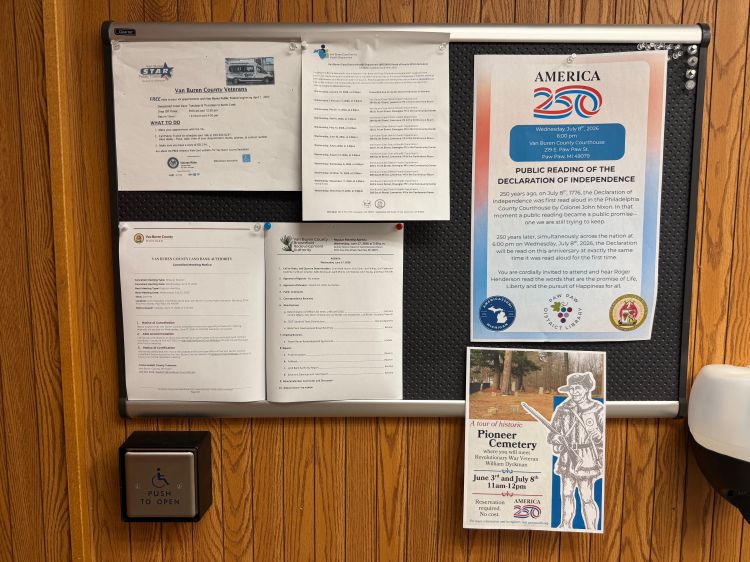
The Michigan Open Meetings Act (OMA), MCL 15.261 et seq or Public Act 267 of 1976, is the state law that requires meetings of public bodies to be open to the public and minutes to be kept of the meetings. The OMA also establishes minimum notice requirements for meetings of public bodies like local governments.
If the OMA’s notice requirements aren’t met, then the public body’s meeting cannot be held. This article summarizes the key points about content, location, and timing of public meeting notices as well as requirements for emergency meetings.
Public notice content
The OMA requires the following information to be included in the notices of public meetings:
- Name of the public body (MCL 15.264)
- Telephone number of the public body (if available) (MCL 15.264)
- Adress of the public body (MCL 15.264)
- The public notice for a rescheduled regular or a special meeting of a public body must have the date, time, and place of the meeting (MCL 14.265(2-3))
- The OMA allows electronic meetings for certain public bodies (see MCL 15.263a(1)(d-g)), and for the participation of members absent due to military service (MCL 15.263a((1)(c)) or as accommodations for individuals with a disability (Attorney General Opinion No. 7318, February 4, 2022). In those situations, the notices must also include additional details about why the meeting is being held electronically and how members of the public can participate (see MCL 15.263a(4)(a-d))
Note: The OMA does not require agendas as part of the meeting notice generally. However, if a public body is meeting electronically under Section 3a, has an agenda, and an official internet presence with at least monthly update of agenda or minutes, the agenda must be made available online at least 2 hours before the electronic meeting begins (MCL 15.263a(5)).
Public notice locations
The public meeting notices required by the OMA must be posted in the following locations:
- Principal office of the public body and other locations considered appropriate by the public body, such as a satellite office (MCL 15.264(b)).
- When a public body is part of a state department, legislative or judicial branch, institution of higher education, political subdivision, or school district, meeting notices must also be posted at the principal office of the corresponding parent entity (e.g., state department, university, legislative office, court, municipality, or school district) (MCL 15.264(c)).
- If the public body has no principal office, the notices for local bodies are posted at the county clerk’s office and the office of secretary of state for state bodies (264(d)).
- For rescheduled regular or special meetings, if the public body directly or indirectly maintains an official internet presence that includes monthly or more frequent updates of public meeting agendas or minutes, notice must be posted on the website (MCL 15.265(4)).
Public notice timing
The OMA establishes some time frames for public meetings notices. Those requirements are listed as follows:
- Within 10 days of the first meeting of the public body for the year: A list of regular meetings ((MCL 14.265(2))
- Within 3 days of the change, any changes to this schedule of regular meeting must be posted with the new date(s), time(s), and location(s) (MCL 14.265(3))
- Public notice must be posted at least 18 hours before a rescheduled meeting (MCL 15.265(4))
- If the public body maintains an official internet presence, public notice shall also be posted at least 18 hours before the rescheduled meeting on the public body’s website (MCL 15.265(4))
- A meeting of a public body that has recessed for more than 36 hours must meet the 18-hour notice requirement before reconvening (MCL15.265(5))
- Time requirements for public meeting notices refer to the time that the notice is accessible to the public (MCL 15.265(7))
- For example, if the notice is on a bulletin board inside a building which is only open from 9 a.m. to 5 p.m., then eight hours each day are counted toward the required 18 hours.
Emergency meetings
The OMA recognizes that situations may arise that call for a public body to meet without the required 18-hour notice. The following provisions apply to those emergency meetings (MCL 15.265(5)):
- There must be a severe and imminent threat to the health, safety or welfare of the public.
- Must have two-thirds of the members serving on the body decide that delay would be detrimental to efforts to lessen or respond to the threat.
- Then, if a public body holds an emergency public meeting that does not comply with the 18-hour posted notice requirement, it must:
- Have paper copies of the notice available at the meeting that explains specifically why the 18-hour notice requirement cannot be met.
- If the public body directly or indirectly maintains an official internet presence that includes monthly or more frequent updates of public meeting agendas or minutes, post the notice of emergency meeting with explanation on their website.
- Within 48 hours after the emergency public meeting, inform the county commissioners that a meeting with less than 18-hour notice has taken place and include the meeting notice with explanation via the U.S. Postal Service or electronic mail.
Other requirements
The notice requirements and details in this article are taken only from Michigan’s Open Meetings Act. There may be additional notice requirements that apply to specific public bodies such as the additional notice requirements for a local unit of government hearing on proposed budgets (MCL 141.412), a local planning commission hearing for a special use permit, or general law township board’s special meeting (OAG Opinion 6821, October 18, 1994). There may also be additional local charter provisions related to meeting notices. Communities should work closely with their legal counsel and other qualified professionals to ensure meeting notice requirements are being met.
More information
An up-to-date copy of the Open Meetings Act is available from the Michigan Legislature. The Michigan Attorney General also publishes an Open Meetings Act Handbook.