Northwest Michigan fruit update – June 9, 2026
 Print
Print Email
EmailRecent rain was much needed after an extended dry period. Fruit is sizing across orchard blocks. We are still in the thinning window for apples.
Weather report
The weather has felt particularly summer-like over this last week. We have had lots of sunshine, and when you look out into the orchards or non-irrigated lawns, it looks more like July in northern Michigan than early June. Prior to today’s (June 9) rains, it has been unseasonally dry, and growers have been scrambling to water new trees by hand until they can get in irrigation systems as quickly as possible. Even in orchards with established irrigation, trees are wilted and systems have been running a lot to make up for the lack of rainfall. So far today, we were predicted to receive over a half inch of rain. Jeff Andresen, MSU agricultural meteorologist, also mentioned that we have another three chances for more rainfall from Tuesday through this Friday.
We’ve accumulated 819.5 growing degree days (GDD) base 42 at the Northwest Michigan Horticulture Research Center. At this same time last week, we had accumulated 645.7 GDD base 42—again this week, we have had quite the jump in GDD. This week we’ve accumulated 438.3 GDD base 50, last week we were at 319.3 GDD base 50. Our 36-year averages are 792.8 GDD base 42 and 421.8 GDD base 50.
The forecast is predicting warm weather on Wednesday and Thursday, June 10 and 11, and these warm conditions could be coupled with some more extreme weather—mostly high winds, but Dr. Andresen thought that there would not be a lot of widespread hail coming in with the change in weather.
Andresen’s forecast showed a higher potential for rain in northwest Michigan today and through Friday. After Saturday, there is a cold front of Canadian air that will come into the state bringing cooler than normal temperatures. The high for Sunday, June 14 is only predicted to be 61 degrees Fahrenheit. This change in weather pattern will be quite abrupt after the warm weather we have had for the past two weeks.
Crop report

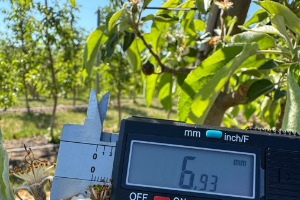
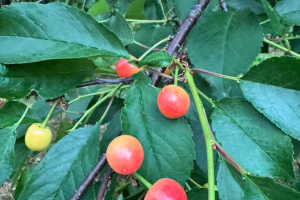
Crop development has moved quickly this week with the warm conditions. Montmorency tart cherries are at 11 millimeters (mm). Balaton fruit is at 10 mm. Sweet cherries are just larger than tarts, ranging from 11-12 mm depending on variety.
The Michigan Cherry Committee released their estimates for Michigan: 40 million pounds for northwest, 4 million pounds for west central, and 2 million pounds for southwest.
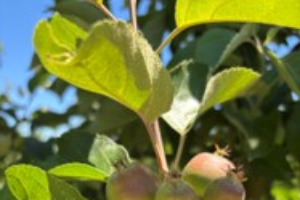
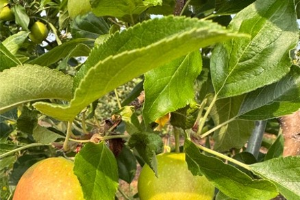
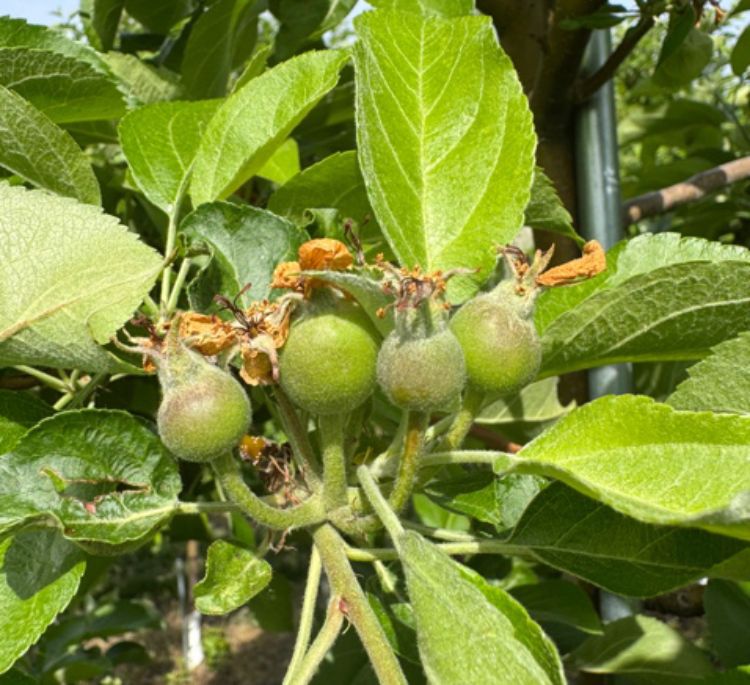
Apples at the station are also sizing. There is some variability in development and crop across our blocks, but in general Galas are 11 mm and Honeycrisp are 15 mm. Growers are still in the thinning window but will quickly move out of that range with the coming warm weather. Apply thinner applications before the cold weather comes this weekend. Growers should be thinking about NAA applications for return bloom in Honeycrisp. Chayce Griffith, PhD, recommends these treatments:
- 10 ppm NAA at 30, 45, and 60 DAFB
- 150 ppm ABA at 30 DAFB
- 10 ppm NAA at 30, 45, and 60 DAFB + 150 ppm ABA at 30 DAFB (so NAA and ABA are tank- mixed at 30 DAFB)

Disease report
Apple scab. We are not calling the end to primary scab but we are getting closer to that goal. We had a light scab infection today, June 9. MSU Enviroweather’s scab model is showing 100% spores are matured and 93% of them are dispersed. They called the end to primary scab in southwest Michigan on June 4, and they have not called the end to primary in west central Michigan as they caught spores over the weekend when they had rain. After these rains move through west-central, the end to primary will likely be over. If we get substantial rains, we will also call the end to primary here in northwest Michigan.
Cherry leaf spot. The cherry leaf spot model on Enviroweather shows we are having a light infection period for this disease. Growers need to be covering up new tissue and protecting it from the cherry leaf spot pathogen. There are a lot of new leaves in the orchard, and growers need to be applying a fungicide to control leaf spot. We want to delay infection as long as we can because early leaf spot infections can lead to early defoliation, and we need all the leaves we have to ripen the crop this season.
Powdery mildew. Unlike other fungal pathogens, powdery mildew thrives in hot and dry conditions. This recent weather pattern is perfect for powdery mildew as this fungus grows well when temperatures are between 60-80 F. This fungus does not need rainfall to infect as humidity and/or dew can result in an infection. Once this disease infects the leaves, a white mycelium appears on the foliage. Once this mycelium is visible, there are no fungicides that can eradicate powdery mildew.
This disease must be treated preventatively. Our previous work has also shown that the first cover timing is optimal for controlling powdery mildew for the remainder of the season—do not delay a powdery mildew application (or tank-mix for powdery mildew and cherry leaf spot). Luna Sensation, Merivon, Torino, Pristine, Flint Extra and Cevya are all rated excellent for powdery mildew.
Apple powdery mildew has also been on the rise in Michigan orchards. Treat for this disease earlier in the season. Since we do not have hot conditions at tight cluster, many growers may not put a material targeting powdery mildew into the tank until later in the season. Luna Tranquility, Merivon, Inspire Super and Miravis are all rated excellent in the E-154 guide.
Insect report
Our insect counts have increased markedly this week following a long stretch of warm weather.
Codling moth. We caught our first codling moth at the research station two weeks ago, May 26. We caught a lot of codling moth again this week, especially for the Northwest Michigan Horticulture Research Center where trap counts have historically been low. Our trap counts for this week were 10, 35 and 57. Because we have sustained catch for codling moth, we are setting the biofix for May 26. Based on the Enviroweather codling moth model, the first egg hatch is predicted to happen on June 11. It is too late to be using Rimon as an ovicidal material, and growers should be targeting codling moth larvae now. Use the Northwest Michigan Horticulture Research Center biofix timing if you are not trapping codling moth on your own farms.
Plum curculio. We have had many reports of plum curculio in sweet and tart cherry orchards. Our apricots at the station also have lots of plum curculio stings. Apples are also sizing, so be on the lookout for plum curculio in apple orchards. Plum curculio activity increases in warm weather, and with the extended cold period this spring, they have recently become active. Look out for the moon-shaped oviposition scar. Most orchards have hotspots for plum curculio activity, likely near a woodlot where they are moving in from overwintering. Plum curculio also seem to lay in wait for cherries to come out of the shuck, so protect exposed fruit.
Avaunt works primarily by lethal activity, but ingestion is the important means for delivering the poison. Neonicotinoids are highly lethal to plum curculio via contact for the first several days after application, but as these systemic compounds move into plant tissue, they protect fruit from plum curculio injury via their oviposition deterrence and anti-feedant modes of activity. The rotation of these two modes of action is critical to successful plum curculio control. Avuant needs to be used prior to any neonicotinoids because Avaunt must be ingested to work effectively, and the neonicotinoids have that anti-feedant characteristic. If needed, use Avaunt first followed by neonicotinoid insecticide.
At this time in the season, cherry growers should be using the neonicotinoid and indoxacarb (Avaunt) chemistries as these materials are not effective at controlling spotted wing Drosophila. Save Imidan and the pyrethroids to target and potentially overlap these materials to control late season plum curculio and early spotted wing Drosophila emergers. Imidan and pyrethroids are rated excellent for spotted wing Drosophila, and neonicotinoids are only rated as fair against this pest. To make the most out of a cherry insecticide program, the more broad-spectrum materials, like pyrethroids and Imidan, should be used later in the season to do double duty on these two pests.
Obliquebanded leafroller. We have had many reports of obliquebanded leafroller larvae in apple and cherry orchards. Obliquebanded leafroller is a threat to apples as a direct pest; the larvae feed on leaves and fruit in summer and fruit in fall. In cherries, obliquebanded leafroller does not feed on fruit, but they can cause damage to cherry leaves, which can result in defoliation. The greater concern of obliquebanded leafroller in cherries is the threat as a contamination pest, as they can be found in cherry tanks if present in trees at harvest.
If you are seeing abnormally higher than normal obliquebanded leafroller larvae in orchards, target them while they are small as this pest is much harder to control once the larvae are larger. If you do not treat now, set obliquebanded leafroller traps to monitor for adult flight and set a biofix to target summer generation larvae. Sometimes the summer generation larvae overlap with cherry harvest, and as mentioned above, the larvae can end up in tanks if the populations are high enough. Cherry growers with past obliquebanded leafroller issues should treat now so they are not a problem at harvest.
Black stem borer are still relatively low at the Northwest Michigan Horticulture Research Center.
American plum borer numbers are much lower this week than last week. This is to be expected as this pest has two generations per season. We did catch substantially more lesser peachtree borers this week (30, 21, 19), so if this pest has been an issue in the past, a trunk spray at this time will control lesser peachtree borer and American plum borer adults. Altacor is a good material for trunk sprays in sweet cherry because Lorsban is no longer registered in this crop. Lorsban can still be used in peaches and tart cherries, but check with your processors before applying in bearing blocks.
Spotted wing Drosophila. We caught adult flies in our traps at the Northwest Michigan Horticulture Research Center this week. We have caught them earlier in past years but remember there is little relationship between trap catch and infestation. Just because we are catching adults in traps doesn’t mean there will be larvae in fruit. The fruit is not susceptible to infestation until it colors, and we have ample time before fruit is vulnerable to spotted wing Drosophila.
Horticulture
Thinning. We are still in the thinning window for apples across the region. Gala are at 11 mm and Honeycrisp are at 15 mm, both of which are still a good size for thinning. Once fruit gets to 20-25 mm, there are few options for effective thinning. We have data that shows Accede will work on 20-25 mm fruit, but as soon as the fruit reaches 25 mm, it is not an effective thinner.
We still have some warm days in the forecast before it cools down. Take advantage of this weather and put on a thinner as needed. We thinned at the station last week, but using Einhorn and Hillmann’s Fruit Size Distribution (FSD) model, we still have too many fruit for our target crop load.
We are applying another round of thinner today. The fruit will size quickly and the weather will be warm for a few more days, so if your crop load is still too big, take the chance to apply thinner before the fruit is too big and the temperatures too cold for adequate thinning. This is an excellent article about thinning apples in Michigan.
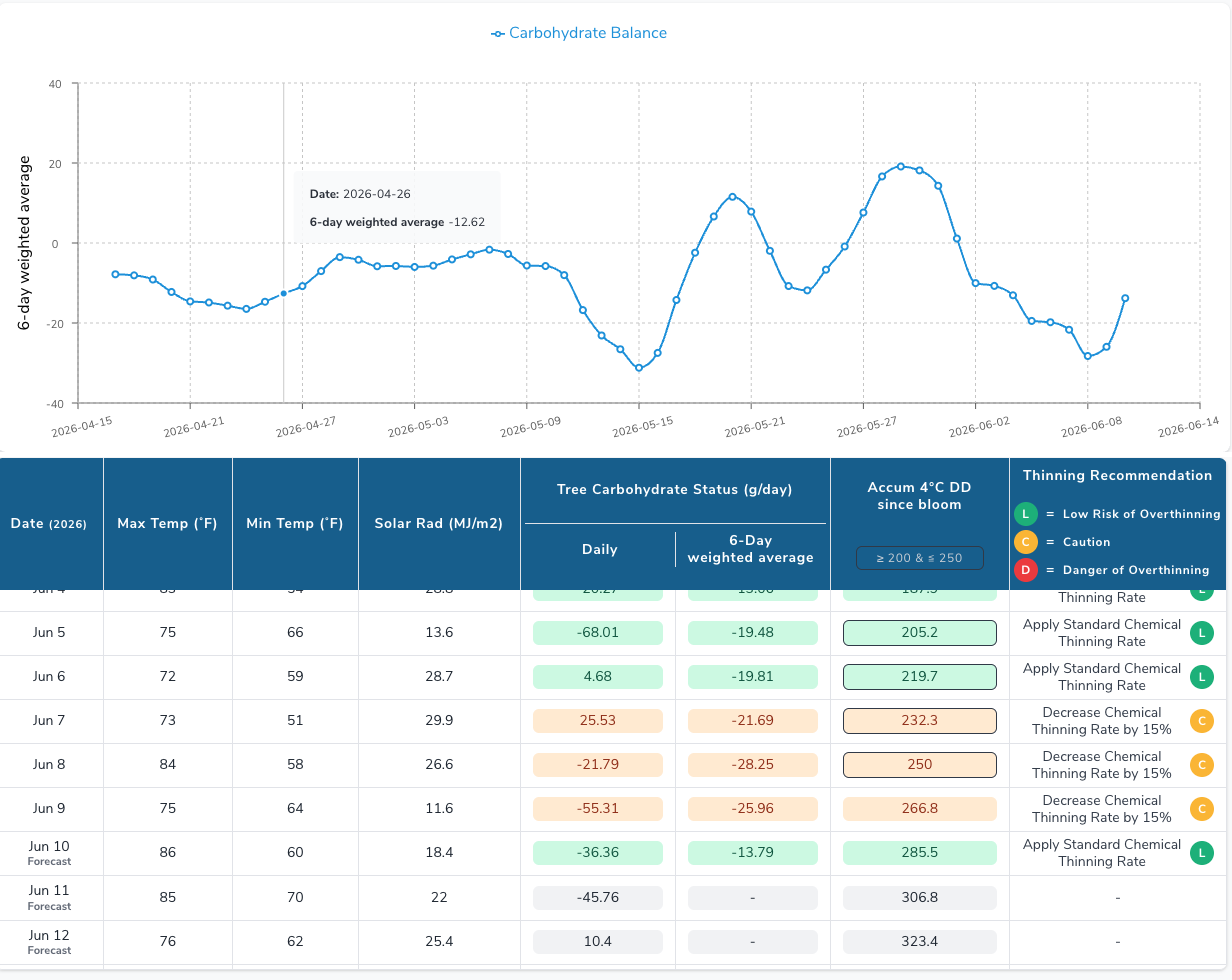
The carbohydrate model shows we are going to have some stress on the trees (-20 for the six-day weighted average today). The model is suggesting to use a normal thinning rate.
This work is supported by the Crop Protection and Pest Management Program (grant no 2024-70006-43569) from the USDA National Institute of Food and Agriculture. Any opinions, findings, conclusions, or recommendations expressed in this publication are those of the author(s) and do not necessarily reflect the view of the U.S. Department of Agriculture.