Organic mulching for weed control and mitigating cold stress in Christmas tree production
 Print
Print Email
EmailManaging weeds and reducing winter injury simultaneously are benefits of using organic mulching in Christmas tree production.
The declining temperatures during winter cause cold stress in Christmas trees. Low temperatures lead to cell membrane breakdown causing electrolyte leakage that injures needles and reduces photosynthetic efficiency. Young Christmas trees and seedlings are more susceptible to cold injury than mature trees. Both root and shoot growth of seedings are limited at temperatures below 0 degrees Celsius (32 degrees Fahrenheit). A research trial conducted by Lindström and Stattin showed that in Scots pine, root growth capacity and shoot elongation are severely reduced at temperatures ranging from -6 C (21.2 F) to -20 C (-4 F) and the exposure below -20 C (-4 F) completely halts root growth.
Cold tolerance varies among species of Christmas trees. Norway Spruce seedlings are less affected by low temperature than Scots pine seedlings. Freezing injury also differs among the type of seedling used. According to a study conducted by Creighton, the survival of container grown seedlings planted in December was only 43% compared to 92% survival for bare root seedlings. Bare root seedlings established better when planted during winter, whereas container grown seedlings performed better when planted in summer.
Decreasing temperatures also cause soil moisture to freeze, making water unavailable to trees. In addition, repeated freezing and thawing cycles alter soil physical properties. These cycles fragment soil aggregates, consolidate soil clods, and reduce macropore connectivity, resulting in reduced infiltration and increased runoff and greater erosion. Freeze-thaw cycles can also cause soil heaving, which physically injures roots and young trees.
According to Kohnke and Werkhoven, organic mulch has been found to reduce the frequency of freeze-thaw cycle by up to threefold compared with bare soil. Mulching, widely used for summer weed control, can therefore play a critical role in mitigating winter cold stress in Christmas tree production. Organic mulches also conserve soil moisture and help retain heat energy in soil. Organic mulch suppresses early-summer weeds by limiting light penetration and moderating soil temperature. This reduces early-season competition at a time when root systems may be weakened by winter injury, allowing trees to establish and outcompete weeds more effectively.
Mulched areas maintain continuous soil cover and provide long-term weed suppression without disturbing soil structure. Organic mulches gradually decompose and increase organic matter. Higher soil organic matter improves water-holding capacity and supports rhizosphere development. Soils with greater organic matter are more resistant to freeze-thaw degradation and provide a more stable thermal environment for roots across multiple seasons.
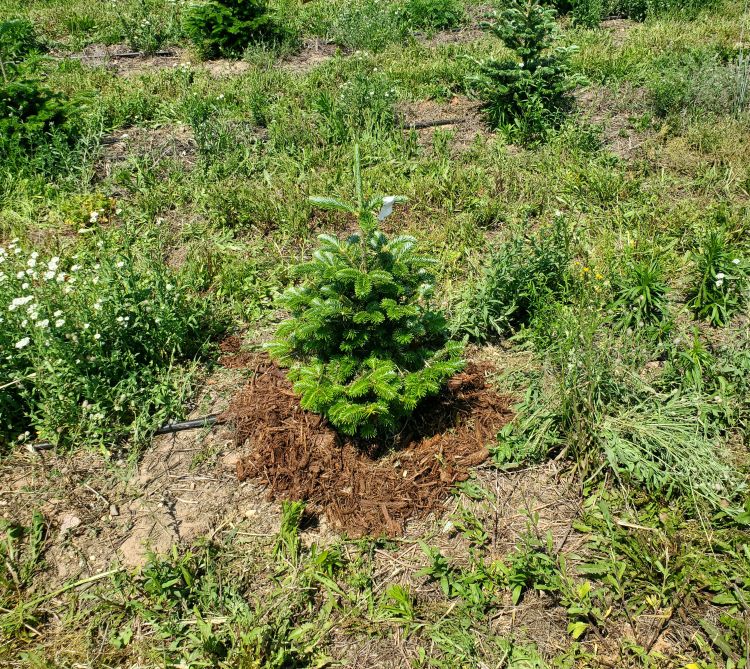
Overall, Michigan State University Extension recommends mulching in Christmas tree production as a year-round management tool rather than just a weed management practice. By suppressing weeds, conserving soil moisture, moderating soil temperature and freeze-thaw cycles, mulching improves establishment and survival of Christmas trees, particularly young seedlings (Figure 1.).