Do rubber mats on concrete slatted floor feedlot facilities improve cattle welfare and performance?
 Print
Print Email
EmailAdding rubber mats to concrete slats reduces lameness and typically improves average daily gain in heavier finishing cattle over 1,000 pounds.
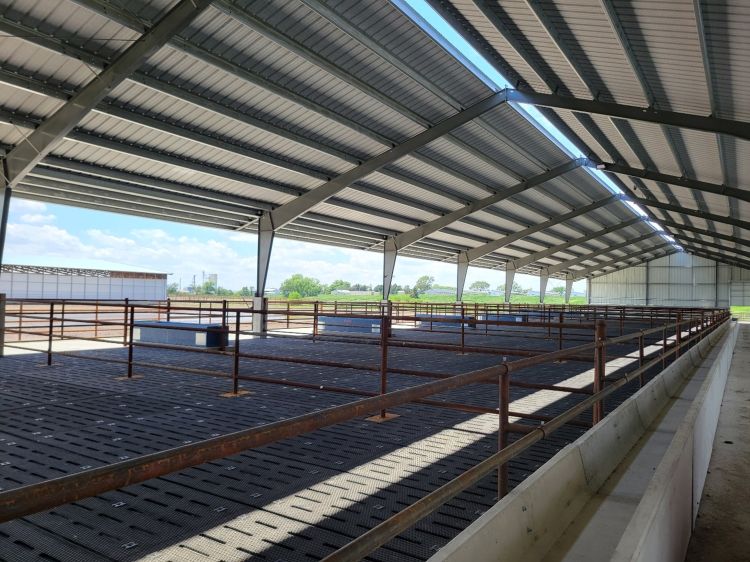
Covered slatted floor beef cattle feeding facilities are found throughout the Great Lakes region and parts of the Northern Plains and offer many advantages to cattle feeders. One of them being protection from the weather, particularly during the winter, where cold temperatures and large snowfalls can negatively impact cattle welfare. Protection from weather-related stressors outside the thermal neutral zone reduces energy expenditure, lowers maintenance costs and improves feed conversion to weight gain.
Research has demonstrated that feedlot cattle housed on covered slatted floor facilities require less space compared to solid floor (concrete and dirt) facilities, thus allowing for greater stocking densities and more intensive beef production. As a result of requiring less space per animal, feedlot facilities require less land to produce the same amount of beef. A positive concept when one considers the increasing cost and competitiveness of farmland availability. Cattle with less space also expend less energy walking around the pen and can use that energy for body weight gain.
With slatted floor facilities, manure falls through the slats into a deep pit for temporary storage and containment. This is a benefit in areas such as the Great Lakes region, where concerns of nutrient runoff into surface water continue to be a concern.
Slatted floor designs do not require the additional cost of labor and bedding material frequently required for cleaning and bedding pens. If you are considering adding rubber slatted mats to the facility design, there will be a cost associated with purchasing and installing new mats and removing old mats. Additionally, manure and dirt tag on the hide is generally less for cattle raised in slatted floor facilities, thus reducing a major food safety concern during slaughter.
However, a drawback of slatted floor facilities is the increased risk for injury and lameness issues for cattle. Which brings us to the point of discussion: can rubber mats help improve feedlot cattle performance, mobility and welfare?
Table 1. Studies (n=10) investigating the use of rubber mats in slatted floor cattle feedlot facilities.
|
Study |
Location |
Production Stage |
ADG difference (%) w/ rubber slats versus concrete |
Mat brand |
P-value |
|---|---|---|---|---|---|
|
Briscic et al. (2015) |
Italy |
Finishing |
4.98 |
Riverstick |
0.04 |
|
Elmore et al. (2015) |
IN, USA |
Growing |
- |
Ani-mat |
NS |
|
Keane et al. (2015) |
Ireland |
Finishing |
13.55 |
Durapak |
<0.01 |
|
Earley et al. (2017) |
Ireland |
Finishing |
11.71 |
Durapak |
0.011 |
|
Earley et al. (2017) |
Ireland |
Finishing |
-1.46 |
Easy Fix |
0.011 |
|
Earley et al. (2017) |
Ireland |
Finishing |
3.90 |
EVA |
0.011 |
|
Murphy et al. (2018) |
Ireland |
Growing - dairy |
1.00 |
Comfort Slat |
NS |
|
Murphy et al. (2018) |
Ireland |
Finishing - dairy |
3.09 |
Comfort Slat |
NS |
|
Murphy et al. (2018) |
Ireland |
Switched at Finishing |
7.81 |
Comfort Slat |
NS |
|
Dewell et al. (2018) |
IA, USA |
Finishing |
7.50 |
Ani-mat, Easy Fix, Krailburg |
NS |
|
Lowe et al. (2019) |
Ireland |
Finishing - dairy |
3.96 |
Comfort Slat |
0.003 |
|
Magrin et al. (2020) |
Italy |
Finishing |
4.98 |
Riverstick (CH) |
0.022 |
|
Magrin et al. (2020) |
Italy |
Finishing |
6.21 |
Riverstick (LM) |
0.022 |
|
McGettigan et al. (2022) |
Ireland |
Finishing |
17.13 |
Durapak |
<0.001 |
|
McGettigan et al. (2022) |
Ireland |
Growing |
-3.29 |
Durapak |
NS |
|
Dawson et al. (2022) |
IL, USA |
Finishing |
3.39 |
Ani-mat max grip |
<0.01 |
|
Dawson et al. (2022) |
IL, USA |
Finishing |
4.44 |
Ani-mat pebble |
<0.01 |
|
Dawson et al. (2022) |
IL, USA |
Finishing |
-0.52 |
Ani-mat pebble (Old) |
<0.01 |
|
Dawson et al. (2022) |
IL, USA |
Finishing |
1.61 |
Ani-mat pebble |
NS |
|
Dawson et al. (2022) |
IL, USA |
Finishing |
1.08 |
Ani-mat pebble (Old) |
NS |
Across 10 cattle feeding research studies conducted since 2015 in Ireland, Italy and the United States, rubber slatted mats improved average daily gain (ADG; 4.79%) compared with cattle housed on concrete slat floors (Table 1). For growing cattle, the ADG response with rubber slatted mats is similar to concrete slats. Therefore, the negative effects of housing cattle on concrete slatted flooring are not yet realized in lighter weight growing cattle that have spent fewer days in the feedlot compared to finished cattle. Heavier finishing cattle over 1,000 pounds experience a much greater ADG benefit (5.49%) from the rubber slatted mats compared with concrete slatted floors.
Rate of gain responses to rubber slatted mats compared with concrete slats vary by location due to cattle genetics, space allowance, days on feed, climate and facility design, as well as the rubber slatted mat brand being used. Interestingly, a study conducted at the University of Illinois reported similar ADG for steers raised on 12- to 15-year-old rubber slat mats or concrete slats, while new rubber slats resulted in a 3.15% ADG improvement. This result demonstrates the importance of replacing rubber slatted mats when they reach their life-expectancy in order to continue experiencing the improvement in ADG from the rubber slatted mats.
Cattle housed on slats are typically cleaner, with less tag on hides, compared with deep bedded pack or outdoor dirt lot facilities. However, between concrete slats or rubber slats, the results on the cleanliness of cattle are mixed and may be dependent on the type of rubber mats used. Factors such as slot size, porosity and texture of the rubber mats can influence manure drainage into the pit and affect animal cleanliness.
Both Italian studies indicated locomotion was improved and cattle exhibited less bursitis (joint inflammation) when raised on rubber slats compared with concrete. However, cattle raised on rubber slats had longer front and rear hoof claws, presumably due to reduced hoof wear. Two out of three Irish studies reported more hoof lesions for cattle raised on rubber slats compared with concrete slats, but no difference in the occurrence of lameness. Along with reduced lameness, it is commonly reported cattle raised on rubber mats spend more time lying down and exhibit more bouts of lying down/getting up compared with cattle raised on concrete slats.
In all three U.S.-based studies, lameness was less for cattle raised on rubber slats compared with concrete slats. For both experiments in the University of Illinois study, the percentage of cattle with a lameness score of 2 or greater (1 to 5 scale, 5 being worst) was reduced by 21 and 32 percentage units when raised on rubber slats as opposed to concrete slats. In the second experiment of this Illinois study, cattle awarded lameness scores of 3 had reduced ADG compared with cattle awarded lameness scores of 1 (-13.0%) or 2 (-8.8%).
A commercial-based feedlot study conducted in Iowa reported pulling cattle from pens three times less often and lesser lameness scores (1.6 versus 2.1) for cattle raised on rubber slats compared with concrete slats, respectively. Additionally, the Iowa study reported a 27% reduction in the percentage of cattle with lameness scores of 2 or greater on a 5-point scale. Interestingly, morbidity (20.5 versus 7.6%) and mortality (2.1 versus 0.7%) rates were greater for cattle raised on concrete slatted floors versus rubber slatted floors.
In conclusion, cattle raised in covered slatted floor facilities benefit from adding rubber slatted mats. This is particularly true for heavier finishing cattle, while lighter growing cattle appear to be more tolerant of the hard concrete slat surface. Cattle raised on rubber slats have better mobility, as witnessed by getting up and down more frequently, and exhibit less lameness when assessed while walking compared with cattle raised on concrete slats. The rubber slatted mats offer less resistance and more cushion, therefore helping reduce joint inflammation and injury.
Interestingly, but not surprising, lameness seems to influence overall cattle health, with lame cattle more likely to experience illness or death while in the feedlot. Additionally, the incidence of lameness has shown to reduce rate of gain and final weight in the feedlot, with the increased likelihood of realizers (cattle that need to be sold early). Producers must also consider the cost of rubber mat installment with the positive benefits of rubber mats on cattle mobility and performance.
For more information about rubber slats, reach out to Jerad Jaborek, MSU Extension beef feedlot educator. For other beef cattle production related inquires, check out the Michigan State University Extension Beef website.
This article was originally published in the spring 2026 issue of Michigan Cattleman Magazine.