Solar fields don’t have to sit idle
 Print
Print Email
EmailA Genesee County sheep producer explains how grazing sheep on solar sites supports agriculture, manages vegetation, and creates new income opportunities.
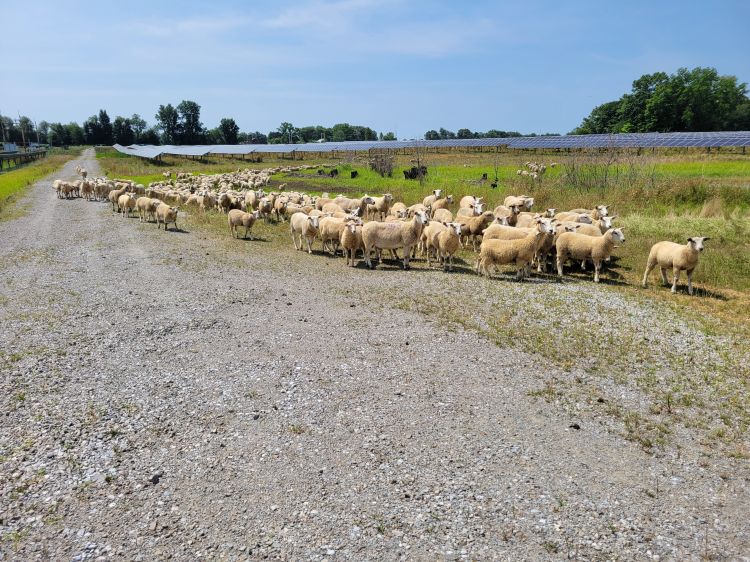
As solar development expands across Michigan farmland, one sheep producer is demonstrating how solar sites can remain productive agricultural landscapes.
During the MI Ag Ideas virtual session Solar Grazing in Michigan: Lessons Learned from One Sheep Producer hosted by Michigan State University Extension, Sy Caryl, a Genesee County sheep producer and partner in J&S Solar Grazing and Mowing, shared lessons learned from grazing his sheep on more than 330 acres across two utility-scale solar projects this past summer.
A long-time agricultural producer, Caryl grew up on a dairy farm and spent decades shearing sheep across Michigan and neighboring states. As solar development accelerated, he began to see an opportunity. He noticed that solar projects were being repeatedly mowed, and believed sheep could provide a practical alternative.
Transitioning into solar grazing required more preparation than many might assume. Grazing sheep on solar farms involves subdividing large, fenced sites into smaller paddocks, rotating flocks carefully and working around infrastructure such as transformers that must be gated off. Caryl emphasized that understanding site layouts ahead of time is critical and often begins with reviewing aerial maps before sheep ever arrive.
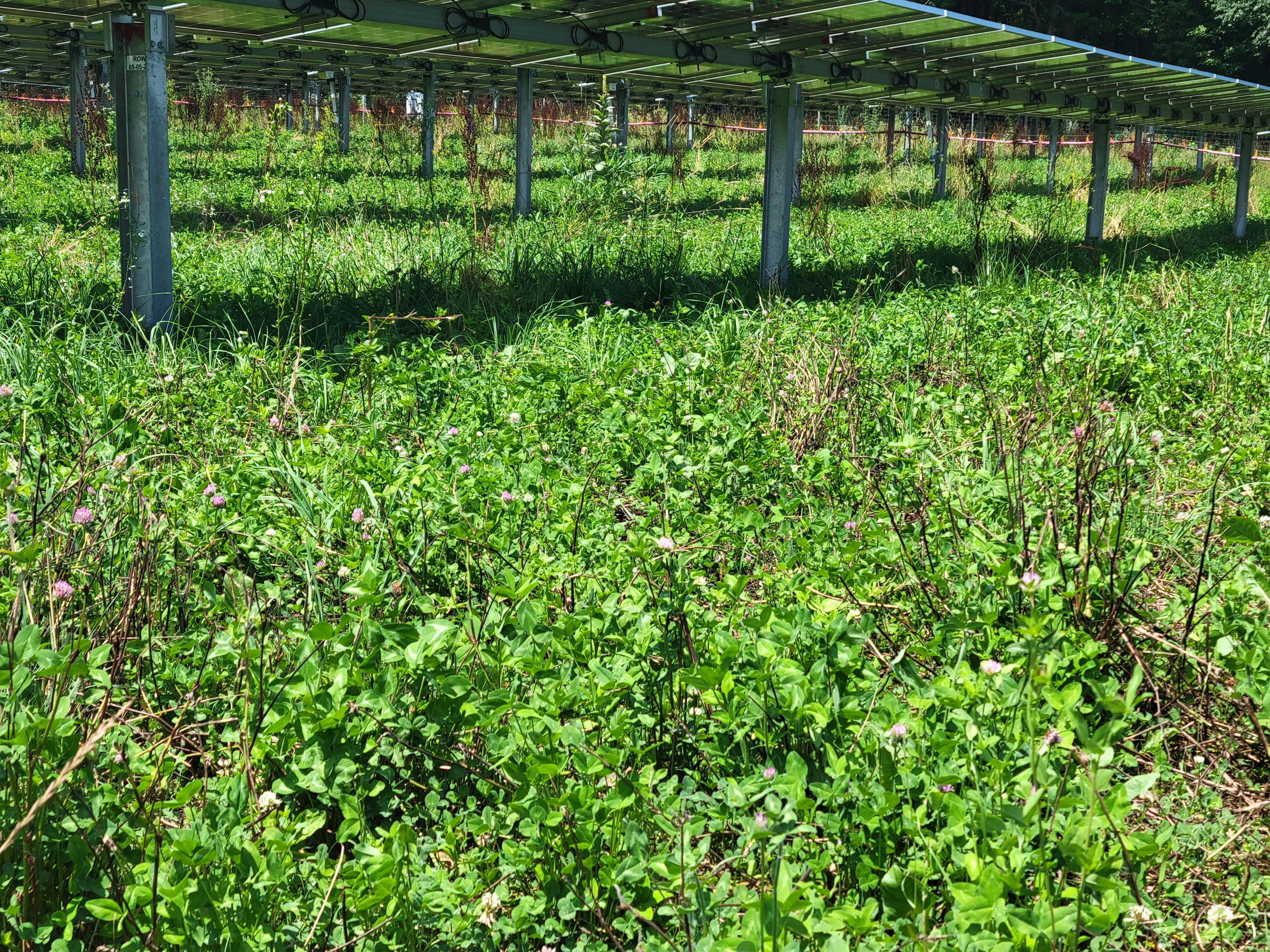
Water access and fencing were among the first logistical challenges. Portable water systems had to be installed, and internal electric fencing was required to manage rotations effectively. Over time, Caryl found that forage growth under solar panels was more productive than expected, reducing both water demand and pressure on fencing.
Forage productivity, Caryl said, exceeded expectations. “The productivity of the ewe out on the solar farm was phenomenal. Ewes maintained their body condition on the forage and milked like no tomorrow. Their lambs grew phenomenally.”
Beyond animal performance, Caryl highlighted the importance of managing relationships with solar site technicians and operators. Unlike traditional pasture settings, solar farms operate under strict safety and access protocols. Grazers must comply with federal requirements, check in and out of sites and follow detailed procedures outlined in lengthy contracts.
“You’re not just farming anymore,” Caryl explained. “You are now abiding by safety regulations and working as a service provider.”
Those contracts also require specialized insurance coverage, which Caryl said many first-time solar grazers underestimate. Standard farm insurance often does not cover off-site grazing or liability related to solar infrastructure, so making early coordination with insurers essential.
From a business standpoint, Caryl stressed that solar grazing must be priced competitively against mowing services. While sheep grazing can be less expensive and provide ecological benefits, it remains a paid vegetation management service rather than free pasture. Fuel, equipment, labor, insurance and travel between sites all factor into the cost structure.
Despite the learning curve, Caryl sees solar grazing as a way to keep land in agricultural use and support the state’s growing demand for lamb. He noted that Michigan producers struggle to meet market demand, forcing buyers to rely on imported lamb.
“They’re not making any more land,” Caryl said. “If we can keep this ground productive and feed sheep on it, that’s still agriculture.”
Looking ahead, Caryl believes solar grazing will continue to grow as producers, developers and communities become more familiar with the model, and as more sheep producers step forward to meet the opportunity.
If you have questions about agrivoltaic opportunities, please contact Charles Gould, Michigan State University Extension Bioenergy Educator, at 616-834-2812 or gouldm@msu.edu. The MSU Extension Agricultural Bioenergy and Energy Conservation website has additional information on renewable energy.