Southwest Michigan fruit update – April 8, 2026
 Print
Print Email
EmailFruit are still waking up despite this week’s chill.
Weather
The cold night of Monday, April 6, into the morning of Tuesday, April 7, caused damage to advanced fruit buds across southwest Michigan. The greatest impact is expected in apricot and Japanese plum, both of which were in bloom when temperatures dropped into the low 20s.
Apples at tight cluster may also have experienced some injury, particularly in the most advanced varieties where individual flower buds were exposed. These exposed buds are less cold-hardy than those still held within the cluster, increasing their susceptibility to damage.
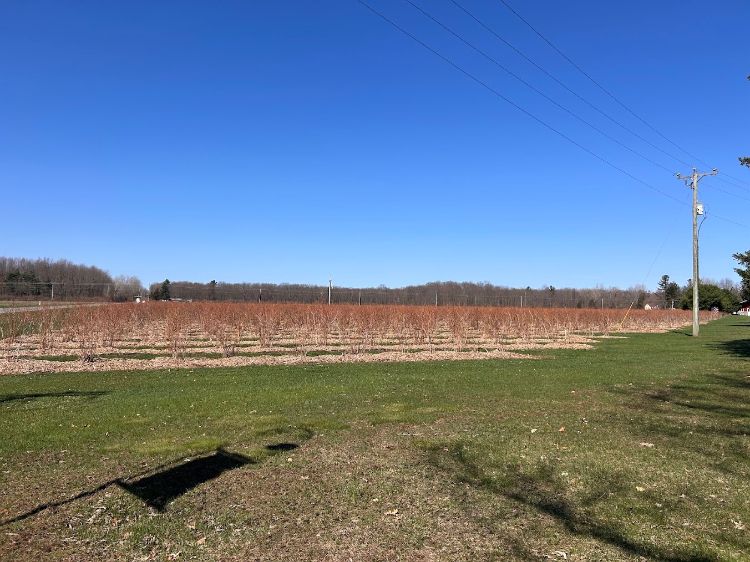
Early season blueberry varieties might have experienced some losses in low-lying areas. Berries at bud burst can handle temperatures down to 20 degrees Fahrenheit.
A clearer picture of crop loss will develop over the next week as buds continue to progress and damage can be more accurately assessed through dissection.
Table 1. Temperature summary for southwest Michigan.
|
Location |
Low Temp - F |
Hours below 28 F |
Hours below 25 F |
|
Benton Harbor (SWMREC) |
23.5 |
7 |
3 |
|
Berrien Springs |
23.7 |
7 |
2 |
|
Dowagiac |
23.2 |
8 |
3 |
|
Cassopolis |
21.9 |
8 |
5 |
|
Lawton |
20.4 |
9 |
6 |
|
Lawrence |
19.8 |
9 |
5 |
|
Hartford |
22.7 |
7 |
3 |
|
South Haven |
22.3 |
7 |
3 |
|
Fennville |
21.2 |
9 |
4 |
|
Allegan |
20.8 |
7 |
6 |
Cold hardiness and injury dynamics
Cold injury during Monday night’s event was driven by both bud stage and the duration of exposure to critical temperatures. As buds advance, cold hardiness declines rapidly, with small differences in development (e.g., tight cluster versus bloom) leading to large differences in susceptibility.
In general, injury thresholds are not fixed points but ranges. A table was put together by Michigan State University Extension to help growers understand the hardiness of fruit crops at different stages. For many tree fruit crops, temperatures in the mid-20s can cause light injury (about 10% kill), while temperatures in the low 20s or below can result in severe losses (about 90% kill), particularly when exposure lasts several hours. In this event, multiple locations experienced extended periods below 25 F, increasing the likelihood of damage in more advanced crops.
Crops in bloom, such as apricot and Japanese plum, were the most vulnerable due to fully exposed reproductive structures. In contrast, crops at tighter stages, such as apple and pear at tight cluster, retain greater protection and are less likely to experience significant injury under the same conditions.
Site variability also played a major role. Low-lying and frost-prone areas likely experienced colder temperatures and longer exposure durations, resulting in more severe damage compared to higher elevation or better air-drained sites.
Preparing for future frost events
With many crops now moving into more sensitive stages, the risk of additional frost and freeze events remains a concern over the coming weeks. As buds continue to advance, even marginal temperature drops can result in significant injury, particularly during bloom and early fruit set.
Growers should closely monitor forecasts and site-specific conditions using tools such as Enviroweather, which provides localized temperature data, inversion potential and freeze risk guidance. Pay particular attention to forecasted low temperatures, wind conditions and dew point, as these factors influence both the severity of cold events and the effectiveness of protection strategies.
Where available, frost protection measures such as wind machines, irrigation or heaters should be prepared and ready to deploy ahead of forecasted events. Even a few degrees of temperature protection can significantly reduce crop losses at advanced phenological stages.
Understanding block-to-block variability will also be critical. Low-lying areas and sites with poor air drainage are more likely to experience colder temperatures and should be prioritized for protection. Continued monitoring and rapid response will be key as the season progresses.
Tree fruit
Apricot trees are at the end of full bloom in central Berrien and Van Buren Counties. At this stage, flowers were fully exposed and highly sensitive, and most blocks will see reduced crop potential following Monday night’s freeze. Over the next several days, cutting flowers to check for ovary browning will help determine what remains. In heavily impacted areas, growers should plan for a reduced crop and adjust inputs accordingly.
Peach buds have advanced to calyx green to calyx red in early varieties. At this stage, buds retain moderate cold hardiness, and overall damage from the recent freeze is expected to be limited.
There is still a narrow window for peach leaf curl management in blocks that have not fully pushed. Copper applications remain the primary control option, though efficacy declines quickly as green tissue expands.
More information on crop potential will become clearer as buds are dissected over the coming week.
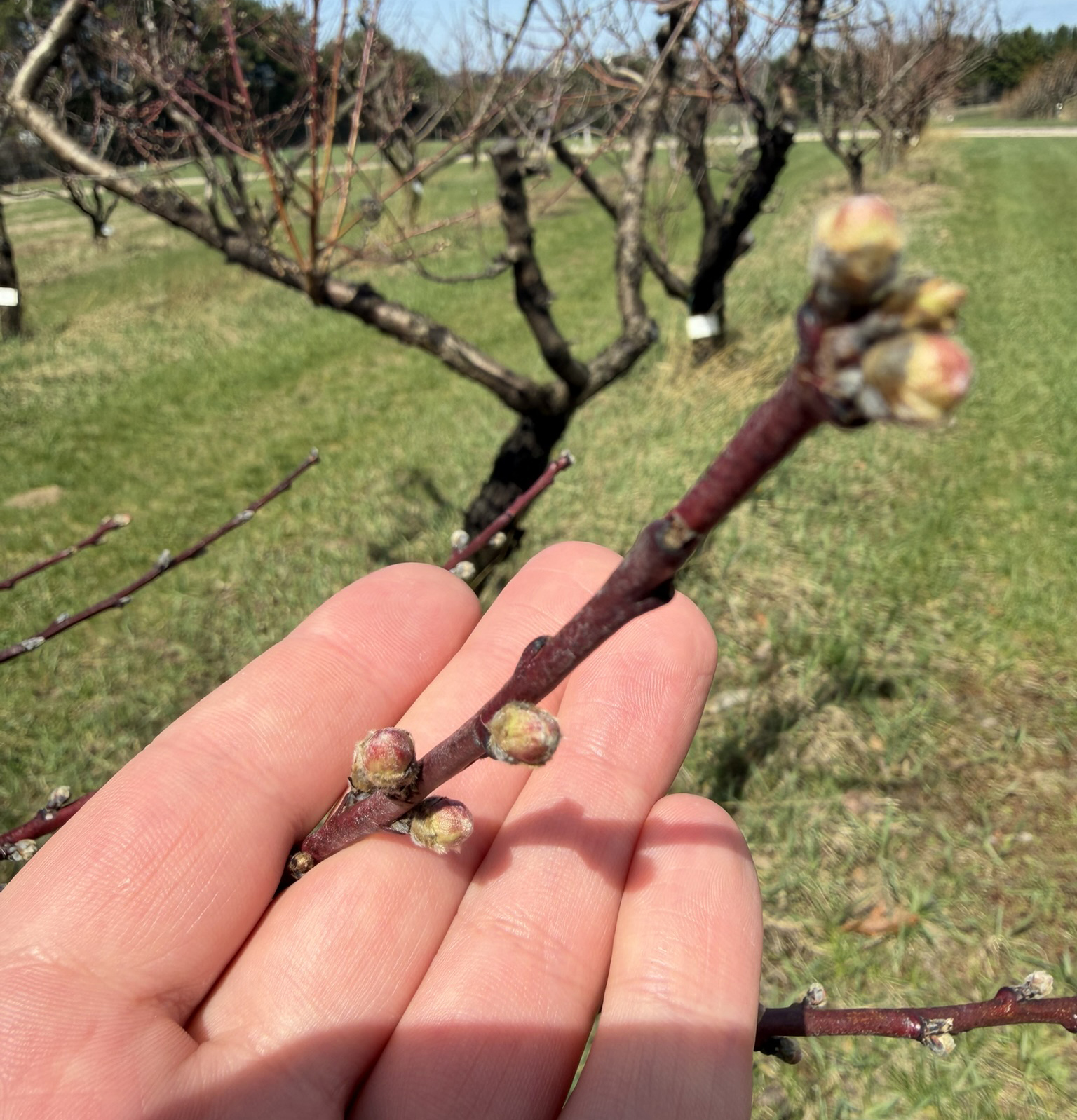
Plums are at tight cluster, while some Japanese varieties are in bloom in Berrien and Van Buren Counties. Significant losses are expected in Japanese varieties that were in bloom during Monday night’s freeze. European plums at tighter stages are likely to have experienced less damage.
In cherries, tart cherries and sweet cherries are at green tip in Berrien and Van Buren counties. Development has been relatively slow over the past week.
Copper sprays can be applied safely up to bloom, with rates adjusted to 25–35% of a dormant application. As always, pay attention to the specific formulation and metallic copper content. Copper applications may help suppress bacterial canker, particularly under cool, wet conditions.
In apples, most varieties are at 0.25- to 0.5-inch green, with early varieties reaching tight cluster over the weekend in central Berrien County. Some minor injury may have occurred in the most advanced blocks, but most apples remain at stages with relatively good cold tolerance.
Scab protection will be critical with upcoming rainfall as more green tissue emerges. Copper should be avoided beyond 0.5-inch green to reduce the risk of fruit russeting.
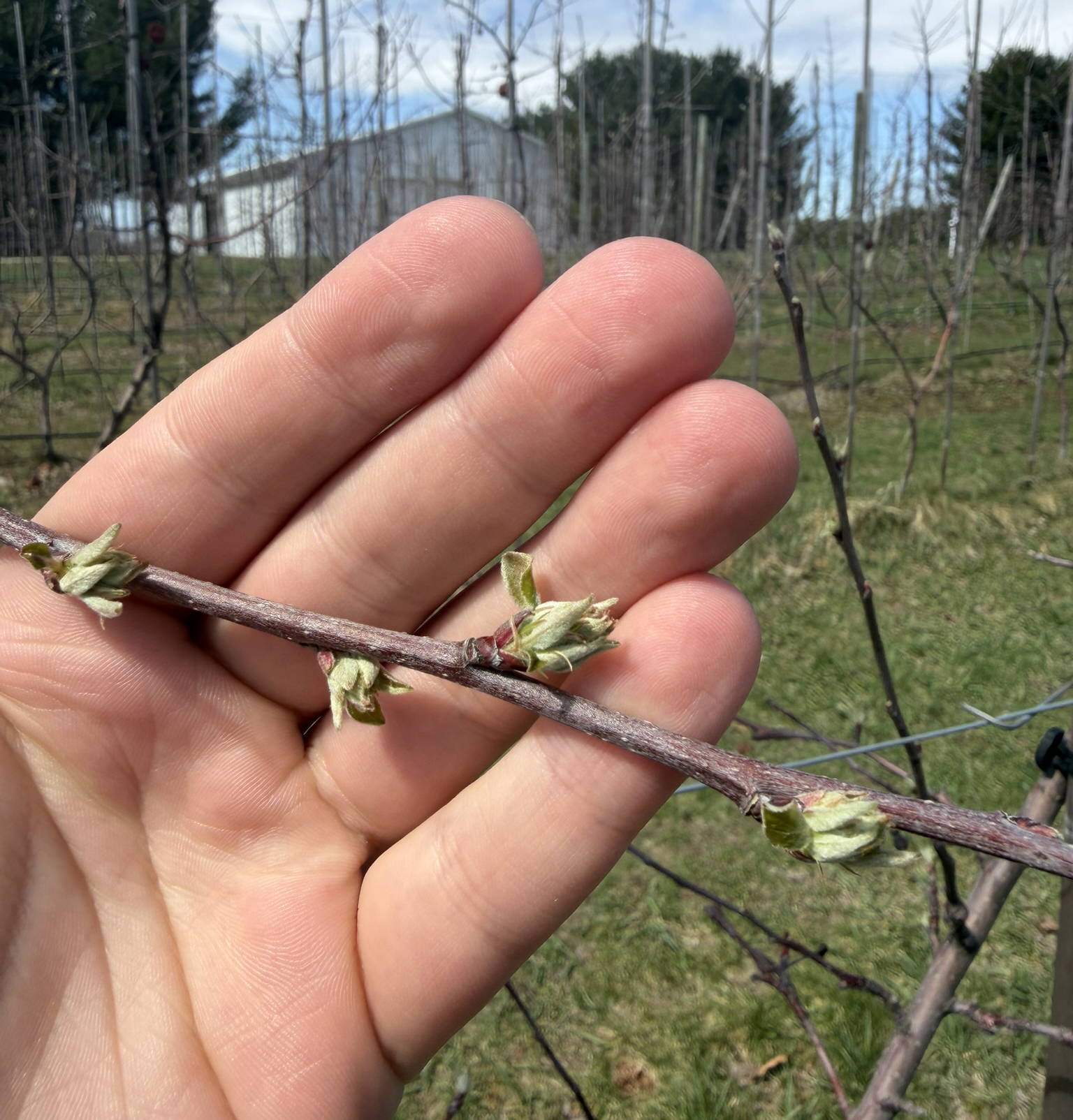
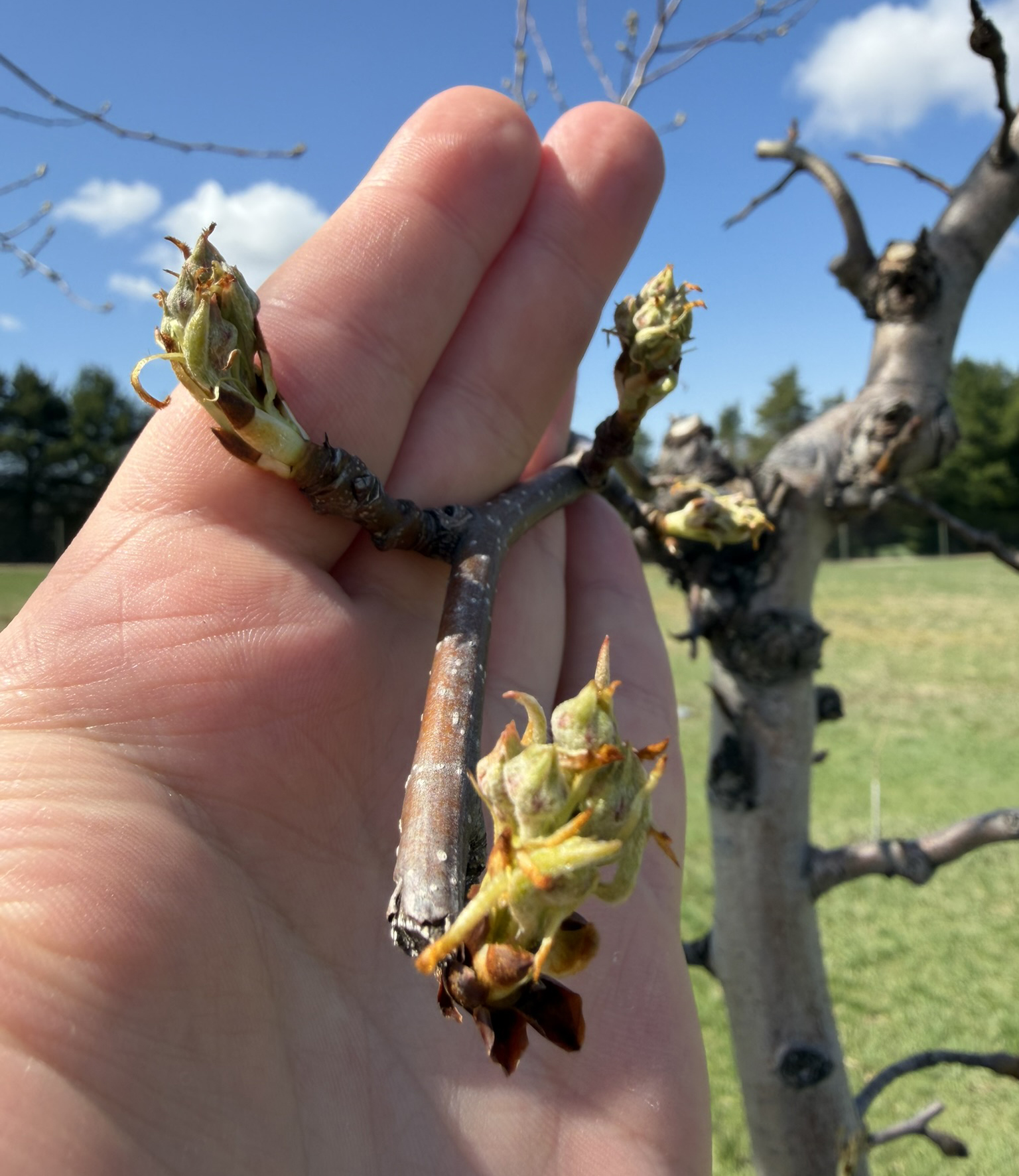
Pear buds are at tight cluster across much of the region. At this stage, buds have moderate cold hardiness, and overall damage from the recent freeze is expected to be limited compared to more advanced crops.
Some injury may still be present in the most advanced blocks or frost-prone areas. Damage can be difficult to detect at this stage and may not become fully apparent until bloom. Growers should begin checking buds over the next several days, particularly in low-lying sites, to assess potential impacts.
Small fruit
Grapes have started weeping in southern Berrien County. Marquette is just beginning bud swell. Organic and unconventional growers might want to start thinking about dormant sprays in the near future.
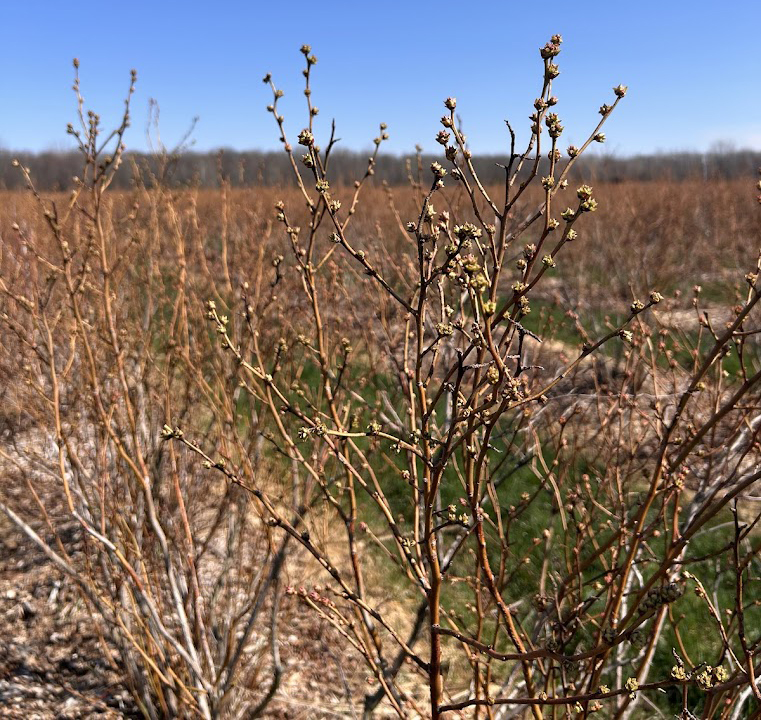
Blueberries are at the beginning of bud burst through southern Allegan County. Growers still have time to apply copper, Sulforix or lime sulfur products to suppress early season diseases. These dormant sprays aren’t supposed to be applied once leaves are out. Fields with a history of mummy berry infections need to be protected from early tight cluster until the end of bloom. Dormant sprays with lime sulfur can help protect against mummy berry shoot strikes.
Strawberry overwintering mulches should be removed and raked between the rows. Some growers are putting out floating row covers. Growers are looking at early season herbicides to control overwintering weeds. When selecting an herbicide, make sure and check the pre-harvest interval (PHI). New leaves are beginning to appear in the crown, growers should be thinking about
Many bramble growers are dormant pruning. In summer bearing raspberries, last year’s primocanes should be headed (cut back) to the desired height and any remaining floricanes from last year should be removed. Fall bearing raspberries should be cut or mowed to the ground. Lime sulfur treatments for anthracnose can still be applied.
Upcoming meetings
This year, we are hosting Tuesday Night Fruit IPM meetings. They take place in person at the Southwest Michigan Research and Extension Center in Benton Harbor and online via Zoom. The meetings cover phenology, insect and disease progression and selected topics from experts in Extension. These meetings cover small fruit for southwest Michigan and tree fruit for southwest and southeast Michigan. The meetings start at 5:30 p.m. and occur weekly until June 24. Sign up for the online option. Past meeting recordings are available online via MSU Mediaspace.
Join us at the Trevor Nichols Research and Extension center on April 14 for our blueberry pollination day! Click on the link to sign up and for more information.
This work is supported by the Crop Protection and Pest Management Program [grant no 2024-70006-43569] from the USDA National Institute of Food and Agriculture. Any opinions, findings, conclusions, or recommendations expressed in this publication are those of the author(s) and do not necessarily reflect the view of the U.S. Department of Agriculture.