Understanding the water use needs of Michigan growers
 Print
Print Email
EmailA statewide agricultural water use needs assessment provides insight into irrigation practices, water management challenges and the resources needed to make informed water-use decisions.
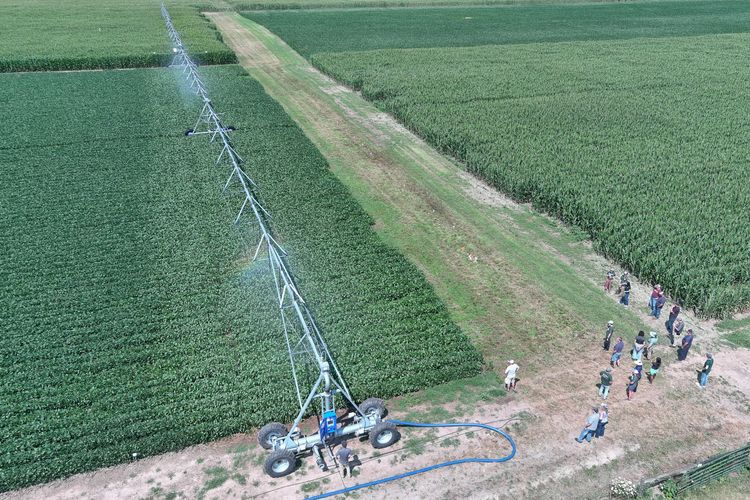
Water is one of Michigan agriculture’s most important resources. With access to nearly 20% of the world’s fresh surface water, Michigan has a unique water resource that supports communities, industries and agriculture. However, water availability and quality can vary across the state, and in some areas, demand can place additional pressure on available resources.
To better understand these needs, Michigan State University Extension conducted an agricultural water use needs assessment to learn how producers use and manage water, the challenges they face and the types of information and resources that could support their operations.
What did growers tell us?
The assessment received responses from 104 participants including producers, agricultural supply businesses, consultants and agency partners. Collectively, respondents represented approximately 103,074 irrigated acres across Michigan. Responses also included participants from other Great Lakes including Indiana, Ohio and Wisconsin.
Center pivots were the most commonly reported irrigation system, with many respondents managing between 101 and 500 irrigated acres. Other systems, including drip, big-gun and solid-set irrigation, were more common among smaller operations and specialty-crop producers. Technologies such as subsurface drip and micro-sprinklers were less commonly reported.
Growers are interested in improving irrigation management
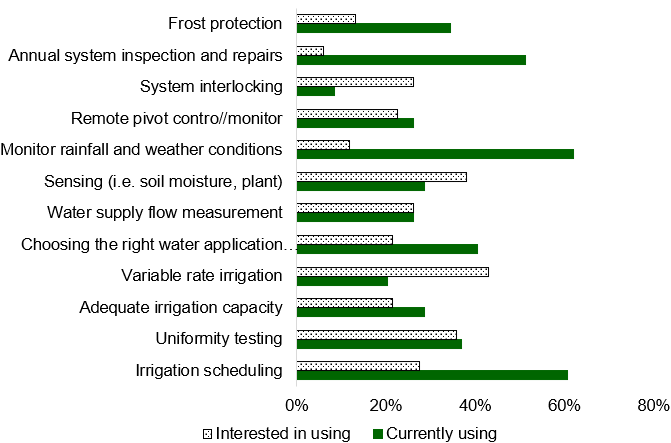
Traditional irrigation practices remain common. Many growers monitor rainfall and weather conditions, inspect their systems annually and manually schedule irrigation.
At the same time, growers showed interest in moving toward newer tools, including variable rate irrigation, sensing technologies, uniformity testing, and automated irrigation scheduling.
Growers are interested in technology, but they need practical information to determine whether it is worth the investment.
The cost of change matters
The assessment identified several barriers to modernizing irrigation practices. Among the most commonly identified challenges were high initial costs, limited technical knowledge for system repairs and maintenance, and uncertainty about the return on investment of new technologies and equipment.
This suggests that growers are interested in improving water management, but new practices and technologies need to make sense from both an agronomic and economic perspective.
For example, growers may be interested in soil moisture sensors or automated scheduling, but they also need practical information about installation, maintenance, expected water savings and whether the investment will provide a reasonable return.
What information do growers need?
The assessment showed a strong demand for practical, hands-on information that can be applied directly to farm management decisions.
Growers identified irrigation scheduling as an important educational need, particularly understanding when to irrigate and how much water to apply. There was also interest in irrigation system evaluations and uniformity testing to help identify opportunities to improve the performance of existing systems.
Table 1. Producers’ educational needs related to agricultural water use.
|
Educational need |
Examples |
|---|---|
|
Irrigation scheduling |
“When and how much to apply” |
|
Cost and profitability |
“Grant information to assist in cost to establish” |
|
Water use efficiency |
“Better efficiency” |
|
Trickle/Drip irrigation |
“Drip system design and pump selection” |
|
Irrigation system repair |
“Repairing systems” |
|
Water quality |
“Water quality assessments” |
|
Fertigation and chemigation |
“Run times with fertigation” |
|
Regulatory compliance |
“Water reporting” |
|
Remote monitoring and control |
“Use of new technology in monitors and controlling irrigation systems” |
|
Specialty crop irrigation |
“How to build irrigation in an apple orchard” |
|
Water supply |
“Supply” |
Information delivery also matters. Participants identified print resources and live meetings among their preferred ways to receive information about agricultural water use. More than half of respondents reported receiving water management information primarily from irrigation suppliers, MSU Extension and agribusiness suppliers.
The internet, in-person field days and trade shows were also important channels for finding information and making management decisions.
Table 2. Information channels used by producers to access irrigation-related information.
|
Information channels |
Total responses |
Percent of total respondents |
|---|---|---|
|
Commodity groups |
22 |
24% |
|
Industry conferences |
37 |
40% |
|
Internet (social media (e.g., Facebook, TikTok, X, YouTube, podcasts, etc.) |
46 |
50% |
|
Magazine and industry publications |
39 |
42% |
|
MSU Website (e.g., News articles, podcasts, publications, videos) |
35 |
38% |
|
In-person field days |
42 |
46% |
|
Trade shows (e.g. Open house, Agro Expo, etc.) |
40 |
43% |
|
Other |
5 |
5% |
|
Total respondents |
92 |
These findings reinforce the importance of providing information in multiple formats and meeting growers where they already look for information.
What’s next for agricultural water management?
The findings from this assessment can help guide future MSU Extension education, research, demonstrations, tools and outreach related to agricultural water use.
Michigan growers have access to an expanding range of irrigation technologies and management tools, from irrigation scheduling and soil moisture monitoring to variable rate irrigation and system evaluations. However, access to technology is only one part of the equation.
Future educational efforts can help bridge the gap between emerging irrigation technologies and farm-level economics. This includes developing practical tools to help growers evaluate the ROI of new technologies, maintain and upgrade existing irrigation systems, improve irrigation scheduling and evaluate system uniformity.
Learn more: Read the full Agricultural Water Use Needs Assessment Report from Michigan State University Extension.