West central Michigan tree fruit update – April 21, 2026
 Print
Print Email
EmailDrier conditions are a welcome change this week. Bud phenology is advancing steadily across tree fruit crops.
Weather update
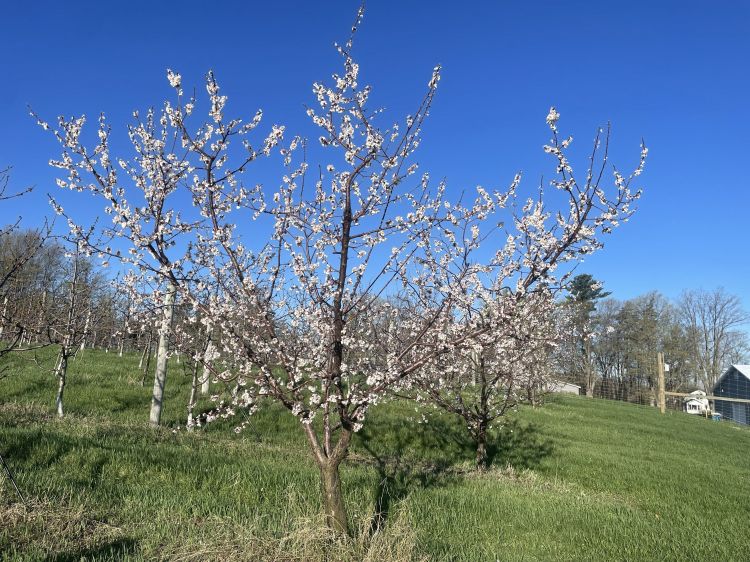
Cooler weather has kept bud development moving slowly, but new leaf growth is still emerging across west central Michigan (Figure 1). Based on the Hart Enviroweather station for April 21, current degree-day (DD) accumulation is 259 DD42 and 118 DD50. At the Sparta Enviroweather station, current DD accumulation is 331 DD42 and 170 DD50. Across the region, degree-day accumulation is above the five-year average for the Hart and Sparta Enviroweather stations, and we are estimated to be about a week head of normal.
This week started out cold with temperatures below freezing on Sunday night and into Monday morning, April 19-20, across west central and Grand Rapids, Michigan, regions. Warmer weather is forecasted for the rest of this week in the Hart area with highs in the 60s and 70s and lows in the 40s and 50s. For the Sparta area, highs will be in the 60s and 70s with lows in the 40s and 50s. There are slight chances of rain toward the end of the week across the region.
Listen to the weather update from Jeff Andresen, MSU climatologist, at the Fruit & Nuts Weather page from MSU Extension.
Weather data was gathered from MSU Enviroweather.
More information and reports on normal weather conditions and departures from normal can be found on the NOAA Climate Prediction Center website, NOAA U.S. Climate Normals website, NOAA Climate Normals Quick Access Page.
Crop update
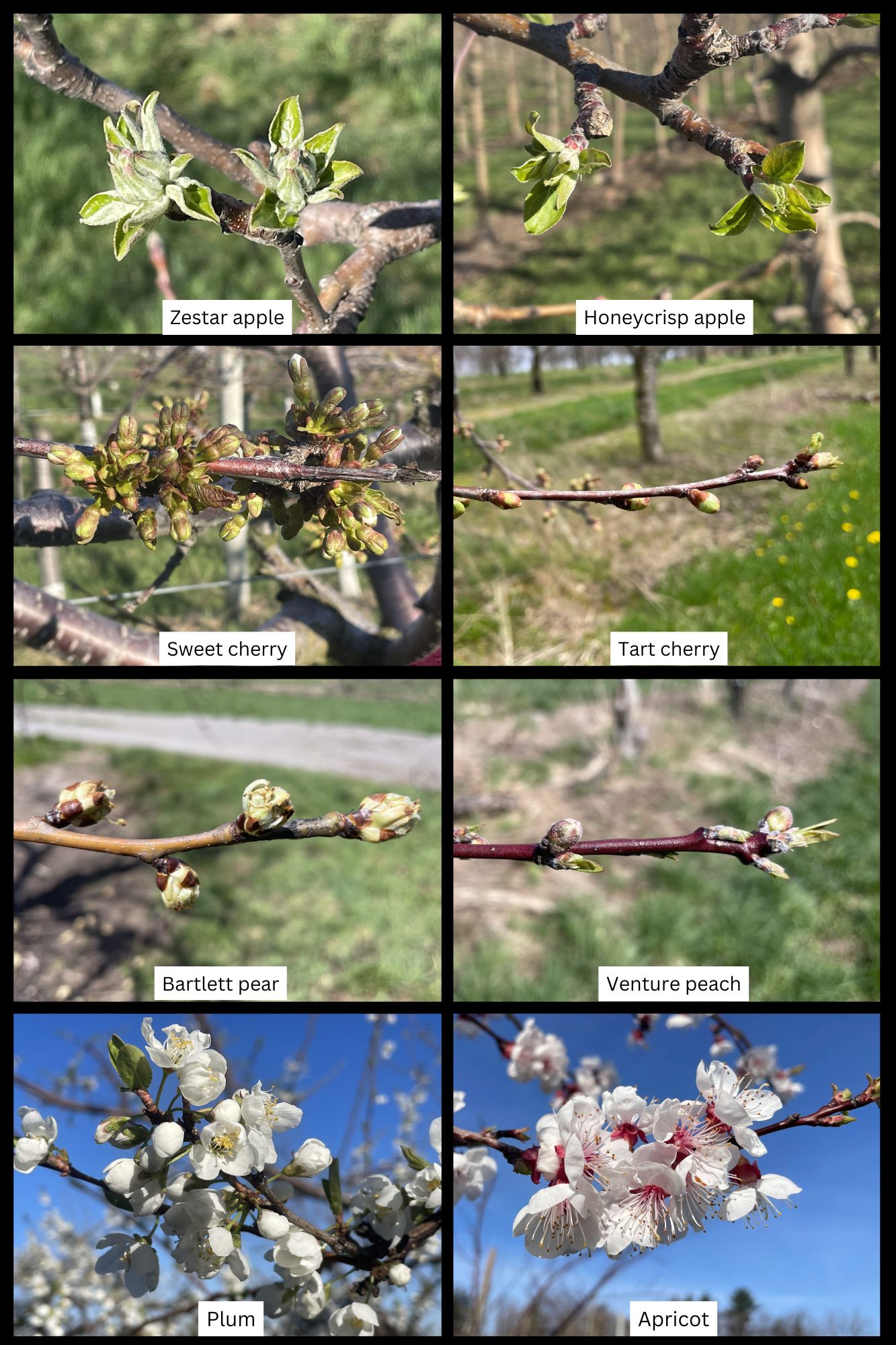
Apple varieties in Oceana County range from half-inch green to tight cluster. Early varieties such as Zestar and Idared are at tight cluster, and later varieties such as Gala and Honeycrisp are at half-inch green. As a reminder, half-inch green in apple is 205 DD42 for McIntosh based on over 30 years of observation from Sparta, Michigan. Other apple varieties will be ahead or behind McIntosh. Hart is at 259 DD42, and Sparta is at 331 DD42.
Growers in Michigan are currently assessing potential damage from cold temperatures on April 19-20. Damage will depend on the stage of development and the environmental variability across orchard blocks as well as frost protection methods used such as wind fans. If there is damage to apples, using products that contain the plant growth regulators gibberellic acid 4 and 7 (GA4+7) can be used to stimulate cell enlargement. Gibberellins can stimulate parthenocarpic fruit development, which is the natural or artificially induced production of fruit without fertilization of ovules. Partenocarpic fruit develop without the presence of seeds. Research with Michigan State University suggests Promalin or Perlin could be used up to four days after a frost or freeze event to increase fruit set. Find out more information about gibberellin use in apples in “Setting apples with plant growth regulators” from Michigan State University Extension.
Scout block by block to determine the damage in apples and other tree fruit crops. Damage can occur at a range of temperatures depending on stage of development. It’s important to look at the center of the flower to see if the pistil is damaged. Find information to evaluate frost or freeze damage and assess the impact of cold temperatures on early fruit development in “Assessing frost and freeze damage to flowers and buds of fruit trees” from Michigan State University Extension.
Tart and sweet cherry buds range from green tip to tight cluster. There is still time to apply delayed dormant applications of oil or copper sprays to manage bacterial canker and early pests such as mites or scale insects as needed. As the week continues, managing green fruitworm is also warranted. European brown rot (blossom blight) management may be needed, particularly under cool, wet conditions. Infection can begin in the popcorn stage before bloom. Treatment should include two applications, one at white bud and the other at full bloom. More information about European brown rot management can be found in “New-old options for European brown rot control in tart cherries” from Michigan State University Extension.
Peaches are showing signs of red calyx and first pink in some early varieties. Spot treatments for San Jose scale may needed in peach blocks with hot spots. Scout orchards to determine if treatment is needed.
Plum is at first white or first bloom in some European plum varieties. Stanley plums are behind phenologically and are at the swollen bud or bud burst stage.
Pear varieties are at swollen bud and at bud burst. Managing pear psylla and San Jose scale should be done at this time. Applications to manage pear scab can also be included this week to cover new green tissue before the next rain forecasted for this Friday, April 24.
Pest and disease update
Hart, Michigan
With variable temperatures and gradual bud development, emerging tissue in apple is at low risk for apple scab infection this week according to the RimPro model in Hart. For the last rain event on April 17-18, five spores per rod were counted.
We have had multiple long wetting events. As a reminder, lower temperatures require longer wetting periods for infection. With cool temperatures and low spore counts, infection risk has been low to date. However, with temperatures warming and more spores maturing to be ready for release, new tissue will need to be protected through fungicide coverage. Through the rest of the week, a slight risk of apple scab infection is expected, with rain in the forecast for the Hart area later in the week. I will continue to check the spore trap and monitor spore release as the season continues.
Sparta, Michigan
The following information was provided by Amy Irish-Brown, Valent U.S.A.
Apple scab spores are being monitored in a commercial McIntosh block located near the Sparta Enviroweather station. Apple scab infection risk is predicted to be low for the rest of the week, according to the Rimpro model in Sparta. For the extended rain event in Sparta that occurred from April 14-17, 650 spores per rod were counted.
Powdery mildew can also start to infect at tight cluster in apple. The powdery mildew fungus prefers humid but not wet conditions. With less rain this week, conditions for powdery mildew infection are present. Target blocks with high powdery mildew pressure from last season.
Similar to last week, the Trevor Nichols Research Center trapped a few adult green fruitworm this week. In Oceana County, three green fruitworm were trapped at one site.
For more information about regional reports, please visit the Michigan State University Extension website.
This work is supported by the Crop Protection and Pest Management Program [grant no 2024-70006-43569] from the USDA National Institute of Food and Agriculture. Any opinions, findings, conclusions, or recommendations expressed in this publication are those of the author(s) and do not necessarily reflect the view of the U.S. Department of Agriculture.