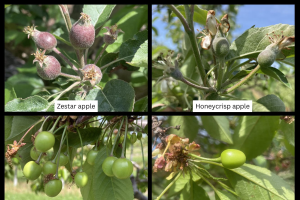
West central Michigan tree fruit update – April 7, 2026
 Print
Print Email
EmailWeather has been variable with a mix of cooler and warmer temperatures with more precipitation than normal. Changes in bud phenology have been slow. Dormant sprays have been applied to manage peach leaf curl and San Jose Scale before bud break.
Weather update
After a cold winter with consistent snow cover and average temperatures well below freezing, March was cool in Michigan’s west central and Grand Rapids regions, which led to a slow accumulation of growing degree days and a slow start to the spring. Temperatures have been fluctuating over the past few weeks in Hart, Michigan, with highs ranging from the 40s to 60s, even up to the low 70s in late March. Low temperatures were generally in the 30s and 40s with dips below freezing into the mid- to low 20s.
For the upcoming week in Hart, high temperatures will range from the 30s to low 60s, and low temperatures will range from low 20s to mid-40s. For Sparta, high temperatures will range from the 40s to low 70s, and low temperatures will range from well below freezing, down to 18 degrees Fahrenheit, and up to the high 50s. Rain is also expected this week across the regions.
With a few days of warmer temperatures coming over the weekend, rapid changes in bud development are expected. From March 1 to April 6, the Hart Enviroweather station is reporting growing degree days (GDD) of 114 GGD42 and 41 GDD50. The Sparta Enviroweather station is reporting 153 GDD42 and 70 GDD50.
Rain and snow have been observed over the past week. Since April 1, 3.34 inches of rain was reported in Hart and 2.06 inches at the Sparta-North Enviroweather station. Rain is forecasted for the end of this week on April 9.
With April showers and fluctuating spring temperatures, continue to monitor weather and soil conditions to best complete orchard tasks such as applying dormant sprays, pulling out old orchard blocks, finishing dormant pruning and planting new trees.
Weather data was gathered from MSU Enviroweather. You can find a full weather update from Jeff Andresen, MSU climatologist, at the Fruit & Nuts Weather page from MSU Extension.
More information and reports on normal weather conditions and departures from normal can be found on the NOAA Climate Prediction Center website, NOAA U.S. Climate Normals website, NOAA Climate Normals Quick Access Page.
Crop update
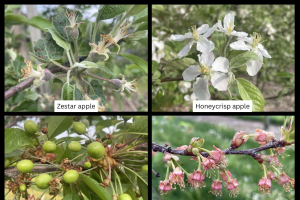
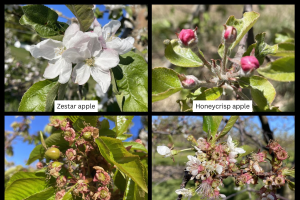
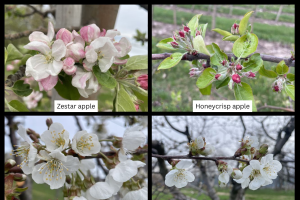
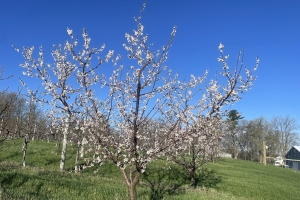
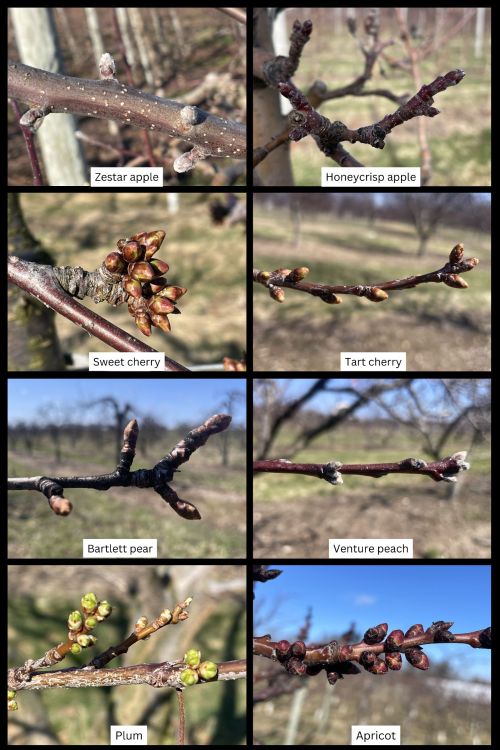
Changes in bud phenology have been slow so far this spring (Figure 1). Bud development is spread out more this year between the regions, similar to last year. Some apple varieties have buds at silver tip or are still tight in Oceana County and in some parts of Mason County. Phenology is more advanced in Kent County with green tissue showing in some locations.
Apple varieties in Oceana County range from dormant to silver tip. Early varieties such as Zestar and Idared will likely be at green tip by the end of this week. As a reminder, green tip in apple has historically been at 127 GDD base 42 F for McIntosh based on over 30 years of observation from Sparta, Michigan. Other apple varieties will be ahead or behind McIntosh.
Tart and sweet cherry buds are at bud swell with some side green in Hart. If you have not been able to get out in the field yet, there is still time to apply dormant or delayed dormant applications of oil or copper sprays to manage bacterial canker and early pests such as mites or scale.
Peaches are showing signs of swelling in Hart. If you have not already applied a spray for peach leaf curl, an application for final spring dormant sprays using copper products for managing peach leaf curl and bacterial canker is warranted in the next week.
Some plums are at bud swell and side white, and apricots are at the stage where tips separate. For plums, now is a great time to cut out black knot symptoms on branches and limbs. The black knot fungus infects new tissues in the green cluster stage of early bud development. Infection can continue until new shoot growth ceases in June. Cut out knots and remove 4–6 inches of wood below any visible signs of the knot. Fungicides sprays can be used starting at green cluster to protect tissue.
Pear varieties are at bud swell. Dormant applications of oil can still be applied to help suppress psylla populations. Scout for adults and eggs around bud scales this time of year to determine when early treatment is needed.
Pest and disease update
With cooler conditions, pest and disease activity is expected to be delayed in west central and Grand Rapids area orchards. Pear psylla eggs were observed in Bartlett pear at the West Central Michigan Research and Extension Center on April 7. San Jose scale was also observed this week on stone fruit and apple. Check out this article for early season reminders for application timings for dormant and delayed dormant fruit sprays.
I will be regularly monitoring common orchard pests and apple scab infections periods over the coming weeks in Oceana County. Apple scab spore trapping equipment will be put up in a commercial apple orchard in Oceana County this week. According to the Rimpro model, there is low risk of infection events for Sparta and Hart this week for apple scab due to cool temperatures and rains coming overnight.
The trapline at the Trevor Nichols Research Center in Fennville, Michigan, trapped an average of 4.3 adults of green fruitworm this week. Redbanded leafroller were trapped with 13 adults per trap.
Note that if you have not applied dormant sprays such as oil or copper, you should do so shortly. Oil sprays should not be used 48 hours before or after a frost event or if temperatures are very high (over 85 F) and humid. Additionally, avoid applying sulfur or Captan within several days of oil application as this will also cause phytotoxicity.
Pests to start thinking about include:
- Black stem borer
- Green fruitworm
- Pear psylla
- Redbanded leafroller
- Spotted tentiform leafminor
- Obliquebanded leafroller
- Climbing cutworms
- San Jose scale
For more information about regional reports, please visit the Michigan State University Extension website.
This work is supported by the Crop Protection and Pest Management Program [grant no 2024-70006-43569] from the USDA National Institute of Food and Agriculture. Any opinions, findings, conclusions, or recommendations expressed in this publication are those of the author(s) and do not necessarily reflect the view of the U.S. Department of Agriculture.