West central Michigan tree fruit update – June 5, 2026
 Print
Print Email
EmailFruitlets are rapidly growing with hot weather this week in the west central region.
Weather update
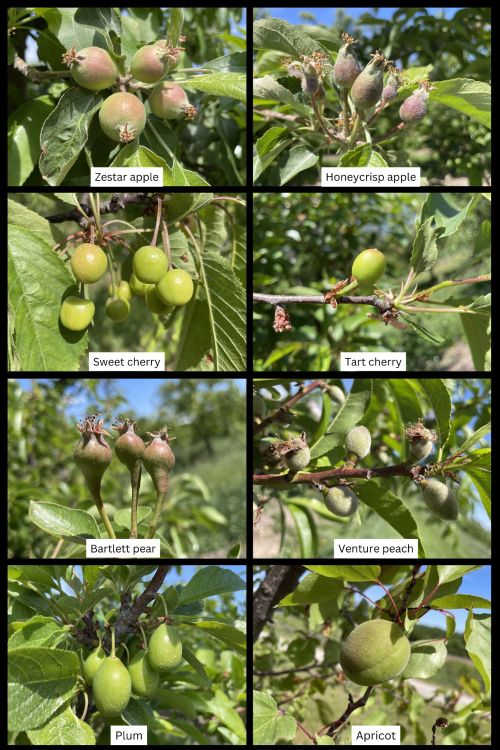
Conditions this week have been hot and dry in the west central and Grand Rapids regions. Hot weather has rapidly advanced phenology and fruitlet size for tree fruit crops such as cherry, peach and apple (Figure 1). Based on the Hart Enviroweather station for June 4, current degree-day (DD) accumulation is 846 DD42 and 451 DD50. At the Sparta Enviroweather station, current DD accumulation is 999 DD42 and 563 DD50.
As a storm moves across the region on June 5, high temperatures will be slightly cooler around 70 degrees Fahrenheit on Friday but will warm back up to the upper 70s and 80s over the weekend and into next week. Nighttime temperatures will be in the 50s and 60s. Rain is forecasted for Friday into Saturday, and up to 1 inch of precipitation is possible. Chances of rain are also in the forecast for Monday and Tuesday next week in Hart and Sparta.
Rain is needed across the state as soil conditions are very dry. For the Hart Enviroweather station, the maximum percent soil moisture at 4 inches deep is 1.8%, and at 20 inches below the soil surface, percent soil moisture is 2.8%. The sandy soils in the west central region have been dry throughout May with only a handful of rain events to enhance soil moisture.
Soil temperatures have been increasing, and average soil temperature at 2 inches deep is 77.1 F. Average soil temperature in Hart at 4 inches deep is slightly cooler at 62.1 F. Irrigation is needed, particularly in high-density plantings and for young and newly planted trees.
The NEWA apple irrigation model is a helpful guide to determine how much water is needed for your planting.
For the Sparta Enviroweather station, the maximum percent soil moisture at 0-12 inches deep is 46.1%. This is a higher % soil moisture than in Hart, but the soils with more clay will hold more tightly onto water as it moves through small pore spaces, which also makes it difficult for tree roots to access that water readily. Soil temperatures have also been increasing, and average soil temperature at 2 inches deep is 96.1 F and 85.8 F at 4 inches deep. These soil temperatures are very high for tree fruit and can lead to lower root function or death of fine roots that are responsible for water and nutrient uptake.
Listen to the weather update from Jeff Andresen, MSU climatologist, at the Fruit & Nuts Weather page from MSU Extension.
Weather data was gathered from MSU Enviroweather.
More information and reports on normal weather conditions and departures from normal can be found on the NOAA Climate Prediction Center website, NOAA U.S. Climate Normals website, NOAA Climate Normals Quick Access Page.
Crop update
With warmer weather over the past few days, tree phenology advanced quickly, and we can see fruitlets rapidly growing in some orchards.
Apple varieties in Oceana County range from fruit set to the 15 mm fruitlet growth stages depending on the location in the county. In Hart, average fruitlet size for Zestar on June 1 was 16 mm. Average fruitlet size for later varieties such as Gala was 12.3 mm, Honeycrisp is 12.5 mm, Jonagold was 14.1 mm, and Minneiska was 13.9 mm.
Scout block by block to assess early fruit set to determine potential crop load and thinning needs. Scouting is critical this year to best optimize crop load. There has been a lot of new vegetative growth with the warmer weather with extension shoots and new leaves. At this time, primary spur leaves and bourse shoot leaves are contributing to the sugars going to developing fruitlets. Extension shoots are actively growing, and they start contributing sugars to developing fruitlets about 25-30 days after bloom. This is also the time when apples start to become less sensitive to chemical thinners and the competition for carbohydrates between fruitlets is easing due to more leaves supplying carbohydrates.
Some varieties have lighter fruit set this season such as Empire, Golden Delicious, Fuji and Red Delicious. These varieties may not need thinning or may need some light chemical thinning or follow up hand thinning. Other varieties that have heavier set include Gala and Honeycrisp, although this also varies from block to block.
Over the next week or two, apple thinning sprays will need to be applied as fruit set can be evaluated, and efficacy of earlier thinning sprays can be evaluated. Based on measurements using the fruit growth rate model, fruitlet growth rates and sizes are beginning to differentiate in some varieties. With the hot weather conditions this week and next, fruitlets are expected to grow fairly rapidly, around 0.5 mm or more per day.
Temperatures this weekend and into next week will be in the 70s and up in the 80s, which will enhance thinner efficacy. Also, fruitlets are getting bigger so the thinning window will start to close shortly so the next seven days or so will provide a good opportunity for chemical thinning.
Information on the fruit growth rate model and the Malusim carbohydrate model can be found in this article from MSU Extension.
To access the apple carbohydrate thinning model, go to the apple tab in MSU Enviroweather and click where it says “Apple Carbohydrate Thinning.”
For Hart, the carbohydrate thinning model is predicting a carbon deficit (-26.8 g/day for the six-day average on June 6), so use caution if a thinner is applied or wait to apply a thinner until the carbon balance is higher. High daytime, warm nighttime temperatures and cloudy daytime conditions lead to high respiration rates, which burn carbohydrates and can lead to a carbohydrate deficit.
For Sparta, the carbohydrate thinning model is predicting a six-day weighted average of -28 g/day, but based on fruitlet growth stage, the model is predicting that there is low risk of overthinning. Be sure to check fruitlet size and include site specific information for green tip and bloom dates to use the model.
More information about general apple thinning recommendations and decision-making tools for apple can be found at: Honeycrisp crop management - Apples (msu.edu).
Apple scab pressure is continuing, and primary scab spores are still being trapped in low numbers. According to the Hart Rimpro model, leaf wetting periods have been short which has limited infection periods; however, some apple scab lesions are starting to show up on leaves in west central and Grand Rapids regions. The Rimpro model for Hart is predicting that spores will be released with the storm coming in on June 5, and there will be an infection period during June 5-7. This was also shown on the Enviroweather model for Hart and surrounding stations. Enviroweather is predicting that 100% of the spores are mature and 93% of them have been released.
Similar conditions are predicted for Sparta. The Rimpro model is showing an infection period June 5 -7, and Enviroweather is predicting that 100% of the spores are mature and 96% have been released at this time.
Fire blight is becoming less of a concern now that bloom is finished. Start scouting for fire blight symptoms from previous infection events on May 18-19 because symptoms will start to show. Cut out infected tissue as soon as possible because the fire blight pathogen can spread rapidly – as much as 5 cm per day in young shoots.
Tart and sweet cherry fruitlets are growing rapidly in Hart. Average fruitlet size is 15.2 mm for sweet cherries and 12.2 mm for tart cherries. There is risk for cherry leaf spot in tart cherries during the rain event on June 5-7. Tart cherries should also be protected against powdery mildew to protect new growth during extended dry periods. The powdery mildew fungus infects when weather conditions are warm, dry (not when leaves are wet) and high humidity.
Peaches are out of the shuck for some varieties. Average fruit size for Venture peach at the West Central Michigan Research and Extension Center in Hart is 12.5 mm. Rusty spot (powdery mildew) and bacterial spot management are needed in peaches, particularly if disease pressure was high in 2025.
For the MSU trapline, oriental fruit moth have been trapped this week at the West Central Michigan Research and Extension Center with one per trap. A biofix date has been set for Hart for May 11. Oriental fruit moth populations around the county are declining for this first generation.
Plum fruitlets are growing rapidly in west central Michigan. If needed, management for black knot is recommended. Average fruitlet size for Castleton plums is 19.6 mm.
Pear fruitlets are also growing, and average fruitlet size of Bartlett pear at the West Central Michigan Research and Extension Center is 12.3 mm. Similar to last week, applications to manage pear scab are needed to cover new green tissue similar to apple scab. Pear scab symptoms have been observed in the region. Pear psylla adults have been observed in the Bartlett pear block at the West Central Michigan Research and Extension Center.
Additional pest and disease information
No green fruitworm adults were trapped this week in Oceana County. Pest activity has been high with the warm weather. Ambrosia beetle adults and aphids were also observed on sticky traps and shoot terminals.
Other pests to scout for include oblique banded leafroller, American plum borer, rose chafer, green peach aphid, European red mites and white apple leafhopper.
American plum borer (1.5 per trap) and lesser peachtree borer (20 per trap) have now been trapped at the West Central Michigan Research and Extension Center in Hart. Trunk bores can be difficult to manage, especially once bores and larvae are inside the trunk. Without the use of chlorpyrifos, there are other insecticide options that should be considered to manage borer populations. Find out more information on alternative management options.
For more information about regional reports, please visit the Michigan State University Extension website.
This work is supported by the Crop Protection and Pest Management Program (grant no 2024-70006-43569) from the USDA National Institute of Food and Agriculture. Any opinions, findings, conclusions, or recommendations expressed in this publication are those of the author(s) and do not necessarily reflect the view of the U.S. Department of Agriculture.