Impacts of Autonomous Mowing on Dollar Spot on Creeping Bentgrass Fairway Turf
June 18, 2026 - Dr. Ruying Wang
 Print
Print Email
EmailImpacts of Autonomous Mowing on Dollar Spot on Creeping Bentgrass Fairway Turf
Dr. Ruying Wang, Nancy Dykema
PSM Department, MSU
How the MTF funding will be used to support project:
The MTF funds will be used for technical and undergraduate support for setting up and running the research trial, including sample collection and isolation, setting up and maintaining the Kress autonomous mower, making treatment applications based on the timing set forth in the trial, maintaining the study site, rating the study, data analysis, and report-writing, among other tasks.
Expected Results and Methods:
Dollar spot is the most economically damaging disease of cool-season turfgrasses, particularly on creeping bentgrass (Agrostis stolonifera). Treating large areas of fairways with fungicides is very costly. Research conducted at Michigan State University has shown that irrigation applied at night can significantly reduce dollar spot compared to that applied in the morning. The mechanism for this phenomenon has been hypothesized but is not fully understood. However, other management practices, such as mowing implemented at night, have not been evaluated for dollar spot management. Nighttime mowing may impact leaf moisture or guttation formation, potential contributing factors in disease suppression, thereby reducing fungal activity. Autonomous mower technology presents a unique opportunity to overcome challenges on golf courses, such as labor shortages and environmental concerns, and to minimize disruption of play. The study aims to evaluate mowing strategies and implement integrated disease management utilizing an autonomous mower, fungicide programming, and resistant creeping bentgrass cultivars to manage dollar spot pathogen populations that are insensitive to some classes of fungicides.
Objective 1: Identify best management practices for mowing frequency, timing, and fungicide application strategy on dollar spot severity and turfgrass quality.
Objective 2: Evaluate creeping bentgrass cultivar resistance and fungicide application strategy under daily autonomous mowing.
Methods:
Objective 1:
A study with four replications will be established at the Hancock Turfgrass Research Center (HTRC), East Lansing, MI, using the following parameters:
|
Main: Timing |
Sub: Frequency |
Sub-sub: Fungicide |
|
2:00 AM (early morning) |
Twice per week |
14-day calendar schedule |
|
7:00 PM (dusk) |
Daily |
Threshold-based |
|
12:00 PM (midday) |
Smith-Kerns model |
|
|
No fungicide |
Plots will measure 36 × 36 ft for main plots, 9 × 12 ft for sub-plots, and 2 × 6 ft for sub-sub-plots. A Kress KR237 autonomous mower (donated) will be used to mow plots at 0.5 inches at the timings listed above. Fluazinam (0.5 fl oz/1000 sq ft) will be applied using a CO₂-pressurized boom sprayer with flat fan or air-induction nozzles calibrated to deliver 2.2 gal of water per 1000 ft² at the timings listed above.
Objective 2:
A split-plot randomized complete block design study with four replications will be established at the HRTC. The main plot factor will consist of three creeping bentgrass cultivars: ‘L-93’, ‘Declaration’, ‘Flagstick’ (resistant), representing varying degrees of susceptibility. Sub-plots will include four fungicide management strategies: a 14-day calendar-based application schedule, a threshold-based approach (>5 infection centers per plot), the Smith–Kerns predictive model (Smith et al., 2018), and a non-treated control. Main plots will measure 9 × 12 ft, with fungicide treatment plots of 2 × 6 ft. All plots will be mowed daily at 0.5 inches using a Kress KR237 autonomous mower.
Field maintenance, data collection, and statistical analysis
A moderate nitrogen fertility program (1.5–2.0 lbs N per 1000 ft² per year distributed in monthly applications) will be used to maintain turf quality while ensuring adequate disease pressure. Irrigation, weed management, and insect control will be applied uniformly across all treatments as needed.
Data collection and statistical analysis
- Dollar spot incidence and severity (weekly ratings, digital image analysis)
- Turf quality (visual ratings on a 1–9 scale)
- Fungicide inputs (number and cost of applications)
- Canopy reflectance (NDVI), surface temperature, and soil moisture will be monitored to assess microclimatic influences on disease development.
- Treatment effects and interactions (timing × frequency × fungicide program; cultivar × fungicide program) will be subjected to analysis of variance using a mixed model.
Project Update:
This is a new project initiated in the late fall of 2025, and updates will be provided once initial data collection has begun.
Grad Student(s) Involved. None
Benefit Group: Golf course superintendents and other golf turf managers.
Pictures included:

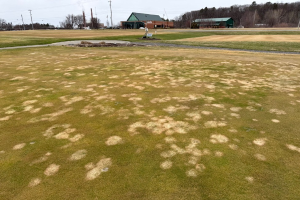
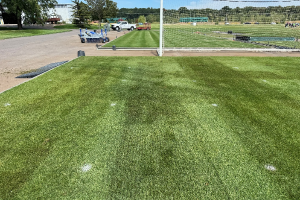
- Photo showing dollar spot in a creeping bentgrass fairway.

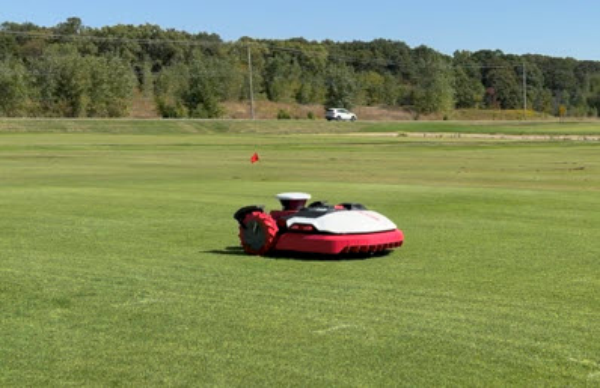
https://gopropower.com/product/kress-robotik-kr237-mower/
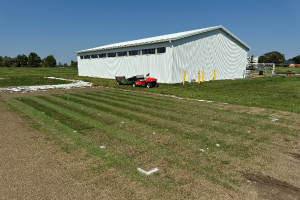
- Kress KR237 autonomous mower at work.

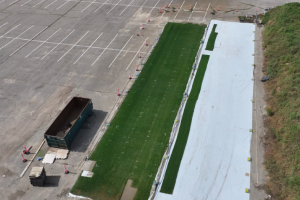
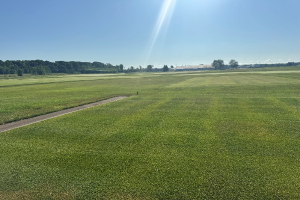
- Dew removal and mowing patterns in response to autonomous mowing treatments.
Estimated project duration: two seasons; funding requested for year 1.