Managing Spotted Wing Drosophila in Michigan Cherry
DOWNLOADJune 25, 2026 - Heather Leach, Jackie Perkins, Blake Dawson, and Julianna Wilson, Department of Entomology, Michigan State University; Nikki Rothwell, MSU Northwest Michigan Horticultural Research Center
 Print
Print Email
EmailSpotted wing drosophila (SWD) (Drosophila suzukii) is an invasive species that was first detected in Michigan in 2010. It is now a key pest of ripening cherries and berries. This factsheet describes current best practices to monitor for this pest and prevent fruit infestation in cherry orchards.
Key Message
- Protect ripening fruit through harvest using effective insecticides with tight spray intervals and thorough coverage.
- Adjust programs in high-risk conditions (rainy periods, high UV) to maintain efficacy.
- Monitor fruit directly for larvae as harvest approaches.
- If possible, avoid harvest delays - overripe fruit in orchards are highly susceptible to infestation.
Monitoring
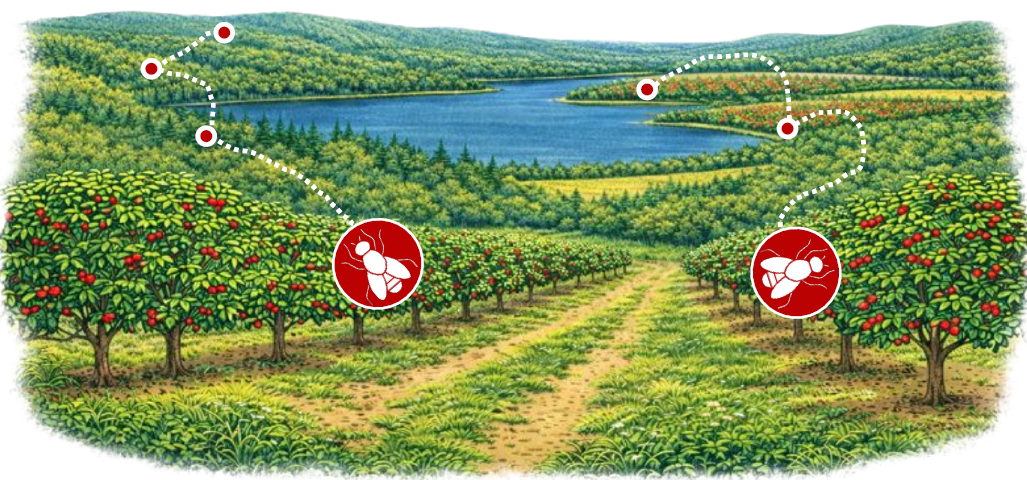
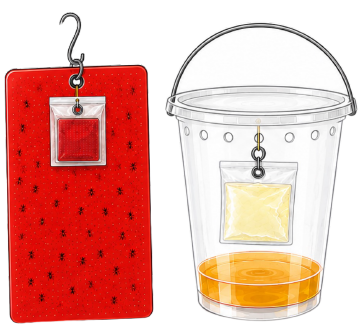
Adult flies are present in surrounding habitats and can quickly build populations in orchards as fruit ripen (Figure 1). Baited traps are useful for detecting SWD and tracking population trends but should not be used to time management actions because trap captures can be highly variable. Both cup or red sticky traps will catch SWD when combined with a bait (Figure 2). Red sticky cards and lures can be purchased. Cup traps (i.e., clear plastic cups with entry holes) can be homemade or purchased. Cups can be baited by combining a couple inches of apple cider vinegar and a drop of unscented dish soap. Improve cup trap selectivity by adding a commercial lure. Hang traps in the shaded tree canopy, especially in areas with past problems. Check traps at least weekly. Accurate identification requires training.[1]
Sampling fruit for larvae using a filter test provides a more direct measure of whether fruit are being infested compared with traps; however, no control options are available to kill larvae after fruit are infested. Growers should rely on fruit susceptibility (ripeness) to initiate management programs (see page 2). An instructional video for the larval testing is available online.[2]
Once cherries become susceptible to infestation, management should focus on preventing larvae in fruit regardless of adult fly trap catch.
When to Begin Protecting Fruit
Risk of SWD infestation depends on two main factors: fruit susceptibility (ripeness) and the seasonal growth of SWD populations. Fruit susceptibility can be estimated using a growing degree day (GDD) model that predicts fruit development and ripening based on the timing of crop bloom. [3][4] Growers are encouraged to use this tool, along with field observations, to determine when fruit become vulnerable to SWD attack.
Infestation Risk by Fruit Ripeness
Cherries are susceptible to SWD infestation as soon as they begin to soften and color. Infestation risk increases as the local SWD population builds and fruit ripens.
Infestation Risk by Variety and Region
LOWER RISK: Processing sweet cherries and crops in the southern Michigan have an earlier harvest window and, in most seasons, the fruit can be harvested before SWD are problematic.
HIGHER RISK: Tart cherries and fresh market sweet cherries, especially those harvested later in the season are at highest risk for SWD infestation.
Ongoing Research
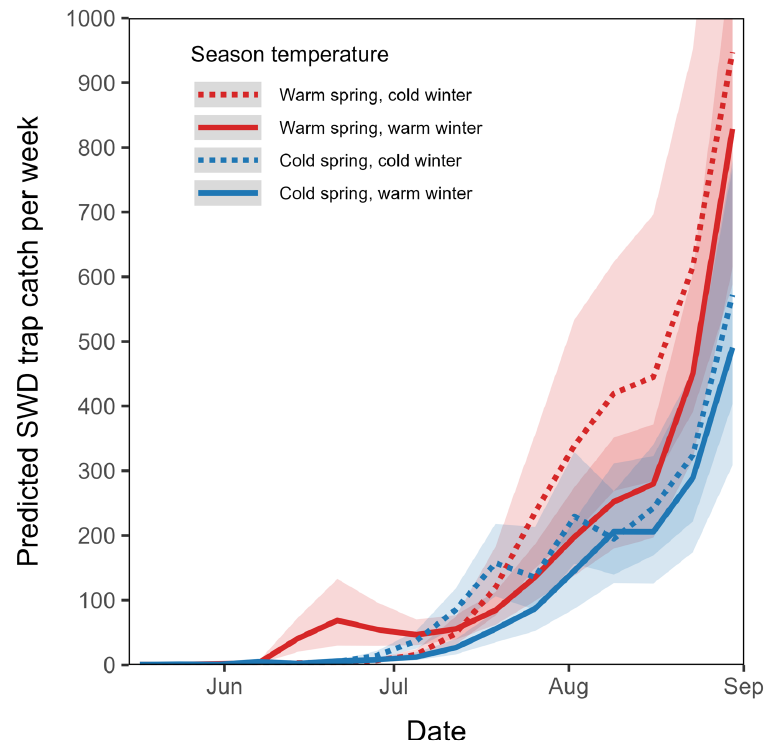
In addition to the crop phenology model described above, we are actively developing predictive models to help growers anticipate annual SWD pressure based on temperature and other environmental variables. [5] Preliminary simulations using historical Michigan trapping data suggest that warm springs, particularly when combined with mild winters, result in earlier SWD activity and faster population growth. Under warm spring/warm winter conditions, sustained captures occurred 1–3 weeks earlier than in other seasonal scenarios, and populations increased from 1 to 10 SWD per trap per week in as little as 2 weeks. These models may eventually help growers anticipate periods of higher or lower SWD pressure and adjust management programs accordingly. However, regardless of predicted pressure, susceptible fruit should be protected once they begin to ripen.
Other active research exploring new approaches to managing or suppressing SWD populations includes biological control, the use of modified or sterilized males to disrupt reproduction, and attract-and-kill strategies. While these approaches are not yet ready to recommend in commercial production, MSU continues to explore other areas of research that may provide additional options for SWD management in the future.
Biological Control
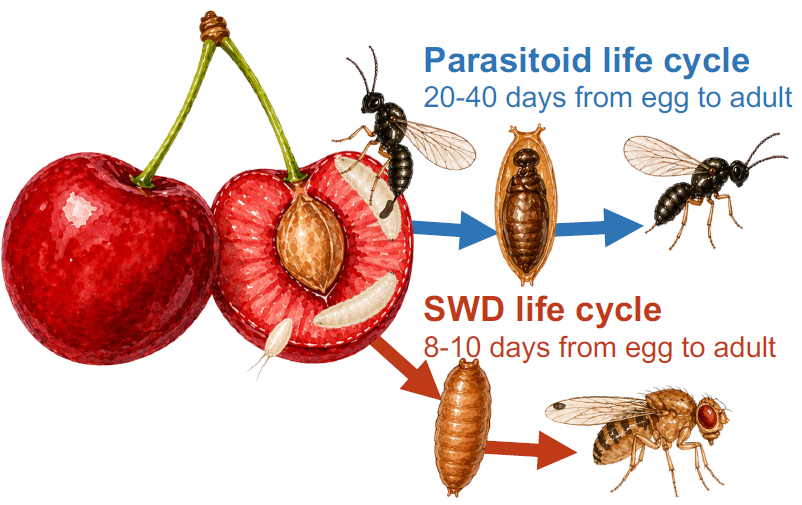
Two parasitoid wasps that attack SWD larvae are now established in Michigan: the ronin wasp (Leptopilina japonica) and the samba wasp (Ganaspis brasiliensis). Both species lay eggs inside SWD larvae feeding within fruit, killing the pest before it completes development (Figure 3). Sampling from 2023–2025 indicates that the ronin wasp is far more widespread in Michigan and, to date, is the only SWD parasitoid detected near cherry orchards (Jones et al. unpublished). As of 2025, the ronin wasp was recovered from fruit or traps at all 14 cherry sites monitored in west and northwest Michigan.
Although these parasitoids do attack and kill SWD, their impact on SWD populations in Michigan fruit production systems remains unclear. Current observations suggest that parasitoid activity occurs primarily later in the season, after cherry harvest in non-crop habitats. Additionally, because these parasitoids require SWD larvae to be present within fruit, infestation has already occurred before parasitism can take place. To help conserve parasitoid populations, avoid unnecessary insecticide applications to wooded edges and adjacent non-crop habitats where they may occur.
Biological control should be viewed as a long-term suppression tool that complements - rather than replaces - chemical protection of susceptible fruit. Other biological control approaches, including entomopathogenic nematodes (EPNs) and generalist predators, are also being studied for SWD management, but to date have shown limited effectiveness in protecting marketable fruit in commercial cherry systems.
Best Practices for Managing SWD in Cherry Orchards
Avoid spray drift into wooded edges. These are reservoirs for beneficial parasitoids and a source of gene flow in SWD populations, reducing the risk of insecticide resistance.
Consider removing early alternative hosts. Wild fruits like honeysuckle that ripen prior to cherries may harbor high populations of SWD.
Maintain excellent spray coverage. Spray every row and ensure applications are above 30 gal/ac. Slow down and keep spray intervals tight based on product residual (see next page). Alternate modes of action to reduce risk of resistance.
Promote better airflow in the orchard. Prune trees to open canopy for reduced relative humidity and for better spray coverage; mowing orchard floors also helps reduce relative humidity.
Insecticide Selection and Resistance Management
Based on our experience in Michigan, SWD control will likely require a minimum 7-day spray interval, with shorter intervals following rain and/or high UV and temperature conditions and dependent on production selection.
SWD reproduces in 8-10 days, increasing the risk of insecticide resistance when insecticides are overused. To date, insecticide resistance has not been detected in Michigan, but it remains a serious concern. To reduce resistance risk, growers should avoid consecutive applications of products within the same IRAC group (see last page) and apply materials only when fruit are susceptible to infestation.
Maintaining thorough spray coverage, shortening spray intervals during high pressure or wet/sunny conditions, and integrating non-chemical practices such as timely harvest, pruning, and mowing are essential components of effective and sustainable SWD management. For adequate coverage, use sufficient spray volume, slow down while spraying, and be sure to operate with a properly calibrated sprayer. Using the highest labeled rate of a product can also help reduce the risk of resistance. Note that certain buyers or export markets may have stricter residue tolerances (MRLs) than those set by the United States EPA. Always verify current market requirements and pesticide labels before application.
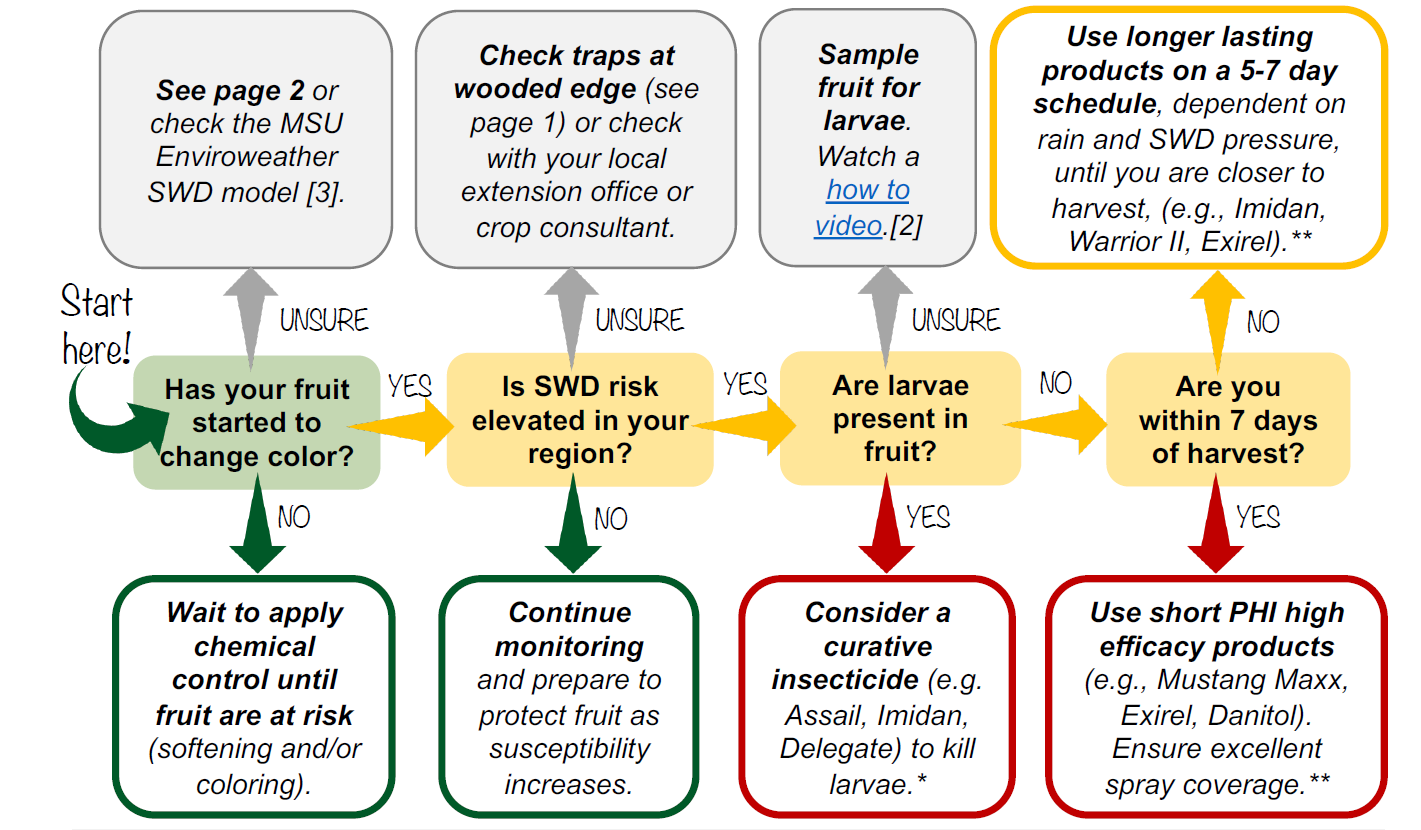
SWD Management Decision Tree
Notes
*Curative products only work when applied within a few days of infestation. However, growers should not rely on curative activity to achieve clean fruit at harvest. Applications to prevent further infestation are likely necessary.
**Reapplication interval depends on product, pest pressure, coverage, crop load, rainfall and UV stability.
Table 1. Insecticides registered for use in Michigan cherries and their expected efficacy against SWD, sorted by efficacy (excellent to good) and the Insecticide Resistance Action Committee (IRAC) codes for each product represented by a different color and shape for each IRAC group. [7] See also the Michigan Fruit Management Guide E-154 for more information.[6]
| Efficacy on SWD | IRAC Code | Product | Active Ingredient | PHI (days) | Rate per acre | REI (hrs) | Retreat Interval (days) | Max per season (product/ac) | Residual activity | Special notes |
|---|---|---|---|---|---|---|---|---|---|---|
| Excellent | 3 | Mustang Maxx EC | zeta- cypermethrin | 3 | 4 fl oz | 12 | 7 |
24 fl oz or 6 apps |
3-5 days | Toxicity decreases in hot (>90º F) weather |
| Excellent | 3 |
Danitol 2.4 EC |
fenpropathrin | 3 | 10.6 - 21.3 fl oz |
24 | 10 |
42.6 fl oz |
5 days | Minimum of 100 GPA. Toxicity decreases in hot (>90º F) weather. |
| Excellent | 3 | Warrior II 2CS | lambda- cyhalothrin | 14 |
1.28-2.56 fl oz |
24 | 5 |
10.24 fl oz |
~5 days | Toxicity decreases in hot (>90º F) weather. |
| Excellent | 3 | Asana XL | esfenvalerate | 14 |
4.8-14.5 fl oz |
12 | 7 |
72 fl oz |
~5 days | Toxicity decreases in hot (>90º F) weather. |
| Excellent | 28 | Exirel 10SE | cyantraniliprole |
3 |
13.5–20.5 fl oz |
12 | 7 |
61.5 fl oz |
5-7 days | |
| Excellent | 28 | Verdepryn 100SL |
cyclaniliprole |
7 | 11 fl oz | 4 | 7 |
33 fl oz |
5-7 days | |
| Excellent | 5 | Entrust SC |
spinosad |
7 | 4-8 fl oz | 4 | 7 |
29 fl oz |
3-5 days | OMRI approved. No more than 3 consecutive apps of IRAC 5 products. |
| Excellent | 1B | Imidan 70W |
phosmet |
7 |
2.125 lbs |
72 | NA |
7.5 lbs |
7 days | Not labeled for use in sweet cherry due to phytotoxicity concerns. |
| Excellent | 21A | Apta 15SC |
tolfenpyrad |
14 |
21–27 fl oz |
12 | 10 |
53.5 fl oz or 2 apps |
3-5 days | Minimum 50 GPA, no alternate row middle (ARM). |
| Good | 3 | Baythroid XL |
beta-cyfluthrin |
7 |
2.4–2.8 oz |
12 | 14 |
5.6 fl oz |
5-7 days | Minimum of 50 GPA. Toxicity decreases in hot (>90º F) weather. |
| Good | 5 | Delegate WG |
spinetoram |
7 |
4.5–7 oz |
4 | 7 |
28 oz or 4 apps |
3-5 days | No more than 3 consecutive apps of IRAC 5 products. |
| Good | 23 | Movento |
spirotetramat |
7 |
6–9 fl oz |
24 | 14 |
15.3 fl oz |
systemic | Must use penetrating adjuvant. |
| Good | Bio | Grandevo | Chromo- bacterium subtsugae |
0 | 2-3 lb | 4 | 7 |
no max |
3-5 days | OMRI approved. |
| Good | 15 | Rimon 0.83EC | novaluron | 8 |
20–40 fl oz |
12 | 7 |
150 fl oz |
minimal (eggs) | While not highly toxic to adults, exposure can result in nonviable eggs. Label requires 100 GPA, no ARM. |
| Good (limited date) | 30 | Zivalgo | isocycloseram | 14 |
1.1-1.6 fl oz |
12 | 7 | 5 fl oz or 2 apps | unknown | New product available for Michigan in 2026. |
| Fair (curative only) | 4A | Assail 30SG | acetamiprid | 7 |
2.3-3.4 oz |
12 | 10 |
13.6 or 4 apps | 5-7 days | Can kill young larvae, but dead larvae will remain within fruit. |
Examples of Insecticide Rotation Programs for SWD Resistance Management
These are examples of IRAC rotation principles and are not intended as recommended spray programs.
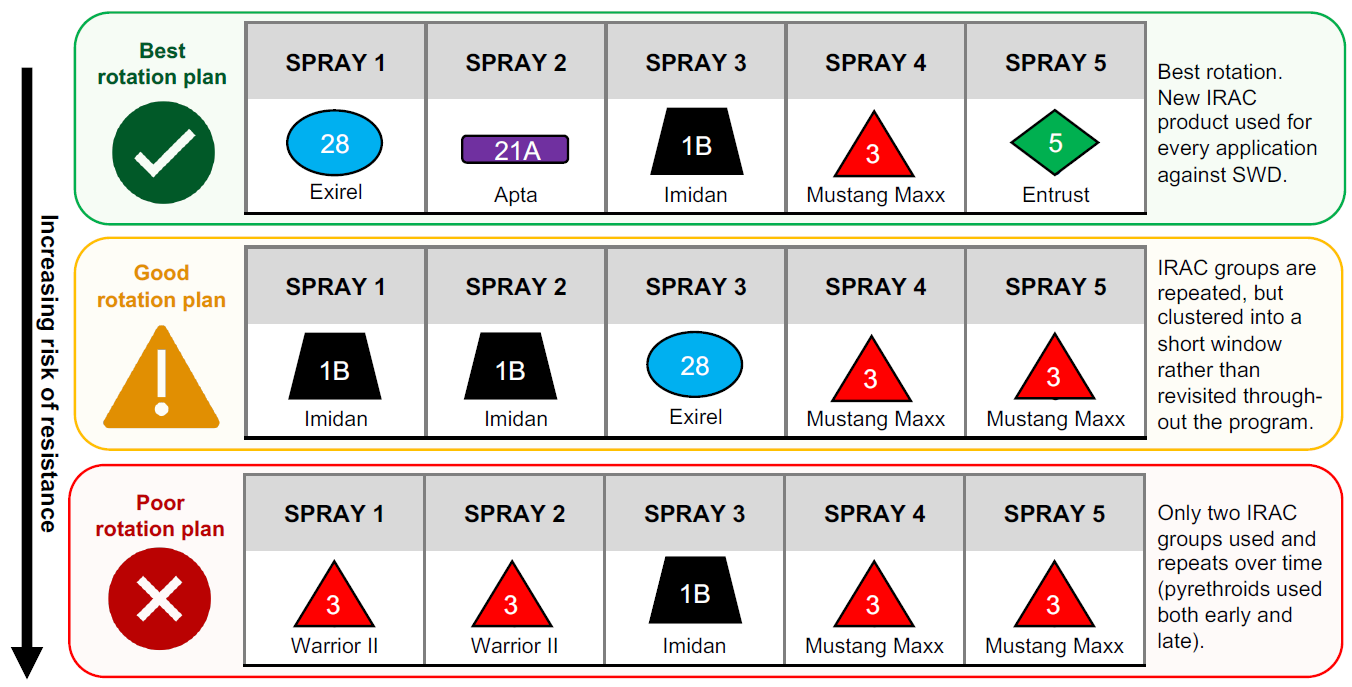
Note: Follow all product labels. Products in each spray timing are examples only. Repeated use of some products may be unavoidable due to efficacy, PHI, and cost constraints. When repeated use is unavoidable, limit repeated IRAC groups to short windows and avoid returning to the same group repeatedly throughout the season. Because SWD generations overlap, maximizing IRAC diversity remains the preferred strategy. Consider PHI, efficacy, and other management practices in addition to rotation when selecting insecticides. Keep in mind that other insect pests may be present in the orchard and can influence product selection and overall resistance management considerations.
References
- [1] Wilson, J., L. Gut, R. Isaacs, and S. Van Timmeren. Spotted Wing Drosophila Biology and Identification. MSU Extension https://www.canr.msu.edu/ipm/uploads/files/SWD%20Biology%20and%20Identification%20-%20June%202020.pdf [last accessed May 30, 2026]
- [2] Perkins, J. Larval sampling of cherries to determine SWD infestation. MSU Department of Entomology https://mediaspace.msu.edu/media/Larval+sampling+of+cherries+to+determine+SWD+infestation/1_ktedrmrj/8093291 [video last accessed May 6, 2026]
- [3] Spotted Wing Drosophila Model for Tart Cherries, MSU Enviroweather https://enviroweather.msu.edu/crops/cherry/spottedwingdrosophila [last accessed May 6, 2026]
- [4] Wilson, K., L.J. Gut, K. Powers, J. Huang, and N. Rothwell (2022) Predicting the risk of tart cherry (Prunus cerasus) infestation by Drosophila suzukii (Diptera: Drosophilidae). Journal of Economic Entomology, 115: 1024-1028 https://doi.org/10.1093/jee/toac024
- [5] Dawson, M., J.K. Wilson, S. Van Timmeren, H. Leach, M.J. Evans, and R. Isaacs (2026) Predicting pest phenology: a temperature- based model for timing of Drosophila suzukii (Diptera: Drosophilidae) population dynamics. Agriculture, Ecosystems, and Environment. https://doi.org/10.1016/j.agee.2026.110555
- [6] Perkins, J., J. Wilson, M. Milbrath, D. Mota-Sanchez, M. Quintanilla, R. Isaacs, C. Lindell, K. Mason, T.D. Miles, G.W. Sundin, B. Zandstra, Beaudry, T. Einhorn, and J. Vanderweide. 2026 Michigan Fruit Management Guide. MSU Extension Bulletin E-0154, 335 pages; October 2025.
- [7] Insecticide Resistance Action Committee webpage, https://irac-online.org/ [last accessed May 6, 2026]