Roller Crimping to Terminate Cereal Rye Cover Crop in Michigan
DOWNLOADJanuary 16, 2026 - Madelyn Celovsky and Korede Olugbenle, Michigan State University Extension
 Print
Print Email
EmailAdapted from Roller Crimping Cereal Rye Cover Crop Ahead of No-Till Soybean Planting. A Systems Approach. A Quick Guide for Organic or Non-Organic Systems, M. O’Donnell & D. Perkins 2019
Seeding cereal rye cover crop
Successful roller crimping termination and maximum weed suppression require a consistent cover crop stand with adequate aboveground biomass. Here are some tips for maximizing cereal rye biomass to increase chances of success.
Seeding date - August-mid October. Though cereal rye can be seeded in Michigan through late November and successfully overwinter, early fall planting will maximize spring biomass.
Seeding method - Seeding with a drill is best, broadcast with incorporation can also work. It is not recommended to broadcast cereal rye without incorporation when planning on roller crimping as it can result in uneven emergence and a poor stand.
Seeding rate – Drill 45-60 lbs/Ac, broadcast with shallow incorporation 50-65 lbs/Ac. Though seeding rate has less influence on cover crop biomass than seeding date, you can sometimes compensate for late seeding, broadcast seeding, and less-than-ideal seeding conditions (e.g., dry fall) by increasing the seeding rate.
Variety - Variety not stated (VNS) seed potentially contains multiple varieties that mature at different times which can complicate roller crimper termination. Varieties that flower early and don’t lodge will be best. In variety trials, Aroostook and Elbon often mature earlier and have low lodge ratings. Check out the results from 2020 MSU Cereal Rye variety trial.
Preparing to roll and crimp
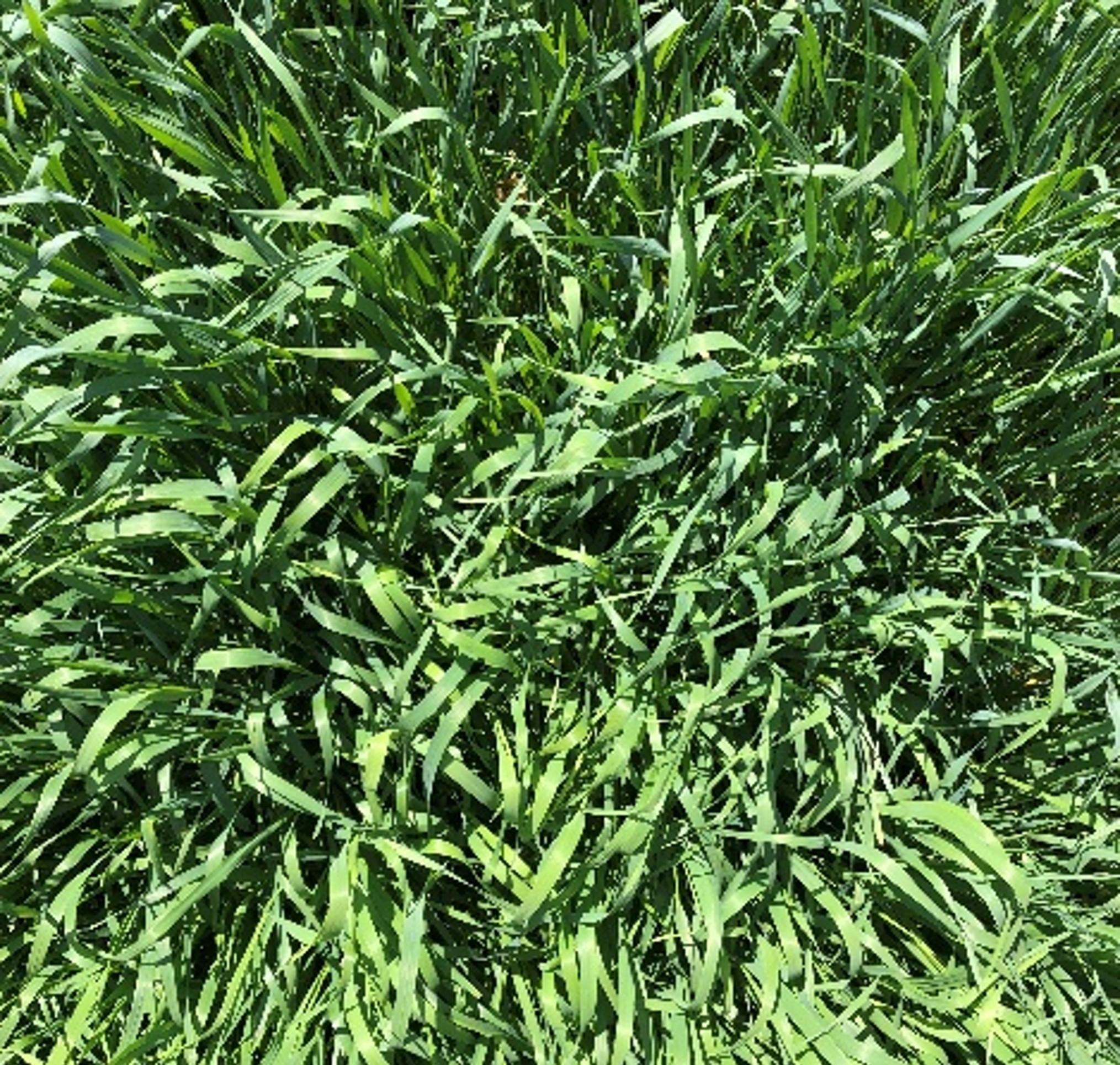
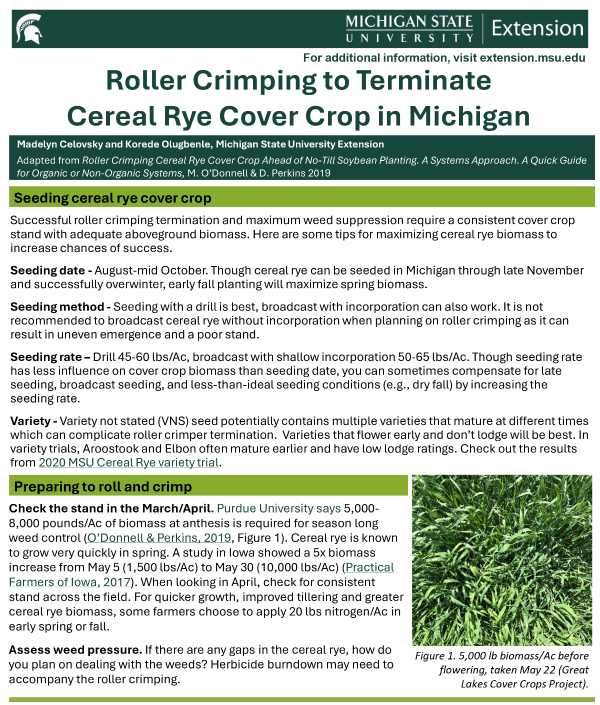
Check the stand in the March/April. Purdue University says 5,000-8,000 pounds/Ac of biomass at anthesis is required for season long weed control (O’Donnell & Perkins, 2019, Figure 1). Cereal rye is known to grow very quickly in spring. A study in Iowa showed a 5x biomass increase from May 5 (1,500 lbs/Ac) to May 30 (10,000 lbs/Ac) (Practical Farmers of Iowa, 2017). When looking in April, check for consistent stand across the field. For quicker growth, improved tillering and greater cereal rye biomass, some farmers choose to apply 20 lbs nitrogen/Ac in early spring or fall.
Assess weed pressure. If there are any gaps in the cereal rye, how do you plan on dealing with the weeds? Herbicide burndown may need to accompany the roller crimping.
Tips for herbicide with roller crimper. There are a few reasons to accompany crimping with herbicide application.
- Planning on crimping before cereal rye anthesis because of fear of lodging (or any other reason)
- Early spring weed pressure
- Poor or uneven cereal rye stand which may lead to failed crimping or poor in-season weed control
- Pre-emergent herbicide application at planting
Burndown and/or pre-emergent herbicides can be applied before or after crimping. Applying before crimping would allow for better coverage for both post-emergent burndown herbicides and soil applied pre-emergent herbicide. Getting Rid of Weeds through Integrated Weed Management’s factsheet “How to Integrate Herbicides with Roller Crimping” has more information (Wallace et al., 2024).
Roller crimping cereal rye and planting the cash crop
Equipment
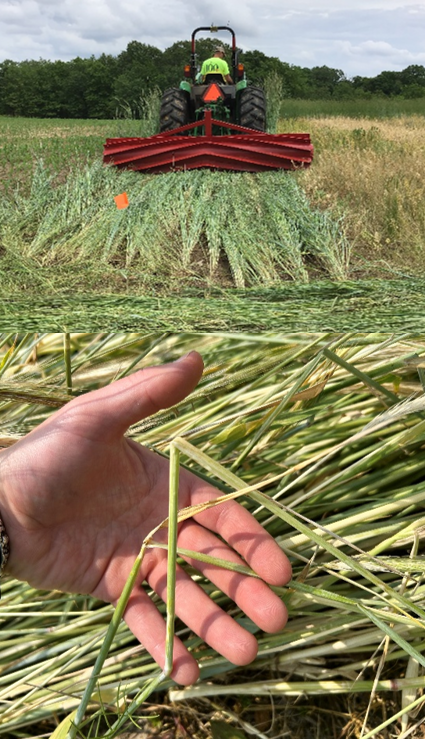
Roller crimper designs each come with benefits and drawbacks. Some only roll (lay the cover down) and some both roll and crimp (break cereal rye stems). Take time to select the one most appropriate for you. Check out USDA ARS FactSheet FS07 for more details.
- Smooth roller drum (This does not crimp. Herbicide will be required for termination.)
- Chevron pattern roller (Figure 2)
- Straight crimping bar roller
- Curved crimping bar roller
- Smooth roller with oscillating crimping bar
- Two-stage roller
- Four-stage roller
No till planter
- Sharp double-disc openers are required
- Extra weight may be necessary to be able to plant and maintain consistent planting depts through heavy residue.
- Set planting depth on planter to compensate for the thickness of residue.
- Starter N applied with the planter is recommended to compensate for N tie up as cereal rye decomposes, especially when planting corn.
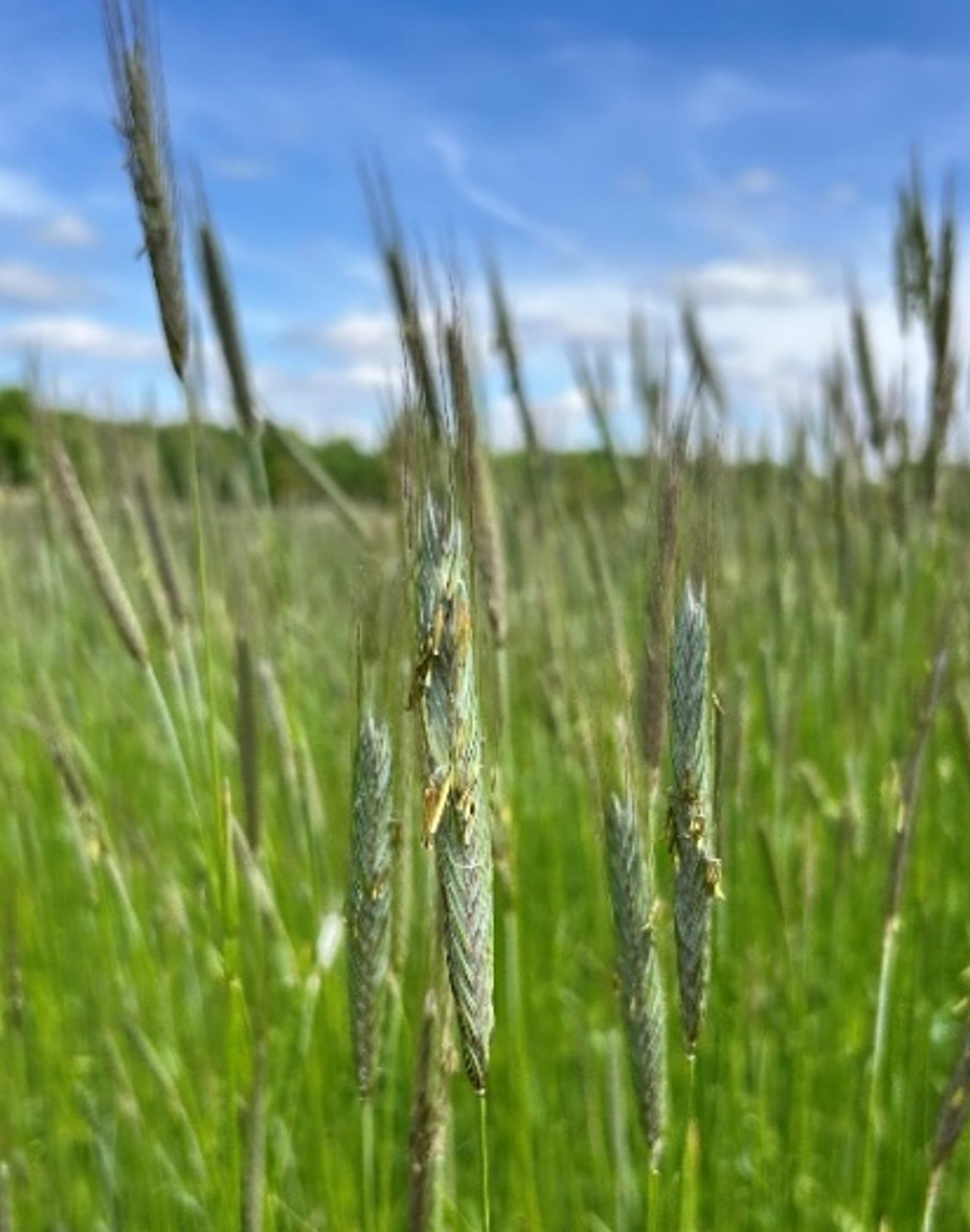
Timing. Organic growers should wait until full flower/anthesis (anthers at the top of the head across the whole field, Figure 3). Anthesis often comes around Memorial Day in Michigan. Timing of crimping is less important for farmers that plan on using herbicides to help with termination. To make planting the cash crop easier, plant before risk of lodging (before high winds or storms are expected).
Crimping before planting:
- Risky if heavy rain comes after rolling, soil dries slowly after rolling
- With residue laid down, residue can make opening and closing seed furrow difficult for the planter
- Planting may be easier if planting the same direction as rolling. However, most no-till planters should be fine either direction if the residue stays laid down flat
Crimping at planting (specialized equipment):
- Planter mounted or mounted on the front of a tractor
Crimping after planting:
- Most farmers choose to plant before crimping
- Crimp before any risk of crop emergence
Soil conditions for planting: Water stressed cereal rye may not crimp effectively (stems are tough and don’t break easily). If soil is not firm, cereal rye may not terminate effectively (stems get pushed into soil but do not crimp).
Benefits and risks of roller crimping
It is always wise to have a back-up termination plan in case rye is not terminated by roller crimping.
| Benefits | Risks |
|---|---|
| Assists in suppressing weed seed emergence and growth | Roller crimping too early may lead to poor termination |
| Reduced soil disturbance, lowering possibility of soil erosion | Roller crimping too late (after cover crop goes to seed) may lead to competition with cash crop |
| Cover crop residue laying flat increases sunlight for emerging seedlings and can keep vegetable crops like pumpkins clean | Possibility of increased pest pressure, including armyworm and slugs, due to dense cover crop residue acting as a favorable environment. |
| Assists in conserving soil moisture | As mature cereal rye decomposes, nitrogen is often immobilized and can cause stunted crop development. |
References
- MSU Cereal Rye Variety Trials – 2020 Results. Michigan State University, https://www.canr.msu.edu/malting_barley/uploads/files/2021-02-10%20MSU%20Rye%20Variety%20Pub%20.pdf
- O’Donnell, M. and Perkins, D., 2019. Roller Crimping Cereal Rye Cover Crop Ahead of No-Till Soybean Planting. A Systems Approach, https://ograin.webhosting.cals.wisc.edu/wp-content/uploads/sites/65/2019/04/Roller-Crimping-Cereal-Rye-Ahead-of-No-till-Beans.-A-Systems-Approach9832.pdf
- Roll-Crimping Cover Crops and Soybean Seeding Date, 2017. Practical Farmers of Iowa. https://practicalfarmers.org/research/roll-crimping-cover-crops-and-soybean-seeding-date-2/
- Wallace, J., Flessner, M., Lingenfelter, D., Singh, V., VanGessel, M., Vollmer, K., & Unglesbee, E., 2024. Cover Crop Termination- How to Integrate Herbicides with Roll-Crimping. Getting Rid of Weeds Through Integrated Weed Management. https://growiwm.org/wp-content/uploads/2024/10/3-How-to-Integrate-Herbicides-with-Roll-Crimping.pdf
- Rollers for Terminating Cover Crops. 2017. USDA NRCS Factsheet FS07, https://www.ars.usda.gov/ARSUserFiles/60100500/FactSheets/FS07.pdf