Spotted Wing Drosophila Biology and Identification
DOWNLOADJune 1, 2020 - Julianna Wilson, Larry Gut, Rufus Isaacs, Steven Van Timmeren, Michigan State University Department of Entomology
 Print
Print Email
EmailDistribution and history in the Great Lakes Region
Spotted wing drosophila (SWD), Drosophila suzukii, is an invasive pest that attacks a wide range of soft, thin skinned fruit crops, as well as many wild host plants. SWD is native to Asia and was first discovered in California raspberries in 2008. It was first detected in Michigan in September 2010, in a trap set up by MSU researchers. It is now a major pest of tart cherries, blueberries, fall red raspberries, and day-neutral strawberries. In some seasons, it can be a problem in June-bearing strawberries and sweet cherries. In Michigan, it will be commonly found infesting honeysuckle, mulberry, and brambles in wooded edges. SWD populations in the Great Lakes Region typically begin surging in July, growing rapidly until cold weather arrives in the fall.
Pest biology
Similar to other Drosophila flies (e.g., the common vinegar fly, D. melanogaster), when conditions are favorable, SWD are capable of reproducing rapidly, with each female able to lay more than 300 eggs in her lifetime. SWD can reproduce on a wide variety of substrates, including mushrooms and rotting fruit, but they are a significant agricultural pest because they can start infesting fruit as it begins to ripen.
Factors that affect development
How quickly SWD develop is largely driven by temperature, and their activity and propensity to lay
eggs are enhanced by higher relative humidity. Under warm, humid weather conditions (77°F), SWD will develop from egg to adult rapidly – in as little as 8 days – with multiple overlapping generations typical during the summer. Under cooler conditions (below 59°F), when temperatures rise above 86°F, or under very dry conditions, development will be slower or will halt until favorable conditions resume.
Life cycle
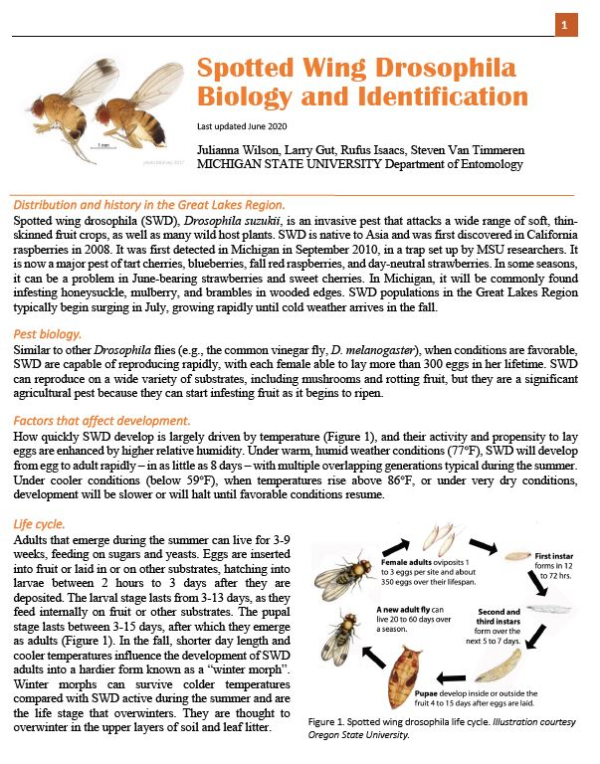
Adults that emerge during the summer can live for 3-9 weeks, feeding on sugars and yeasts. Eggs are inserted into fruit or laid in or on other substrates, hatching into larvae between 2 hours to 3 days after they are deposited. The larval stage lasts from 3-13 days, as they feed internally on fruit or other substrates. The pupal stage lasts between 3-15 days, after which they emerge as adults. In the fall, shorter day length and cooler temperatures influence the development of SWD adults into a hardier form known as a “winter morph”. Winter morphs can survive colder temperatures compared with SWD active during the summer and are the life stage that overwinters. They are thought to overwinter in the upper layers of soil and leaf litter.
Key characteristics for identification
The common name of this pest comes from the spots found on male SWD wings. Adult SWD have several key features to distinguish them from other flies of similar size and coloring: females have a pointed, dark, serrated (toothed) ovipositor that allows them to lay eggs into intact, ripening fruit; mature males have the dark spot on each wing near the margin, and two dark bands on each foreleg. Eggs have a pair of breathing tubes that extend out of the fruit, which can be seen using a hand lens or dissecting microscope. Live larvae can be extracted from fruit using a salt or sugar larval flotation test. Larvae are easier to see with the naked eye under good lighting conditions or with the use of magnification devices.