


Winter recovery management strategies for cool-season turfgrasses
DOWNLOADJune 3, 2026 - Dr. Emily Holm
 Print
Print Email
Email
Winter recovery management strategies for cool-season turfgrasses
By Dr. Emily Holm
Student: Ruilin Miao
Project Description: Winterkill damage of perennial turfgrasses on golf courses and other turf areas is costly to repair and detrimental to the success and sustainability of the turfgrass industry. Maintaining mature turfgrass areas is critical to reducing environmental impacts, which is difficult with climate change induced seasonal fluctuations and severe weather. Therefore, research to determine post-winter management strategies to promote perennial turfgrass plant survival and release from winter dormancy is critical. Light and water are two major factors associated with plant death during the winter to spring transitional period, but little research has been performed to evaluate spring turfgrass management strategies to reduce plant stress associated with these factors. Our research uses controlled condition and field conditions to determine the efficacy of novel spring management practices on turfgrass survival of severe winter conditions.
Objectives and Expected results:
Objective 1 – Quantify water uptake rates of crowns and chlorophyll damage of plants with and without ice encasement and in response to spring warming (de-acclimation) and ABA treatments.
Hypothesis – Ice encasement will cause more rapid water uptake compared than without ice encasement and an interrupting warming treatment will exacerbate this effect. ABA to promote stomatal closure, inhibit growth, and limit water uptake will reduce water absorption of crown tissue. Crown survival could be promoted by delayed water uptake.
Objective 2 – Identify the effect of varying light intensities during ice and during spring recovery from ice encasement on annual bluegrass survival and physiological properties.
Hypothesis – Since minimal levels of photosynthesis could occur under illuminated ice and plants would be acclimated to light, we hypothesize that recovery will be promoted. The shock associated with darkness under ice encasement followed by sudden light exposure could cause photoinhibition and irreversibly damage crown tissue.
Objective 3 - Test sustainable, novel turfgrass spring treatments for post-winter protection and identify whether the treatments moderate annual bluegrass responses to water and light following winter in field and controlled conditions
Hypothesis – Protection from light and moderated temperatures by shading turf with either powder or a cloth following winterkill stress could reduce irreversible damage caused by photoinhibition and promote turfgrass crown survival.
Methods
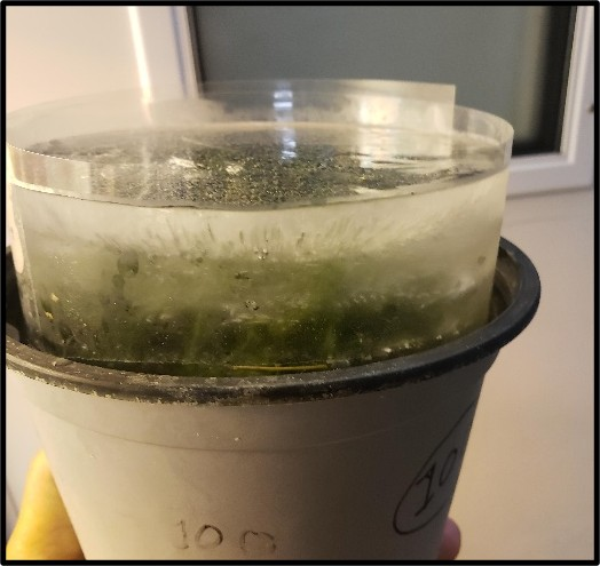
Objective 1- Turfgrass plugs (4” diameter) of annual bluegrass will be collected from the field, exposed to cold acclimation temperature regime and then treated with 0 or 50 d of 1) ice encasement (Figure 1) 2) no ice encasement 3) ice melt + warm period exposure (premature de-acclimation) 4) warm exposure only. De-acclimation temperature and duration methods will be used as in Hoffman et al., (2014). Following winter treatments plants will be de-acclimated gradually and treated with or without ABA (100μM; Wang et al., 2003) and tetralone-ABA (0.5 g·L-1 as in Wang et al. (2025); this rate may be modified with trial). Leaf and crowns will be excised from half of the plant and tested in vitro to measure the moisture content and rate of water uptake of tissue during soaking (Wang et al., 2023) and tissue will be saved in a -80̊C freezer for cuticle analysis. The remaining intact plant will go towards recovery in a greenhouse where light incidence, photochemical health (OJIP parameters including Fv/Fo; Lootens et al., 2004), chlorophyll content (using not destructive meter), chlorophyll ratios (chl a, chl b, chl, carotenoids), malondialdehyde content to indicate lipid peroxidation, green tiller counts, and digital image analysis for percent green cover will be measured.
Objective 2 – Annual bluegrass plugs will be treated as described above and exposed to varying light conditions during winter (ice or no ice) in growth chamber conditions or following winter as a factorial experimental design (high 1000, med 500, low 100 μmol m-2 s-1). Growth chambers will be set to the desired light levels and light incidence will be monitored with a light meter at canopy height. While ice will reduce actual incidence of light plants are receiving, this would be uniform for all plants under the ice and not limit interpretation. Recovery, photochemical health, and plant tissue will be harvested and preserved for health analysis as described in objective 1.
Objective 3 – Preliminary growth chamber experiments of annual bluegrass will test for any toxicity and resolve application issues and rates needed for good coverage prior to field treatments. Subsequently, a two-year field study at the Hancock Turfgrass Research Center will be performed to evaluate spring protective effects of 1) kaolin clay dry application 2) a product called Surround (NovaSource WP Crop Protectant, more soluble in water) as a wet application 3) talc treatment (more hydrophobic compared to kaolin clay) 4) a shade cloth treatment for 5 days 5) shade cloth for 10 days and 6) no treatment. Timing of these application will be made based on weather predictions and may be made on an as needed frequency. Light incidence in the field and under the shade cloths will be tracked. Shade cloths will be pinned down to turf plots. Digital image analysis will be performed to monitor coverage of the white powder. Duration of treatment persistence on the leaves will be tracked and normalized difference vegetative index, chlorophyll content, turf quality and crown viability (triphenyl tetrazolium chloride method) will be measured on field plots during the fall and spring seasons until plots are fully recovered.
Benefit group - The benefit groups include golf courses, athletic fields, homelawns, and turfgrass scientists since the project outcome is new knowledge of turfgrass winter recovery that can be used in management, research, and breeding purposes.
Estimated project duration – 2 years (2025-2027) Supplemental to funding from Project GREEEN
Figure 1 – Ice encasement treatments in controlled growth chambers using pots dipped in paraffin wax and acetate sheeting wrapped around the rim.

