25 years of sturgeon research: MSU celebrates conservation success at Black Lake
 Print
Print Email
EmailSturgeon Palooza will commemorate a quarter century of research, restoration and partnerships that have helped revive Michigan's iconic lake sturgeon population.
*This story is part of a series highlighting the impact of MSU AgBioResearch’s work with Michigan agriculture and natural resources that includes our stakeholders' perspectives. Through partnerships with the State of Michigan and industries, MSU AgBioResearch is finding solutions to some of the most timely problems facing our state. To view the entire series, visit agbioresearch.msu.edu.
EAST LANSING, Mich. — On Sept. 25, Michigan State University will celebrate 25 years of conducting lake sturgeon research at the Black Lake Stream Side Rearing Facility in Onaway, Michigan.
The on-campus Sturgeon Palooza event will highlight how partnerships formed among MSU and state, federal, tribal and non-governmental organizations have helped to save a once-thriving sturgeon population from extirpation in parts of the Great Lakes region.
The impact MSU has had when it comes to sturgeon can be observed many ways, said Scott Colborne, an MSU Department of Fisheries and Wildlife assistant professor who took over MSU’s sturgeon research program in 2024 for Kim Scribner, a professor emeritus in the same department.
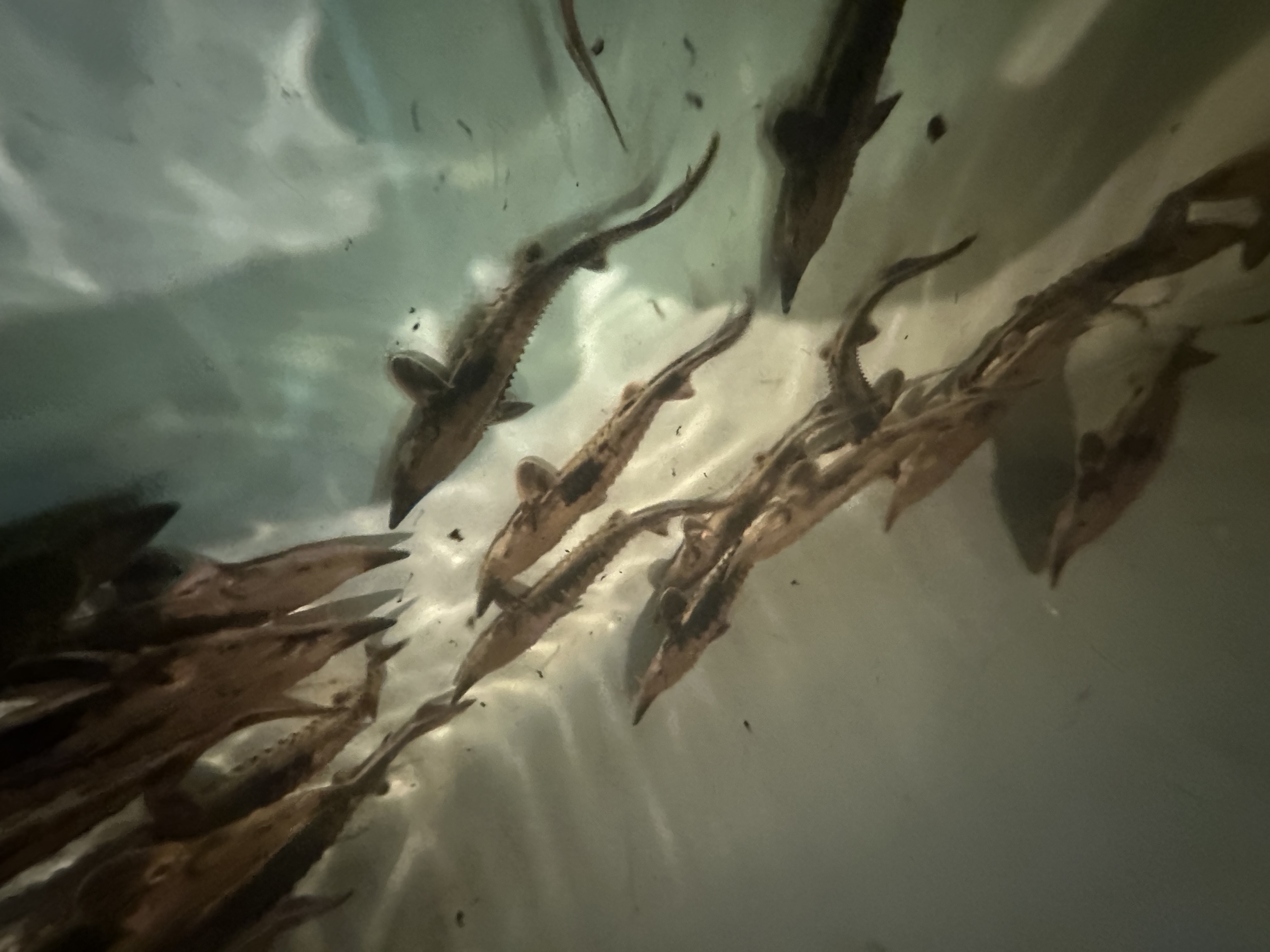
“Twenty-five years of research has taught us an incredible amount about lake sturgeon and what it takes to restore these populations,” Colborne said. “We can see that in the recovery of the Black Lake population, in young sturgeon once again showing up in places like Saginaw Bay, and in more than 80 scientific publications that have expanded our understanding of these fish. But one of the most exciting things about a program like this is that the value of the work continues to grow. We now have decades of data, new tools and experience that allow us to ask questions that simply weren’t possible when the program started.
“The impact also extends well beyond the science and the fish. Eighteen graduate students and more than 100 undergraduate research technicians from across the country have been part of this program, and we’ve seen how these fish can capture the imagination of communities and spark curiosity in the next generation. While Sturgeon Palooza is celebrating what this program has accomplished over the last 25 years, we are very excited about where it can go over the next 25 — and how our research, partnerships, and education efforts can continue to have an impact for sturgeon and the Great Lakes more broadly.”
While this celebration will mark all the accomplishments made by MSU and its partners in revitalizing sturgeon in Michigan’s water systems, restoring critical ecosystem functions and engaging local communities, this work is far from over, echoed Doug Larson, an MSU research assistant who helps run the Black Lake Stream Side Rearing Facility.
“When you look back over the last 25 years, it's remarkable how much has changed,” Larson said. “We started by answering very basic questions about how to restore these populations to having decades of information on individual fish in this population. But for a species which lives hundreds of years, we've only scratched the surface. The long-term datasets and partnerships we've built give us opportunities to ask questions today that we couldn't have imagined when this started.”
MSU helping uncover and share the lessons taught by these ‘durable’ fish
Often referred to as “dinosaur fish” for having been around when dinosaurs roamed the planet more than 100 million years ago, lake sturgeon are the Great Lakes’ oldest fish species, according to Sturgeon for Tomorrow, and one of the largest, with torpedo-shaped bodies that can weigh hundreds of pounds and span over 7 feet.
Unfortunately, their size alone couldn’t protect them from the overharvesting, habitat loss and pollution they experienced in the Great Lakes basin throughout much of the 19th and 20th centuries, and since the late 1980s, they’ve been listed as “threatened” or “endangered” in 19 of 20 states in the Mississippi River, Hudson Bay and Great Lakes basins.
The work MSU and partner organizations have been doing over the last quarter century to tag, track and understand the species better to promote their conservation and restoration is changing that narrative, said Jay Woiderski, president of Sturgeon for Tomorrow.
“Many things that MSU and partners have done through the years have helped to understand how big the sturgeon need to get to be released so that they have a chance at making it into the wild,” Woiderski said. “The difference in survival rate between a newly born sturgeon and one that has reached a 5- to 6-inch length after a few months of being cared for in the hatchery is well under 1% to over 70%. That took years to figure out where that point was.”
Research done at Black Lake by MSU and the Michigan Department of Natural Resources (DNR) has also helped to provide insights about the sturgeon living in Michigan’s water systems long before this work began. Black Lake is locked in by dams in the upstream and downstream parts of the Black River watershed surrounding the lake, and because of this, sturgeon living in this region can be easily monitored and studied over long periods of time.
Earlier this year, a team including Colborne, Larson, Scribner and Ed Baker, research station manager of the Michigan DNR’s Marquette Fisheries Research Station, published a paper detailing how sturgeon — which were previously thought to live around 80-100 years — could live up to 200, 300 or even 400 years.
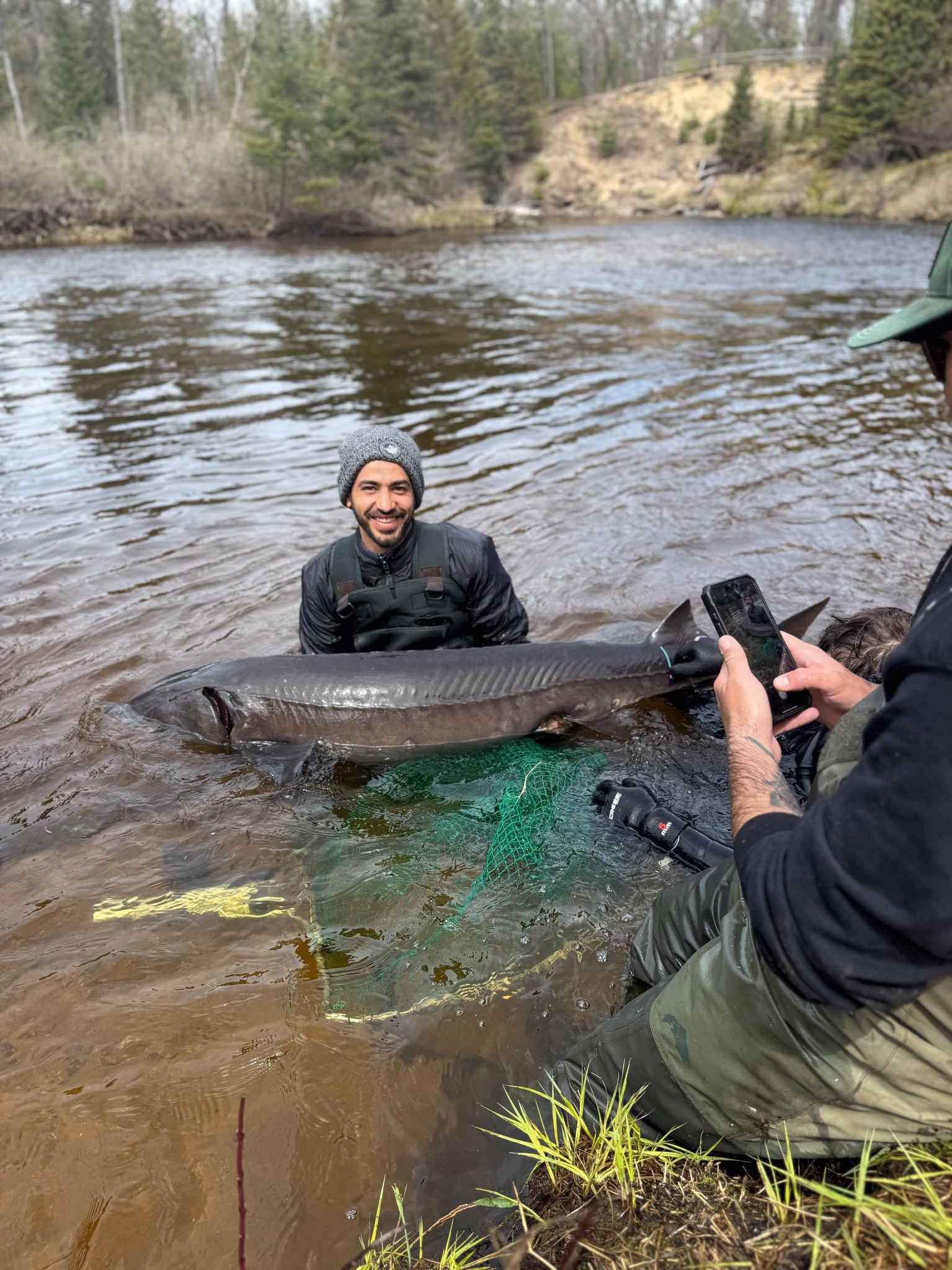
A finding like this that provides deeper clarity into sturgeon biology, Baker said, contributes to a greater understanding of how the Michigan DNR and others can shape conservation strategies and management decisions, which for the past 25 years, have helped to successfully bring back parts of the sturgeon population in Michigan.
“The partnership we have with MSU at our Black Lake research site and hatchery has been an incredibly productive relationship over the past 25 years,” Baker said. “When we started our work there, we didn’t know much about basic lake sturgeon biology, and over the past 25 years, the research we’ve done there has really expanded our understanding of that and has informed our management actions as an agency in trying to restore sturgeon, which we’re starting to see.
“The population in Black Lake, where we do our research, is on the rebound. The adult abundance is continuing to increase.”
Baker said fish from the Black Lake hatchery are now being used to stock other bodies of water within the same watershed as Black Lake, as well as other water systems such as the Saginaw River and other hatcheries such as one managed by the Grand Traverse Band of Ottawa and Chippewa Indians along Boardman River in Traverse City.
The importance of sturgeon can’t be understated.
As a bottom feeder, sturgeon play a profound ecological role in moving nutrients from lakes into rivers when they spawn. Their longstanding ancestry and history hold sacred meaning within many tribal nations.
They’ve previously been an economically significant species for Michigan’s recreational fishing economy. Today, however, stringent management regulations limit when anglers can catch sturgeon. Spearing season at Black Lake lasted only 17 minutes in 2025. Baker said he hopes that with continued success in restoring them, sturgeon can once again become an integral part of Michigan’s fishing experience in the future.
But for Mike Kelly, Great Lakes director of The Conservation Fund, one of the aspects he values most about sturgeon and the role MSU has played in restoring them is how they bring people together.
“Obviously, bringing back the fish population is the overarching goal, but the unique thing about sturgeon is despite the fact they’ve been around for 130 million years, and despite the fact they’re a threatened species, these little fish that come from the MSU hatchery at Black River are durable fish,” Kelly said. “They lend themselves very well to these public restoration events we hold in cooperation with MSU and a bunch of other partners, where we can bring people down to the river — kids and adults alike — and give them the opportunity to hold one of these fish and release them into one of the four waterways: the Cass River, Flint River, Tittabawassee River and Shiawassee River.
“From my perspective, as I mentioned, obviously bringing back the species is the No. 1 priority, but right behind that is the opportunity to bring people down to the river to help them understand why our rivers are so important, and let them play the role of a citizen scientist as part of this project in helping to release and restore this population.”
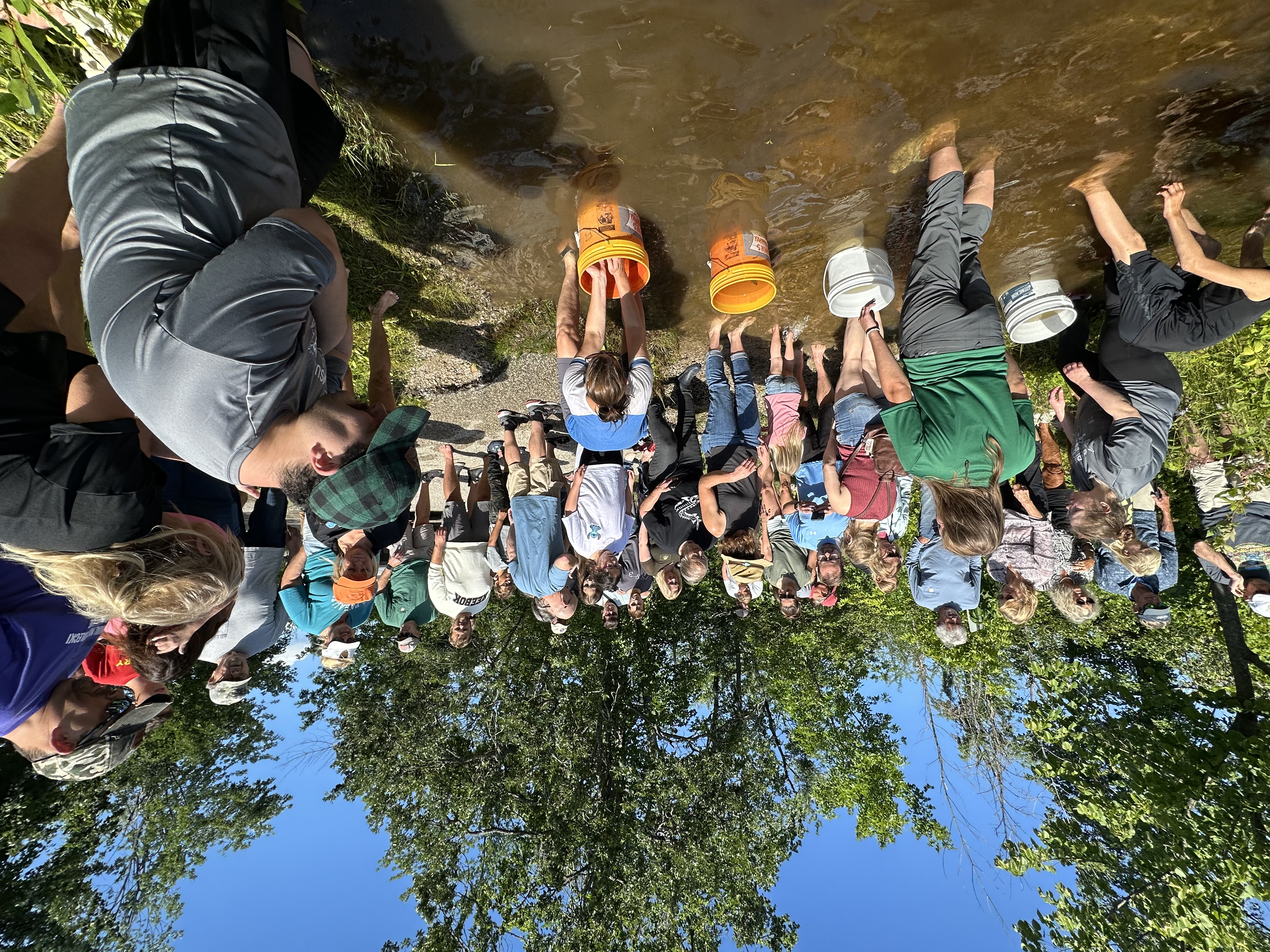
The effort to restore sturgeon is an all-hands-on-deck approach. From researchers diving into Black Lake to study them to students raising them in the classroom through Sturgeon in the Classroom and volunteers keeping watch over Black River to protect them from poaching, everyone is involved.
Kelly said of all the projects he’s been involved in, restoring sturgeon has been the greatest example to him of the power of partnerships, noting MSU’s critical role in helping run the Black Lake Stream Side Rearing Facility and educate people through MSU Extension. Continued funding for this work, he said, is essential.
“One of the things also to remember about this population is that unlike a lot of other fish species, these fish are long-lived,” Kelly said. “They don't reach maturity for 15 or 20 years. The fish that we're putting in the rivers right now don't come back to spawn for a couple decades from now, and they don't spawn every year.
“If there’s one project that needs to be looked at as a long-term project, it’s this, and I think funding needs to support that. People need to understand that we damaged this population, and it’s up to us to bring it back. It’s also important, along with sturgeon, to remember how fragile our ecosystem is sometimes. It doesn’t take long to do serious damage to it.”
Sturgeon teaching MSU students how to become scientists and stewards
Not all the research being done on sturgeon involves getting in the water with them. For Delsin Wright, an MSU Fisheries and Wildlife undergraduate who’ll graduate this fall, some of it has meant spending days in Microsoft applications organizing and analyzing complex datasets detailing the records kept on sturgeon over the past 25 years.
His connection to sturgeon started in 2023 when he interned with the Michigan DNR, working with the Gun Lake Tribe to restore sturgeon in West Michigan. In 2024, he transferred to MSU and connected with Colborne, Larson and others in the MSU AgBioResearch-supported Quantitative Fisheries Center, assisting them with their research.
After reworking their dataset to make it more user-friendly, he was offered a field position in 2025 where he could interact directly with the sturgeon at the Black Lake facility.
“It was cool how things played out,” Wright said. “I had a lot of fun with the database work and working out in the field. It was my first real experience with both research and hands-on fieldwork, and from those experiences, I fell in love with it. I realized this is really where I want my career to go.”
Some of Wright’s greatest memories working on-site at Black Lake were hiking along the spawning grounds with dive and shore teams. Dive teams would fish sturgeon — or sometimes wrestle ones weighing 100 pounds or more — out of the water and pass them to shore teams who’d collect measurements and samples.
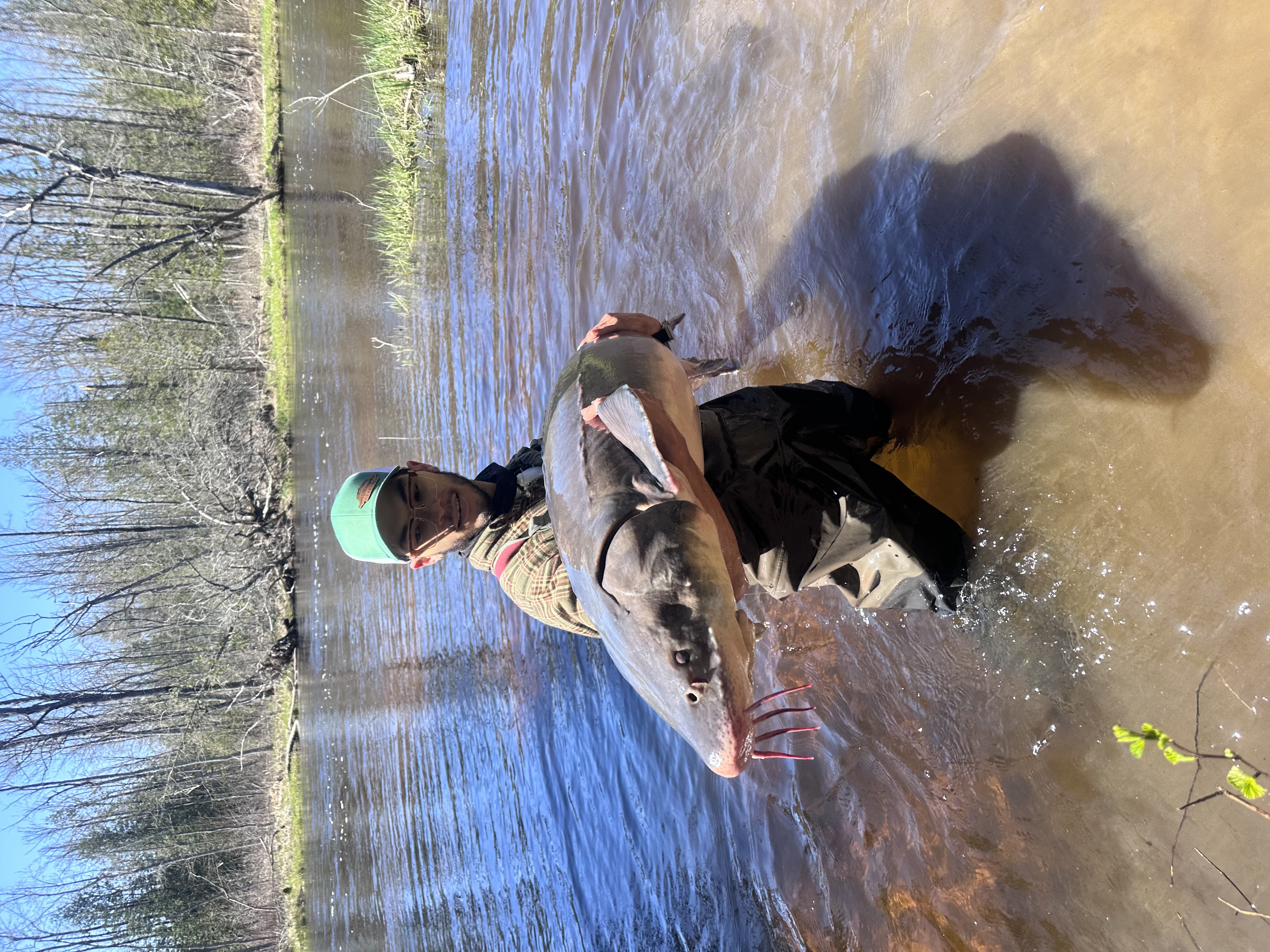
Being in the presence of these gigantic and historic fish, as well as learning more about them and the significance they’ve had within communities across the state for hundreds of years, has shaped how Wright views the responsibility there is to safeguard them.
“Learning more about the history involved has been a really fun part because it’s a much deeper story,” Wright said. “It’s not just that these are cool fish. They’ve got a history that goes back hundreds of years. Going back to the life cycle of these fish, it’s possible that some were babies when tribes were the only ones inhabiting these lands.
“For me, these fish put a lot of things into perspective. They give me a lot to think about beyond the traditional conservation mindset we apply. It’s a broader picture, which I really appreciate. It’s good to not only know about these things but also respect and be a part of them as much as you can.”
Working at the Black Lake facility as a summer technician and being able to participate in various research projects also sparked a love of fisheries research for Jake Kimmel, so much that he applied for and accepted a role as an MSU graduate research student there in 2019 after completing his undergraduate degree.
His graduate research project, which focused on lake sturgeon behavior and sense of smell, was co-advised by Kim Scribner and Weiming Li, a professor and Frederick E.J. Fry Chair for Environmental Physiology in the MSU Department of Fisheries and Wildlife. After three more years at the facility completing his graduate research, Kimmel accepted a position in Li’s lab post-graduate school studying invasive sea lamprey.
Kimmel has since gone on to work at the Great Lakes Fishery Commission to continue researching sea lamprey, but he said the knowledge gained by working with sturgeon at the Black Lake facility has been indispensable to his career.
“Because of my interest and willingness to get involved and ask questions, the researchers at Black Lake were willing to give me opportunities,” Kimmel said. “They gave students ideas about things that needed to be solved and let us run with them and try to figure them out ourselves. That helped my career, gave me a lot of skills in research and problem-solving, and grew my independence and confidence. It was an invaluable experience.”
Click here to learn more about and register for Sturgeon Palooza.
Michigan State University AgBioResearch scientists discover dynamic solutions for food systems and the environment. More than 300 MSU faculty conduct leading-edge research on a variety of topics, from health and agriculture to natural resources. Originally formed in 1888 as the Michigan Agricultural Experiment Station, MSU AgBioResearch oversees numerous on-campus research facilities, as well as 15 outlying centers throughout Michigan. To learn more, visit agbioresearch.msu.edu.