A Freshwater Legacy: 758 Odonata Specimens Find a Permanent Home at MSU
 Print
Print Email
EmailMSU’s A.J. Cook Arthropod Research Collection has received 758 Odonata specimens from longtime collector John F. Douglass, now verified, curated and fully integrated into the university’s permanent scientific archive.
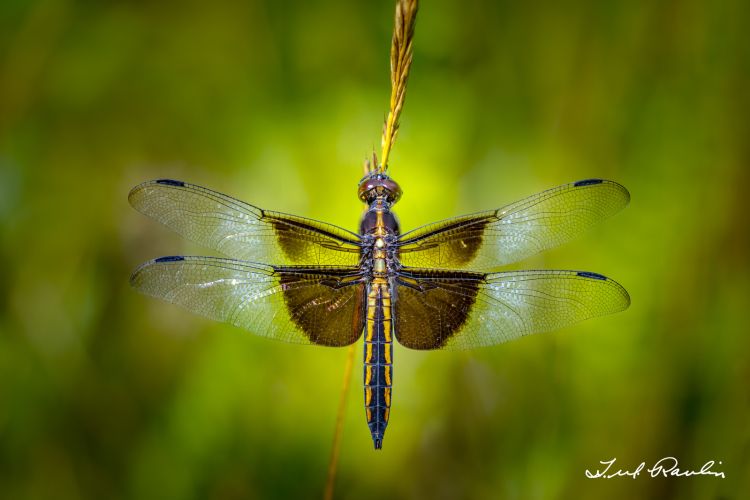
758 adult Odonata specimens have been donated to the A.J. Cook Arthropod Research Collection (ARC) managed by Michigan State University’s Department of Entomology. The dragonfly and damselfly specimens, collected between 1993 and 2011, have now been verified, labeled, databased and arranged in taxonomic order, making them widely available for future research and education.
The collection belonged to longtime Michigan odonate collector John F. Douglass. His work with the Michigan Odonata Survey (MOS) and his trust in the ARC’s adjunct curators, Julie Craves and Darrin O’Brien, led him to place his specimens with the collection.
Craves and O’Brien have been involved in the MOS for more than 20 years and volunteer their time and expertise to the ARC. They emphasize the value of physical specimens and the long-term data they preserve. “The value of a physical specimen permanently housed in a curated collection is SO important,” Craves said.
“Julie and Darrin’s research is at the forefront of entomological projects now underway in Michigan,” Douglass said. “[Their] huge store of vetted records provides a baseline against which future observations on various species’ populations and distributional status can be compared.”
Craves and O’Brien also stress the importance of accessible scientific data. “I feel it’s important to bring specimens to light, make them and their data available, and known to the public,” O’Brien said. “We’re at a point in history where it’s important to create a current baseline of known species distribution and phenology, since there is so much changing in the world due to urbanization, climate change and chemical usage.”
Among the donated specimens were notable state records. “Probably the most significant was a western red damsel (Amphiagrion abbreviatum) from Alger County,” Craves said. “The first county record and one of only a handful of specimens in the state.”
Integrating the collection required detailed taxonomic work. Many of the original identifications were made more than two decades ago, and standards have shifted as research advances. O’Brien carefully examined each specimen to confirm its ID and sex and make any needed changes on the label. Following this, Craves worked to digitize the data to make it available to other scientists around the world.
Personal donations like Douglass’ continue to build the ARC’s scientific value. “All the happy days I thought I had squandered in our state, the ‘freshwater capital of the world’, were scientifically worthwhile after all,” Douglass joked.
“Much of the ARC specimens are acquired through donations from avocational collectors. Their generosity provides publicly available data to the worldwide scientific community,” added Anthony Cognato, director of the ARC.
While this donation is geographically specific to Michigan, it adds significant insight into species' behavior and distribution, complementing the broader diversity represented in the collection. Odonates also serve as ecological indicators of water quality, adding further value to documented, accessible records.
The combination of a searchable digital database and a physical collection containing over 1.5 million insect specimens makes the ARC a major resource for researchers worldwide.