Canada thistle, how to kick this creep out of your landscape
 Print
Print Email
EmailCanada thistle is a challenging weed to manage. Learning more about its biology and the control options available can help.
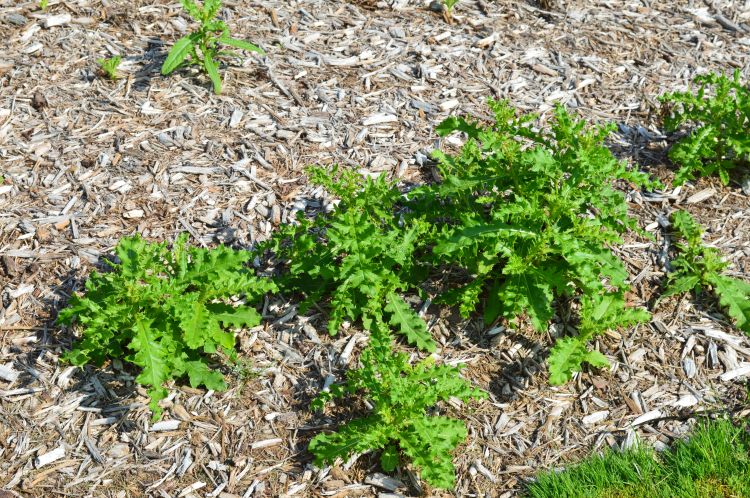
Canada thistle (Cirsium arvense), also known as creeping thistle, is a formidable foe in the landscape, spreading into ornamental beds (Figure 1), vegetable gardens, and even into lawns. Its common name is a misnomer, as it does not hail from the lands of our northern neighbors. R. J. Moore explains that it was introduced to North America from Europe as a seed contaminant and is now considered naturalized and quite common.
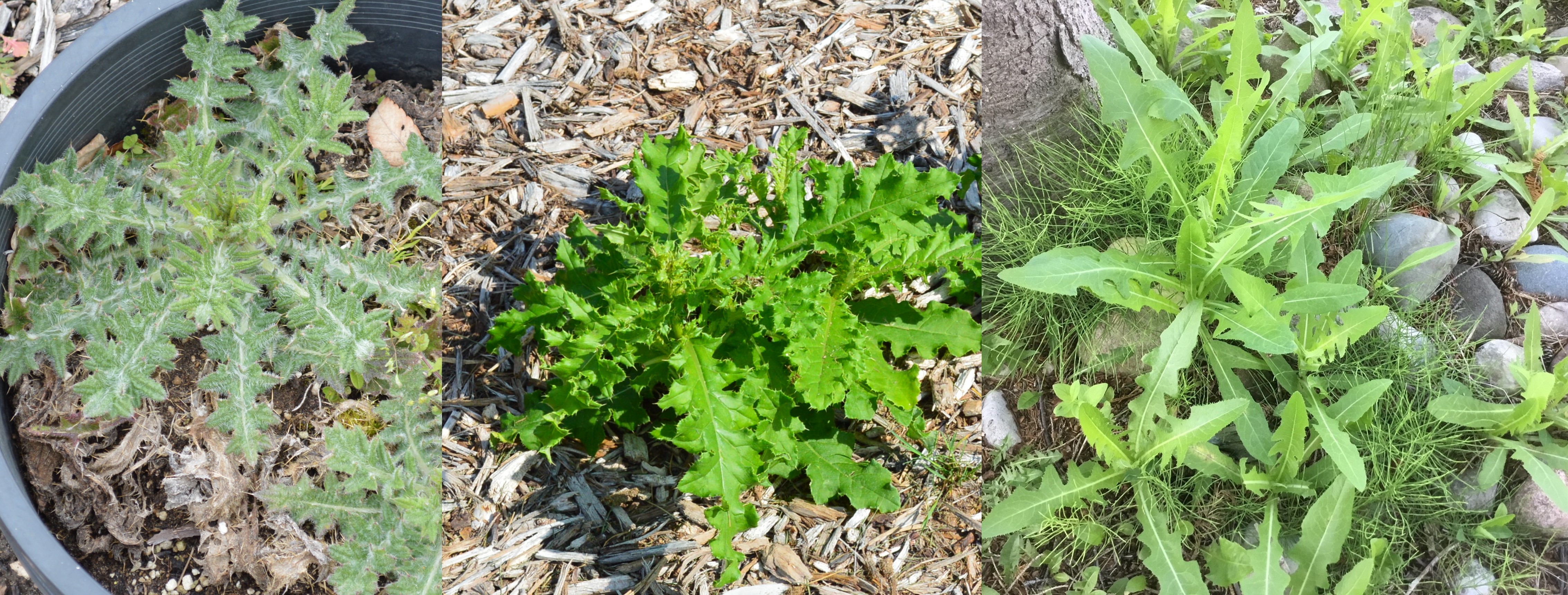
In spring, both seedlings and established Canada thistle shoots emerge as low-growing rosettes, like its relative dandelion. Leaves are lobed, and while the surface can be smooth or slightly hairy, there are always scratchy spines present on the margins. At this stage, if you notice an abundance of hairs on the leaf surface and almost thorn-like spines, it is more likely the related species, bull thistle (C. vulgaris, Figure 2). Canada thistle is a perennial, and while it starts as a rosette, it eventually can grow to heights greater than 3 feet before producing pink flower heads in the late summer months (Figure 3). Bull thistle is a biennial, so it only grows vertically in the second year before dying.
 - Copy.JPG?language_id=1)
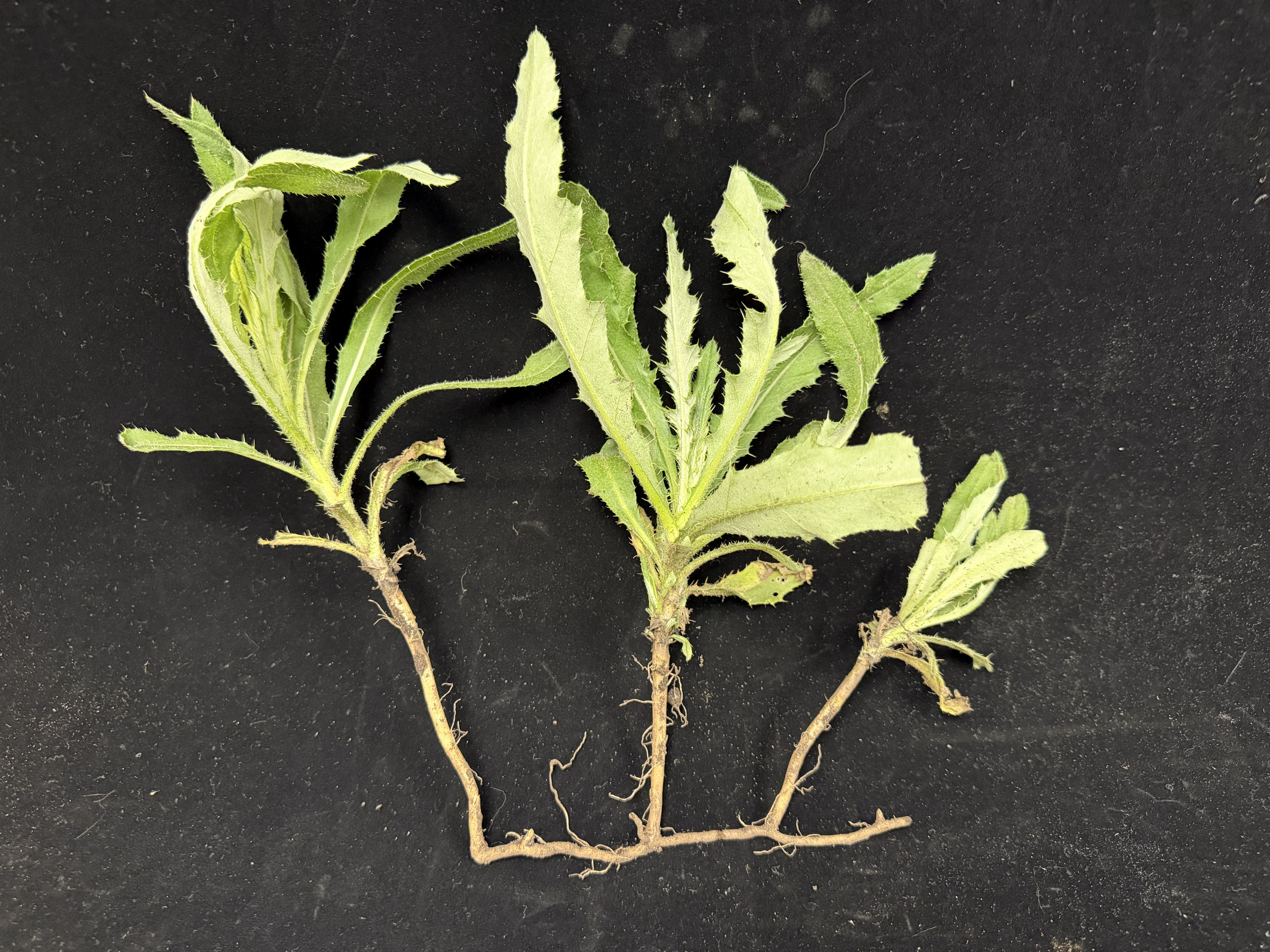
Canada thistle has separate male and female plants, meaning only some can produce seed. Seeds have small, fluffy hairs attached (smaller, but similar to dandelion) that aid in wind dispersal (Figure 4). While seeds play a role in the distribution of Canada thistle, its real strength is in the production of creeping roots. These plants are most often found growing in colonies, and if you were to excavate the soil away, you would see that all the plants in proximity to each other are connected (Figure 5). The colony is really one giant plant! The roots of Canada thistle have been measured down to 6 feet below the soil surface, with most between 8 and 16 inches, explains Moore). This is what makes it so challenging to control.
 - Copy.JPG?language_id=1)
Other species that are often mistaken for Canada thistle include perennial sowthistle (Figure 2) and annual sowthistles.
The following are some options to help suppress or control Canada thistle. Multiple tactics may be required.
Non-chemical options
Mowing. Repeatedly removing the aboveground growth can reduce Canada thistle’s ability to photosynthesize and, in theory, starve the root system, but this may take repeated efforts each season over several years. The biggest impact of mowing may occur when flower buds are present in late summer, as the root system naturally has the least energy reserves at that time.
Digging and tillage. Manually removing plants by digging is typically ineffective unless the infestation is very small. It is often too challenging to remove the entire root system and prevent reemergence from the remaining fragments. Tillage breaks up the root system of Canada thistle and exacerbates the problem; it is not recommended. Root fragments as small as 1/3 of an inch can produce shoots, so instead of one giant plant, you now have several small plants with the capacity to grow and occupy new areas. For this reason, Canada thistle is a very problematic weed for organic growers (Figure 6).
 033 - Copy.jpg?language_id=1)
Smothering. Impermeable mulch (plastic mulch) or smothering the plants with a plastic tarp may help, but if there are any holes in the mulch for desirable vegetation, it is likely Canada thistle will exploit them. Smothering plants can take several weeks to months, depending on several site and environmental factors. Once the plants appear dead, the cover should be removed and the area monitored for regrowth for several weeks under favorable conditions before planting desirable species. If new shoots begin to emerge, the covering needs to be replaced and checked again later.
Organic mulches (e.g., wood chips, bark) are not effective at suppressing Canada thistle, though they can be used to cover landscape fabric during smothering to make it more aesthetically pleasing.
Chemical options
Herbicides are often the fastest way to gain control of a Canada thistle population, but this is nearly impossible when the weed is mixed with a desirable species.
Ornamental garden. The best option here is to carefully spot-treat with a broad-spectrum product labeled for ornamental use, such as Roundup Weed and Grass Killer (active ingredients fluazifop, triclopyr, diquat) or Ortho Weed and Grass B-Gon for patios and landscapes (active ingredients diquat, fluazifop, dicamba). If there are desired ornamentals or other plants in the area, take care to avoid overspray, drift and hot or humid weather (see labels for details).
For extra protection, consider using the “cut stem technique” near desirable species instead of spraying. To do so, cut the Canada thistle stems close to the ground and treat the cut surface connected to the roots with a concentrated herbicide using a dauber or other disposable applicator (e.g., foam brush). Temporarily shielding desirable species with impermeable plastic until the application dries is another way to protect them. Any covering should be handled with impermeable gloves and any other labeled personal protective equipment, never reused, and should be disposed of.
When using non-selective products, such as those previously mentioned, there are a few important points to consider. First, as with any pesticide, remember to read and follow all labeled instructions. The label is the law. Second, non-selective herbicides will injure or kill other plants contacted during application, so care is needed to avoid direct or drifted contact with green plant material, exposed roots, and injured bark of desired plants. As we move away from using glyphosate, it is important to note that many of the currently available products will prevent replanting in the area for some time (see “Not your mother’s Roundup” from Michigan State University Extension). Look for this replant time on the label, as it varies by product.
Third, these products usually contain an ingredient with fast-acting activity that causes burn symptoms to appear quickly (e.g., diquat or pelargonic acid). However, it may take two weeks or more to show the total effect. Herbicides should not be reapplied until the total activity is observed and the label is checked for reapplication timing. There is often a maximum number of annual applications allowed to protect the environment and your property.
Fourth, control of perennial species is most effective in the fall, but applications can be applied anytime the plants are actively growing (temperatures consistently above 50 degrees Fahrenheit, often signaled by the regular need to mow).
Finally, be sure the product you choose is labeled for the area where you intend to apply it. While products that promise long-lasting activity may seem more attractive, often the added active ingredients or increased dose of active ingredients can be hazardous to trees and shrubs and/or may delay the planting of other plants in the coming season(s).
Vegetable garden. At this time, no herbicides are widely available for Canada thistle control in home vegetable gardens. It may still be possible to purchase generic glyphosate from retailers such as Tractor Supply Company or Menards to treat the area before planting. If you choose to explore this option, please note that a single application is unlikely to eradicate a heavy infestation. The same information on non-selective herbicides mentioned above in the ornamental section would also apply.
Lawn. The best way to rid your lawn of this weed is using one of the multi-active ingredient herbicides targeting broadleaf species in lawns. Examples would include BioAdvanced Season Long Weed Control for Lawns or Roundup for Lawns. Applications can be made anytime plants are actively growing (again, temperatures above 50 F), but those made in the late summer to early fall (end of August through early October) are usually the most effective. In the fall, Canada thistle and other perennials move carbohydrates to their roots, so systemic herbicides are more effectively translocated to that region. Multiple applications may be necessary to rid your lawn of this perennial. As mentioned previously, it is important to read and follow all labeled instructions. Special care would be needed to avoid your desired ornamental plants and vegetable garden areas.
Special thanks to Erin Burns, PhD, for her review of this article.
Reference to commercial products or trade names does not imply endorsement by MSU Extension or bias against those not mentioned.
This work is supported by the Crop Protection and Pest Management Program [grant no 2024-70006-43569] from the USDA National Institute of Food and Agriculture. Any opinions, findings, conclusions, or recommendations expressed in this publication are those of the author(s) and do not necessarily reflect the view of the U.S. Department of Agriculture.