Employee training: A simple tool for improving milk quality
 Print
Print Email
EmailUnderstanding the why behind milking practices improves protocol adherence and milk quality.
Articles published in scientific journals can be long and complex, so Dr. Pamela Ruegg summarizes research papers published by her team in a new video series on her YouTube channel. These papers discuss economic aspects of mastitis treatment, including the costs of treating mild and moderate cases of mastitis during lactation, the costs of milk discard and antibiotics during treatment, and determining which cows are eligible for selective dry cow therapy at the end of lactation. This is the third article in the series; view the first and second articles here.
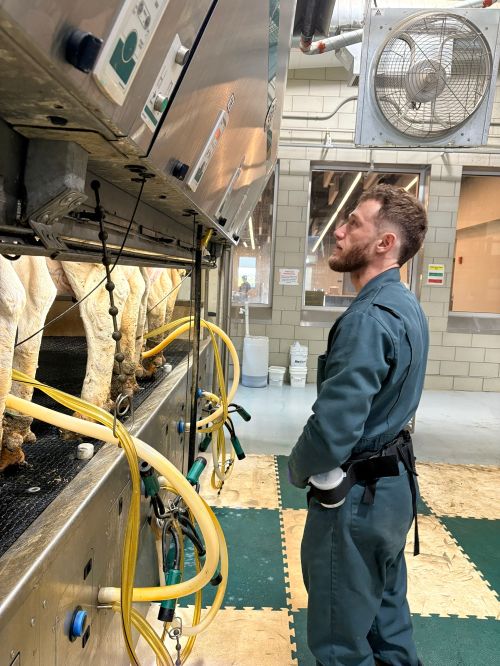
Any dairy farmer knows that farm employees play a critical role in producing high-quality milk. This is especially true for milking technicians who work in the parlor milking cows. In the United States, about 70% of milking technicians have less than one year of work experience on dairy farms. This can contribute to protocol drift or deviations from the correct milking routine.
A recent study conducted by Dr. Zelmar Rodriguez was published in the Journal of Dairy Science. It evaluated the impact of a single training session on milking performance and milk quality outcomes on 16 dairy farms in Michigan and Ohio. Before the training session, each milking parlor was observed to determine if inadequate teat disinfection, inconsistent pre-milking stimulation or incorrect lag times occurred in the parlor. Workers also completed knowledge assessments before the training occurred.
After the observation period, the trainer developed a customized session based on the issues present in the milking parlor. The trainer used examples from the farm and led discussions with the workers to explain both how to perform the task and why it matters. After training, the workers took a knowledge assessment again and the trainer observed the parlor.
There were immediate and measurable results after training. Before the training, workers answered about 49% of questions correctly on the pre-training knowledge assessment. After training, workers answered about 68% of questions correctly.
Beyond the knowledge increase, there were improvements in the milking routine. Premilking disinfectant contact time increased by nine seconds, and the percentage of adequate preparation lag times increased from 31% before training to 52% after training. The percentage of insufficient teat dip coverage decreased by 40%. Further, the time per cow in the parlor decreased by 43 seconds after training.
The researchers also compared bulk tank somatic cell counts and clinical mastitis rates before and after the training. Before the training, bulk tank somatic cell counts were trending upwards. After the training, they leveled off. Interestingly, clinical mastitis cases detected increased after training. This was likely due to workers correctly identifying abnormal milk due to a clinical mastitis infection after the training.
This study demonstrates the value of training on dairy farms. Training should focus on examples actually occurring on the dairy farm, help workers understand why tasks are important, and teach workers exactly what they can do to improve. Even this short, one-time training showed clear benefits on the dairy farms involved in this study, showing that farms should consider employee training an important tool in their milk quality program.
Learn more at Dr. Ruegg’s website and YouTube channel or read the complete journal article.