Erb Family Foundation Continues Support for MSU’s Institute of Water Research to Advance Water Quality Efforts in the Western Lake Erie Basin
 Print
Print Email
EmailErb Family Foundation Continues Support for MSU’s Institute of Water Research to Advance Water Quality Efforts in the Western Lake Erie Basin
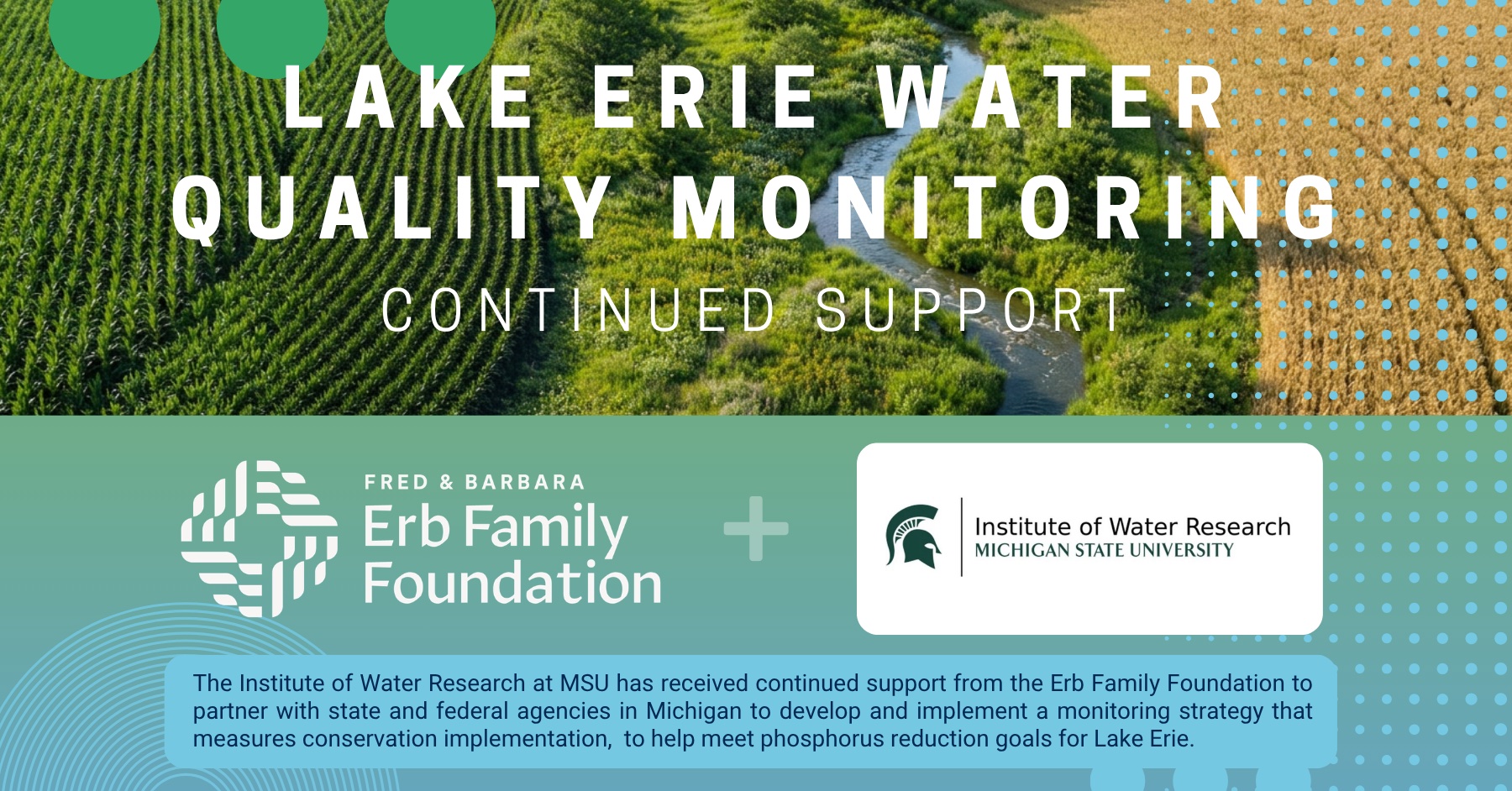
The Institute of Water Research (IWR) at Michigan State University is pleased to announce continued support from the Fred A. and Barbara M. Erb Family Foundation to advance water quality monitoring and conservation efforts in Michigan’s portion of the Western Lake Erie Basin.
The renewed funding will help IWR continue its partnership with state and federal agencies, conservation organizations, and local stakeholders to develop and implement a science-based monitoring strategy that measures the impact of conservation practices across the region. The work supports Michigan’s goal of reducing phosphorus entering Lake Erie by 40 percent, a target established to improve water quality and reduce harmful algal blooms.
Lake Erie is one of the most valuable natural resources in the Great Lakes region, providing drinking water, recreation, tourism opportunities, and habitat for fish and wildlife. However, excess phosphorus from the landscape can contribute to harmful algal blooms that threaten water quality, public health, and local economies. Reducing these nutrient inputs is a critical challenge that requires both effective conservation practices and reliable ways to measure progress.
The continued support from the Erb Family Foundation allows IWR and its partners to strengthen monitoring efforts throughout Michigan’s Western Lake Erie Basin. The project focuses on identifying where water quality data is needed most, improving monitoring networks, and evaluating whether conservation practices are successfully reducing nutrient losses from the land into rivers and streams.
“This grant is critical for developing a science-based approach to strategically monitor, evaluate, and improve water quality across Michigan’s portion of the Western Lake Erie Basin,” said Jeremiah Asher, Assistant Director at IWR. “It will help ensure that conservation investments are guided by reliable data and measurable outcomes that support both agricultural resilience and long-term environmental stewardship.”
The monitoring strategy builds upon a collaborative effort involving the Michigan Department of Agriculture and Rural Development, the Michigan Department of Environment, Great Lakes, and Energy, the Michigan Department of Natural Resources, the U.S. Geological Survey, the Alliance for the Great Lakes, and other partners. Together, these organizations are working to better understand where phosphorus is entering waterways, how conservation practices are performing, and where future investments can have the greatest impact.
The plan also supports long-term efforts to improve transparency and accountability. By collecting and analyzing water quality data over time, researchers and agency partners can track progress toward nutrient reduction goals, identify areas that need additional attention, and provide information that helps guide future conservation decisions.
For Michigan farmers, communities, and residents, this work represents an investment in healthier waterways and stronger environmental outcomes. By combining scientific monitoring with on-the-ground conservation efforts, partners can better understand what works, where improvements are needed, and how resources can be used most effectively.
The Institute of Water Research is grateful for the Erb Family Foundation’s continued commitment to protecting Michigan’s water resources. This support will help ensure that Michigan has the information, partnerships, and tools needed to make measurable progress toward cleaner water and a healthier Lake Erie for future generations.