First Fast Fonz Facts of the 2026 field crops season
 Print
Print Email
EmailIn this addition of “what is eating my row crop field now?” learn about the risk of alfalfa weevil, seed corn maggot, slugs, true armyworm and black cutworm.
The 2026 season has kicked off and so have the insects! With the recent weather, moths are starting to blow in from the south and the Michigan State University Extension field crops team has been busy trapping for insect numbers in order to keep you updated. The following are updates and observations from MSU field crops entomologist Chris DiFonzo, PhD.
Tweaks to the MSU field crops insect management guide
The MSU field crops insect management guide was updated and handed out at winter meetings. An additional update will be added online to include the new insecticide isocycloseram in the corn and soybean sections. There is also an organic version available now.
Alfalfa weevil larval feeding
Alfalfa weevil larval feeding has started in southern counties. The growing degree-day (GDD) total, using base 48 degrees Fahrenheit, since Jan. 1 is useful to predict egg hatch (300 GDD), feeding by small (301-438 GDD) or large (439-595 GDD) larvae, and the start of pupation (greater than 596 GDD). Here are GDD totals and predicted alfalfa weevil stages at representative sites in south and central counties as of April 29:
- Eggs haven’t hatched yet in St. Clair County (225 GDD), Ithaca (278 GDD) or Kinde in the Thumb (156 GDD).
- Small larvae and light feeding are present in Allegan (373 GDD), East Lansing (330 GDD) and Monroe County (311 GDD).
- Fields in Cassopolis (414 GDD) and Coldwater (399 GDD) are close to transitioning to larger larvae and more feeding, although the current cooler weather pattern will slow things down.
It’s easy to track weevil development closer to your location. Simply choose a nearby Enviroweather station at mawn.geo.msu.edu. Under the “Custom reports” drop-down menu, pick “Growing Degree-Day Data.” In the table that pops up, be sure to set the base temperature to 48 and the start date as Jan. 1. Then hit “Generate Report” to generate a table of GDDs by date. Scroll to the bottom of the output for the GDD total, under the column BKEM-SUM. If you have any problems doing this, email me at difonzo@msu.edu and I can send something that’ll help walk you through it.
Do not spray based on the model output! The model simply predicts the stage of the population based on local GDDs, but it doesn’t tell you if or how many larvae are present. Scout field to be sure larvae are present and feeding. A quick threshold is 40% of stems with feeding, based on assessing at least 100 stems across a field. If you are within 10 days of cutting, early harvest is much preferred to keep weevil parasitoids in your fields. Alfalfa fields also produce numerous beneficial insects that move into neighboring corn and beans later in the season.
A spike in true armyworm trap catches
True armyworm trap catches spiked in sporadic locations as moths move on weather fronts from south to north. The Ohio State University trapping network reported high trap catches for the last two weeks in northwest Ohio. In southwest Michigan, MSU Extension field crops educator Nicolle Ritchie reported 125 and 83 moths over the last two trapping periods.
Moths lay eggs on grassy weeds and wheat. In mid-May, check your wheat fields for feeding and larvae. Larvae will be up on plants (especially on a cloudy day) and on the ground under residue. Count both towards the threshold number per square foot: four larvae before heading, two larvae at heading. It’s well worth catching infestations before larvae strip flag leaves and clip heads, as you can see in this throwback video. If found in time, larvae can be well-controlled, and this will also prevent them from marching into neighboring corn fields.
The arrival of black cutworm moths
Black cutworm moths have also arrived in Michigan. The Ohio State University trapping network reported a catch of over 30 moths in a week in Fulton and Lucas counties in northwest Ohio, south of Dundee, Michigan, although catches in Michigan haven’t been as high. Intensive captures simply mean that a significant number of moths have arrived.
Black cutworm is attracted to weedy areas for egglaying. Note which corn fields currently have low-growing broadleaves, especially mats of chickweed or dead nettle. After burndown, remember to scout these same fields for cut or damaged plants (the threshold is 5%). Ideally, if there is a long enough time (two weeks) between dead weeds and crop emergence, many larvae will starve. In practice, the gap between herbicide application and emergence is short or the weeds die slowly. Thus, larvae can move from the dying weeds onto corn.
Got maggot or slug damage? Turn that into useful data
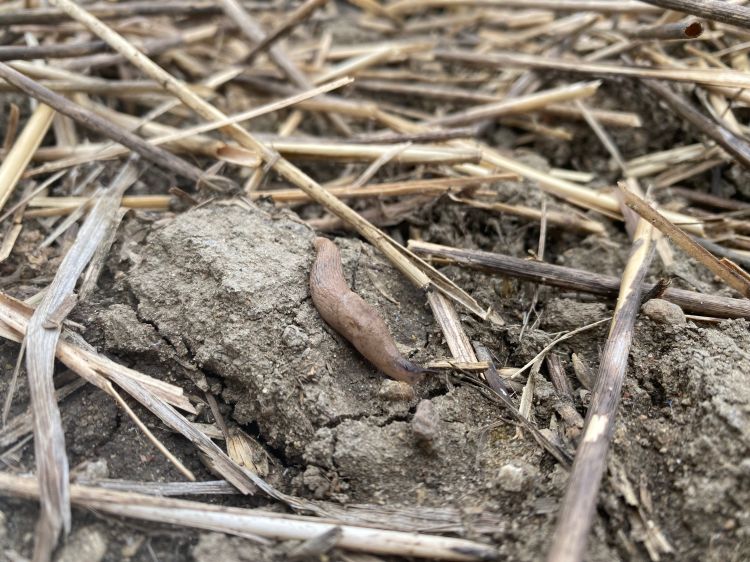
Anders Huseth, PhD in the MSU Department of Entomology is looking for seedcorn maggot- and slug-damaged corn and soybean fields. The goal is to map damage across Michigan to better understand key risk factors at the field and farm scale. What Huseth will ask of you: agronomic inputs and practices, variety, latitude/longitude of the field, and grower contact information. Please reach out to Huseth at huseth@msu.edu or 517-353-5134, or your local MSU Extension field crops educator.