


Haemonchus contortus thrives in the Upper Midwestern United States
 Print
Print Email
EmailHaemonchus contortus, also known as the barber pole worm, is the dominant parasite of sheep and goats in the Upper Midwest. Understanding local gastrointestinal nematode populations helps producers develop effective control programs.
In the United States, there is a perception that the gastrointestinal nematode (GIN), Haemonchus contortus (common name barber pole worm), is a dominant parasite of sheep and goats in certain geographical areas like the Southeastern U.S. and not as significant in other regions, including the Upper Midwest (loosely defined as Ohio, Indiana, Michigan, Wisconsin, Minnesota, Iowa and Illinois). While the origin of this perception is unclear, we offer evidence that it is inaccurate, as we consistently find that Haemonchus dominates the parasite population in large flocks surveyed throughout the year in Michigan. Understanding the GIN population structure is important in developing effective integrated control programs, as it determines the choice of GIN infection control strategy.
It is clear that Haemonchus thrives in warm, humid environments that present optimal egg hatching and larval development conditions. In Michigan, there is great diversity in climate given the range of latitude (42nd-46th parallels) and proximity to one of four Great Lakes; however, despite this diversity in microclimate, there are significant stretches of warm, humid weather in all of them that are conducive to Haemonchus development.
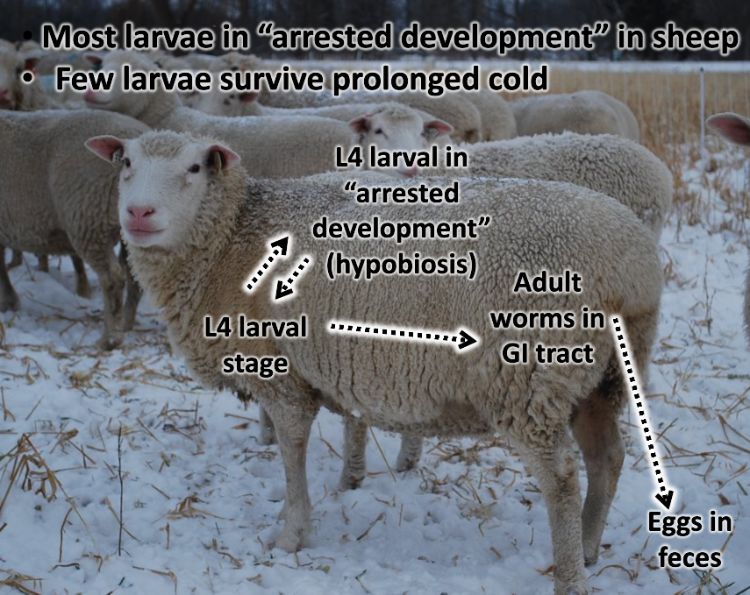
The extent and duration of cold during a Michigan winter in all microclimates kills the vast majority of the free-living, terrestrial population of Haemonchus as confirmed by studies performed at the Michigan Agriculture Experiment Station in the 1940’s. However, while the free-living population is decimated, the population living within the animal is doing just fine as it enters a state of arrested development, or hypobiosis, allowing it to survive until warm weather arrives the following spring (see Figure 1). This arrest wanes markedly at birth, which in many flocks/herds coincides with warm spring weather, thus quickly repopulating pastures and propagating a year-round life cycle even in cold, frozen climates.
Based on this well-documented life cycle, it was not a surprise to find Haemonchus as a major player in the GIN population in the Upper Midwest; however, what did surprise us was how it dominated the GIN population in the flocks we surveyed at all times of the year (Figure 2).
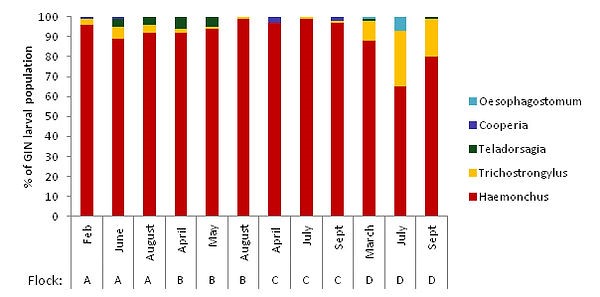
Michigan State University Extension recommends using caution when extrapolating this finding to the entire region, as it is likely that greater GIN population diversity could be found if a larger sample representing a broader range of flock size was surveyed. However, it is striking how consistently Haemonchus dominated the GIN population in these large flocks, which represent a large number of ewes (approximately 3,600 ewes). These flocks varied in location from the far North to the South of Michigan and represented both pasture-based systems as well as those with significant confinement rearing periods.
These findings corroborate field reports in the Upper Midwest indicating that Haemonchus is the dominant GIN species. Furthermore, these findings suggest that targeted selective treatment programs targeting Haemonchus are appropriate strategies for use in many flocks/herds. Because Haemonchus causes severe anemia, monitoring parasite infection status with indicators of anemia (i.e. FAMACHA) can be effective parts of an integrated parasite management program in this region.