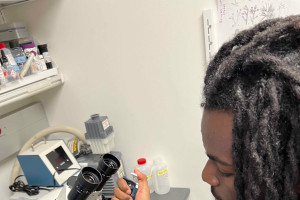
KBS / PSM Post-doc researcher Kaitlin Gattoni presents her work on prairie strips at seminar
 Print
Print Email
EmailKaitlin, who works directly with Dr Christine Sprunger, recently presented highlights of her research spanning studies on the community assembly of nematodes in the Nebraska Sandhills and the effects of prairie strips in row crop fields in Iowa.
View Kaitlin's presentation of MSU MediaSpace
A key focus of her work is the use of 18S rRNA sequencing, currently one of the most effective molecular tools for identifying nematode communities. As this field rapidly advances, Kaitlin and her colleagues are gaining more detailed insight into nematode diversity than ever before, opening new doors for understanding soil ecosystems.
Nematodes are particularly valuable as indicators of soil health due to their sensitivity to environmental disturbances. However, as Gattoni emphasized, this sensitivity also points to a critical knowledge gap: scientists still need a clearer understanding of which disturbances most affect nematode communities and the mechanisms behind these responses.
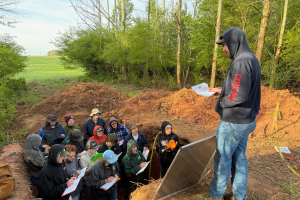
Her research also reinforces the benefits of prairie strips in agricultural systems. These long sections of native plants that run through ag fields appear to significantly enhance nematode diversity well beyond the physical borders of the strip, offering strong evidence that they contribute to improved soil health.
An alumna of Auburn University and the University of Florida, Gattoni demonstrates a strong command of her research trajectory, effectively integrating her publication history into a cohesive narrative.
Looking ahead, she is continuing her work at Kellogg Biological Station (KBS), where ongoing data collection will further illuminate soil ecosystem dynamics across various management regimes. She also expressed interest in building partnerships with other investigators, inviting collaboration to expand the impact of this research.
By improving our understanding of soil health indicators, her research has practical implications for farmers, land managers, and conservationists seeking sustainable, resilient agricultural practices.