Life Cycle Assessment of Compostable and Conventional Coated Paper Plate Production and Disposal in the United States
 Print
Print Email
EmailLCA of coated paper plates finds that ionized PBAT (P35/P36) can cut climate impacts vs LDPE/acrylic when coating is reduced, and plates are composted or recycled at 93.6%, improving landfill diversion despite higher coating-production impacts.
Dwi P. Y. Yudison, Syeda Shamila Hamdani, Hazem M. Elkholy, Muhammad Rabnawaz, Rafael Auras
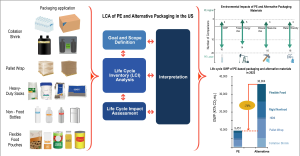
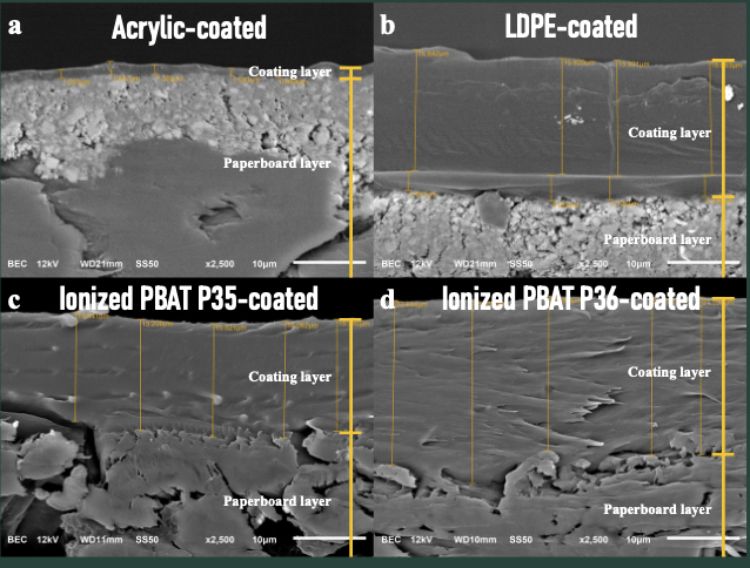
Food contamination and the type of coating material used on coated paper plates prevent recycling and increase landfill waste, creating environmental concerns. Biodegradable coating materials generally provide a more favorable environmental impact. This study evaluates the potential environmental footprints of biodegradable paper plates coated with ionized poly (butylene adipate-co-terephthalate) (PBAT) in two variants (P35 and P36) compared with conventional paper plates coated with an acrylic-based polymer or low-density polyethylene (LDPE). Ionized PBAT is a compostable and biodegradable polymer modified to enhance its aqueous solution dispersibility before coating application. An ISO-compliant cradle-to-gate (production) plus end-of-life (disposal) life cycle assessment (LCA) was conducted for functional units of 100 paper plates with a 20.32 cm diameter. SimaPro version 9.6.0.1 and the DATASMART US-EI 2.2 database were used to model the life cycle inventory. Four coated paper plate types were modeled, considering variations in coating materials, thickness, and end-of-life scenarios, including composting and high recycling rates. TRACI 2.1 midpoint impact method was applied to perform impact assessment and to analyze contribution, sensitivity, and uncertainty/discernibility within the system. Ionized PBAT–coated paper plates initially have a higher environmental footprint due to the coating material production; however, reducing the coating amount mitigates this impact. When matched for coating thickness and composted or recycled at a rate of 93.6%, ionized PBAT P36- coated paper plates show a lower global warming potential than the other two options, highlighting their potential to improve landfill diversion for contaminated paper products.