Managing aphids in vegetables: Population suppression vs. virus prevention
 Print
Print Email
EmailSuccessful aphid management begins with identifying the primary production challenge. Matching management tactics to the production goal allows for more effective, economical and sustainable decisions.
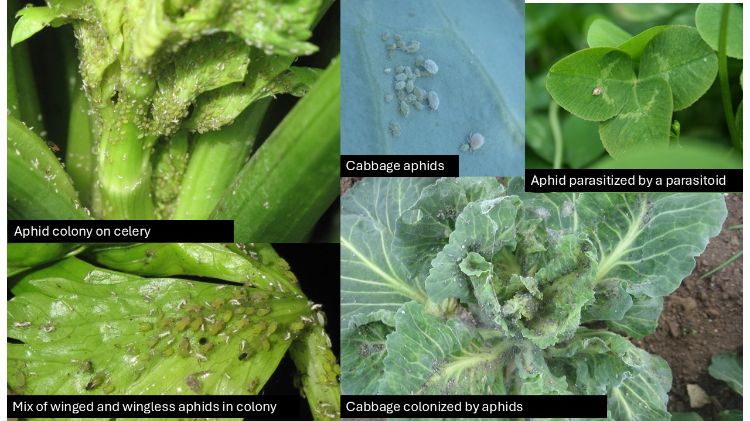
Aphids are among the most common insect pests of vegetable crops. They can reduce plant vigor through feeding, contaminate produce with honeydew, and transmit numerous plant viruses. Although aphids are a common pest across many vegetable crops, the best management strategy depends on the production goal.
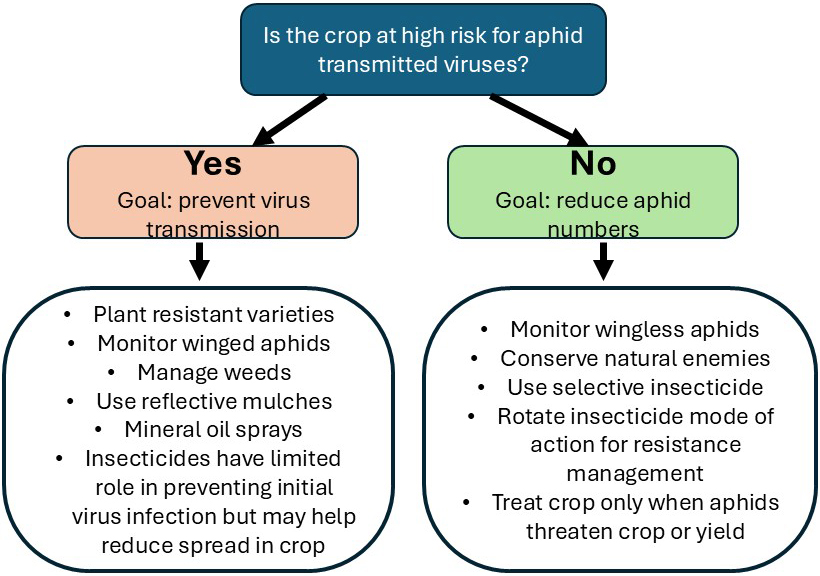
The first question to ask when aphids are detected is not "What insecticide should I spray?" Instead, ask “Is my crop primarily at risk from aphid feeding or from aphid-transmitted viruses?” The answer determines the most effective management strategy.
Two different management goals
1. Crops where aphid feeding is the primary concern
In many vegetable crops, aphids become problematic only after they establish colonies and populations increase. Colonizing aphids remove plant sap, produce sticky honeydew, contaminate harvested produce, and may reduce plant vigor when populations become large. For these crops, growers can often allow small aphid populations to develop while relying on regular scouting and natural enemies to suppress population growth. Insecticides are applied only when populations reach economically damaging levels or when produce quality is threatened.
2. Crops where virus transmission is the primary concern
Some vegetable crops are highly susceptible to aphid-transmitted viruses. Cucurbits are a classic example because viruses such as cucumber mosaic virus, watermelon mosaic virus and zucchini yellow mosaic virus can cause severe yield and quality losses. Unlike colonizing aphids, even a few winged aphids moving through a field can introduce viruses. Many of these viruses are non-persistent, which means they can be transmitted by probing alone and do not require the aphid to stay and feed on the plant. This means plants can become infected within seconds of an aphid landing on a plant.
Because virus transmission frequently occurs before an insecticide can kill the aphid, simply applying foliar insecticides may do little to prevent primary virus infection. For virus-prone crops, the management objective shifts from killing aphids to reducing opportunities for virus transmission.
Choosing the right tool for your management goal
|
Insecticide category |
Insect contact required? |
Systemic? |
Typical residual activity |
Relative impact on natural enemies |
Typical examples |
Best for colonizing aphids? |
Best for virus-prone crops? |
|
Contact (broad-spectrum) insecticides |
Yes |
No |
Short - moderate |
High |
Pyrethroids (e.g., bifenthrin, lambda-cyhalothrin), organophosphates (e.g., dimethoate), carbamates |
Good knockdown of established colonies |
Not effective for reducing virus transmission which often occurs before aphids are killed. |
|
Selective insecticides |
Not always |
Varies* |
Moderate - long |
Low to Moderate |
Sivanto, Beleaf, Movento, Transform, Assail |
Excellent for suppressing established populations |
Limited ability to reduce virus transmission. |
|
Soaps and horticultural oils |
Yes |
No |
Short |
Low |
Insecticidal soaps, horticultural oils, mineral oils |
Useful for small infestations |
Repeated mineral oil sprays can reduce transmission of many non-persistent viruses. |
|
Biopesticides |
Usually yes |
No |
Short |
Low |
Beauveria bassiana, Cordyceps fumosorosea, azadirachtin, pyrethrins |
Useful with repeated applications |
Virus transmission often occurs before aphids are killed. |
|
Seed treatment insecticides |
No |
Yes |
Several weeks after planting |
Low to Moderate |
Neonicotinoids: thiamethoxam, clothianidin, imidacloprid |
Useful for early-season suppression |
May reduce colonization but generally is not used to prevent non-persistent virus transmission. |
*Systemicity varies among selective insecticides. Products such as Sivanto and Movento are systemic, whereas Beleaf is primarily translaminar with limited movement within the plant.
Management recommendations for colonizing aphids
When aphid feeding is the primary concern, integrated pest management should focus on regular scouting, conserving natural enemies and treating only when populations threaten yield or crop quality. Selective insecticides are often preferred because they suppress aphid populations while minimizing impacts on predators and parasitoids. Rotate insecticides among IRAC mode-of-action groups to delay resistance. Some of the most damaging aphid species found in Michigan are notorious for developing resistance to insecticides.
Management recommendations for virus-prone crops
When aphid-transmitted viruses are the primary concern, management should emphasize preventing virus introduction. Use resistant varieties when available, remove weed hosts and volunteer plants, consider reflective mulches, and apply mineral oils at regular intervals to reduce transmission of many non-persistent viruses. Insecticides alone generally cannot prevent initial virus transmission, but they can help reduce the further spreading of the virus in the crop field.
This work is supported by the Crop Protection and Pest Management Program (grant no 2024-70006-43569) from the USDA National Institute of Food and Agriculture. Any opinions, findings, conclusions, or recommendations expressed in this publication are those of the author(s) and do not necessarily reflect the view of the U.S. Department of Agriculture.