Michigan vegetable crop report – August 27, 2026
 Print
Print Email
EmailDisease pressure is increasing in some crops. Whitefly and spider mites pressure remains high while corn earworm pressure was also high in west-central locations.
Weather
For the past week, temperatures were near- to below-normal. Precipitation ranged from very little in the eastern Upper and western Lower, to more than 2 inches in the eastern half of the Lower Peninsula. Degree-day totals (base 50 Fahrenheit) remain within a few days of normal.
- Mostly fair and dry Thursday through Saturday statewide. Scattered showers possible again Sunday and Monday.
- Precipitation totals ranging from up to an inch or so in the Upper Peninsula to 0.25-0.5 inches S.
- High temperatures generally from the mid-upper 70s N to low 80s S through Friday, cooling slightly to the upper 70s this weekend and then warming to the low-mid 80s early next week. Low temperatures from the 40s N to mid 50s S through Saturday warming to the upper 50s N to low-mid 60s S by early next week.
- Medium range guidance suggests above normal mean temperatures and near to above normal precipitation totals. The new long lead guidance calls for near to above normal mean temperatures and near to below normal precipitation totals for the upcoming fall season.
Cover Crop Workshop
MSU Extension and the Tuscola Conservation District are hosting the second year of their hands-on workshop on Sept. 3, 2026, at the Saginaw Valley Research and Extension Center. This interactive event is designed for row crop and vegetable producers, both conventional and organic, as well as anyone interested in learning more about cover crops, regenerative agriculture and soil health. The event is free, but registration is required. Visit the registration link to reserve your spot.
The Midwest Mechanical Weed Control Field Day returns to Michigan
The Midwest Mechanical Weed Control Field Day is on Sept. 16, 2026, at the Southwest Research and Extension Center in Benton Harbor, Michigan. The event will feature hands-on demonstrations of mechanical weed control equipment and emerging technologies. Vegetable growers can learn about new tools and strategies for improving weed management. Learn more about the event in the following article or visit the event registration page.
New website for grass identification
Check out this new online grass identification tool produced by Michigan State University. It is targeted at weedy grasses that are present in turf, but some of these are issues in agriculture as well. It could be a good learning tool since grass identification is challenging.
Crop updates
Asparagus
Between 8-11 DSVs accumulated between August 18-24 at six sensors MSU Extension is monitoring in Oceana County asparagus. A fungicide application would have been due Monday at these locations if nothing had been applied since August 10-14.
Common asparagus beetle grubs had been active at some locations over the past few weeks. If they haven’t already, these larvae will drop to the ground, pupate in the soil, and emerge as the overwintering generation of beetles. These beetles will seek shelter in dead asparagus stems, leaf litter, and other nooks and crannies to survive winter cold and emerge during next year’s harvest. Learn more about where they overwinter here.
As we enter the last months of the fern season, consider that this year’s management can affect the pests and pathogens that create next year’s issues. So continued attention to management may have benefits beyond this year’s fern health. Both purple spot and rust will overwinter on dead, infected fern from this year, and the asparagus beetles that overwinter this fall will lay eggs on spears in spring.
Carrots and celery
For carrots, 9 DSVs accumulated between August 18-24 at one sensor in Oceana County carrots MSU Extension is monitoring. A fungicide application would have been due Monday at this location if nothing had been applied since August 13.
Twospotted spider mites have been reported on carrots. Spider mites can be attracted to drought stressed plants.
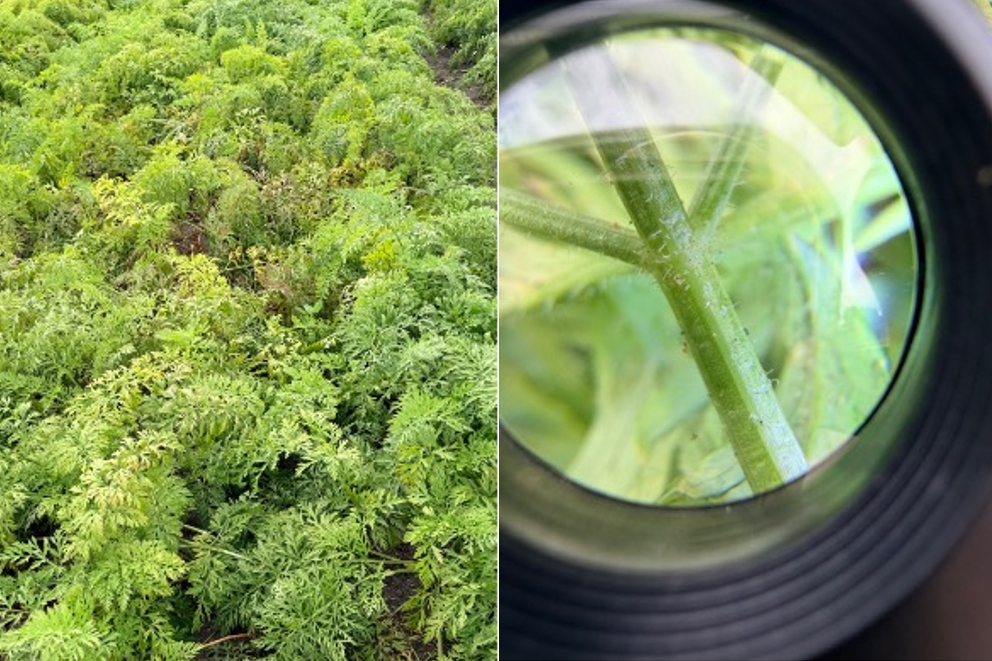
Alfalfa mosaic virus has been detected in carrots. Infected plants may have chlorosis, deformed foliage, stunting, and premature death. This virus is spread from plant to plant by aphids, including the green peach aphid, in a non-persistent manner. This means aphids can transmit the virus quickly while probing plant material. They do not carry the virus for extended periods. Once plants are infected with the virus there are no effective treatment options. If it is feasible, rogue and destroy infected plants.
Cucurbits
Powdery mildew is being seen on pumpkins. For information on controlling pests in pumpkins in the later parts of the season, check out the MSU Extension article “Pumpkin management in the final stretch”.
Cucurbit downy mildew is being reported on more farms in Michigan. Read the latest article on cucumber downy mildew.
Cucurbit downy mildew spores continue to be captured across Michigan State University’s trap network. To date, all spores are clade 2, which affects cucumbers and melons. Clade 1, which affects pumpkins and squash, has not been detected (and only occurs some years in Michigan). Read this article for more information and a list of effective fungicides. As always, you can track the spread of downy mildew with the Cucurbit Downy Mildew forecasting website.
Fruiting vegetables
High numbers of aphids have been reported in field tomatoes. Aphid populations tend to increase during periods of hot, dry weather. Tomatoes can tolerate large aphid populations without significant yield loss. However, severe infestations can cause leaves to curl and may stunt plant growth. Aphids can also transmit viruses.
If you are planning to apply insecticide, be sure to check the pre harvest interval (PHI) and read the product label carefully. The same insecticide might have different pre harvest intervals for different crops.
Sweet corn
Corn earworm trap numbers were variable across locations Michigan State University Extension is monitoring. To our south, corn earworm was present at low numbers in Ohio State University’s trapping network, with one northwest county having elevated captures, as of August 23.
Table 1. Corn earworm captures. Total in trap for week1 (avg # per night2).
|
Week |
Ottawa Co.4 |
Oceana Co.4 |
Washtenaw Co.3 |
Monroe Co.3 |
Saginaw Co.3 |
Lapeer Co.3 |
Genesee Co.3 |
Midland Co |
|---|---|---|---|---|---|---|---|---|
|
June 28 |
15 (1.5) |
- |
- |
- |
- |
- |
- |
- |
|
July 5 |
15 (1.5) |
0 |
- |
- |
- |
- |
- |
- |
|
July 14 |
15 (1.9) |
5 (0.8) |
0 |
- |
2 (0.2) |
6 (0.8) |
1 (0.1) |
- |
|
July 21 |
10 (1.4) |
8 (1.1) |
0 |
0 |
10 (1.4) |
1 (0.1) |
0 |
1 (0.1) |
|
July 28 |
10 (1.7) |
17 (2.4) |
0 |
0 |
4 (0.6) |
0 |
0 |
1 (0.1) |
|
August 4 |
4 (0.8) |
13 (1.9) |
0 |
2 (0.3) |
2 (0.2) |
0 |
0 |
1 (0.1) |
|
August 11 |
- |
- |
1 (0.1) |
2 (0.1) |
1 (0.1) |
0 |
0 |
0 |
|
August 18 |
188 (11.8)* |
83 (5.9)* |
- |
16 (2.3) |
0 |
5 (0.7) |
6 (0.8) |
0 |
|
August 25 |
85 (17.0) |
332 (47.4) |
- |
12 (1.7) |
2 (0.2) |
- |
16 (2.3) |
6 (0.8) |
1Total number collected since last trap check; 2The total number divided by the number of nights since the last trap check; 3Cloth Heliothis traps track trends but catch less moths overall; 4Wire Harstack traps capture more moths. *This is a two-week total as traps were not emptied the week of August 11.
The insect forecast website predicts a low risk of additional corn earworm migration for this Friday, Aug. 28. Check your traps Saturday morning.
Produce Food Safety On-Farm Readiness Reviews
Schedule an On-Farm Readiness Review (OFRR) today for a two-hour educational visit that takes place during the harvest season and is meant to be casual and low stress! Everything discussed during an OFRR is confidential, and focused on ways a grower can reduce their own risks in relation to produce safety. There is no pressure to take our advice either, we are just here to support you in your produce safety efforts!
Events
- August 28, 2026: Washtenaw Conservation District Field Day – Ann Arbor, MI
- August 30, 2026: Bee Palooza - East Lansing, MI
- September 1, 2026: U.P. Potato Field Day – Chatham, MI
- September 3, 2026: Cover Crop Workshop 2- Incorporating Principles of Regenerative Agriculture to Make My Farm More Resilient and Successful- Frankenmuth, MI
- September 3, 2026: Fourth Annual KBS LTAR Field Day - Hickory Corners, MI
- September 9, 2026: Tillage & Soil Health Field Day – La Salle, MI
- September 10-11, 2026: Great Lakes Tek Flex – Benton Harbor, MI
- September 16, 2026: 2026 Midwest Mechanical Weed Control Weed Day – Benton Harbor, MI
- The Midwest Transition to Organic Partnership Program (TOPP) has provided funding to cover admission for any Illinois or Indiana grower and the first 50 Michigan farmers interested in attending this year’s event. Illinois farmers, please use the coupon code ILLINOIS26 when registering. Indiana growers, please use the coupon code INDIANA26, and Michigan farmers please contact Mariel Borgman at mborgm@msu.edu for coupon code.
- September 16-17, 2026: Thumbs-up for Sustainability Farm Tour for beginning farmers.
- September 22-24, 2026: Farm Science Review 2026 – London, OH
- October 1, 2026: “I have no fogging clue!” Greenhouse Workshop - Deneweth’s Garden Center, Macomb, MI
- October 4-6, 2026: Northern Michigan Small Farm Conference – Bellaire, MI
- Michigan's Emerging Farmers team is funding 20 farmers to attend this. Funding support will include conference registration fees (including the Sunday farm tour), lodging near the conference, two shared meals, and a stipend to support participants that can be used to cover travel costs. Farmers and producers can apply by Aug. 20. After the short application is submitted, applicants will be notified of their award by Aug. 21 and be asked to accept it and register with the Michigan's Emerging Farmers team by Aug. 30. Accepted participants will be required to attend the full conference (Sunday-Tuesday) as well as a networking lunch with other participants and NIFBE MEF team members, and complete a post-conference survey. A pre-conference virtual orientation session will be optional for participants.
- November 4-6, 2026: Michigan Agritourism 20th Anniversary Convention – Frankenmuth, MI
- December 8-10, 2026: Great Lakes Fruit, Vegetable, & Farm Market Expo – Grand Rapids, MI
This work is supported by the Crop Protection and Pest Management Program (grant no 2024-70006-43569) from the USDA National Institute of Food and Agriculture. Any opinions, findings, conclusions, or recommendations expressed in this publication are those of the author(s) and do not necessarily reflect the view of the U.S. Department of Agriculture.