MSU scientist Bruno Basso to be honored for outstanding contributions to agronomic research
 Print
Print Email
EmailBasso will receive the Carl Sprengel Agronomic Research Award Nov. 2 in Portland, Oregon.
PORTLAND, Ore. — Michigan State University researcher Bruno Basso, a world-renowned soil scientist and expert in precision agriculture, will receive the 2026 Carl Sprengel Agronomic Research Award from the American Society of Agronomy, Crop Science Society of America and Soil Science Society of America.
The award will be presented Nov. 2 in Portland, Oregon, at the annual CANVAS event hosted by the three societies — a premier conference linking crop, agronomic, environmental and soil sciences.

Basso is a John A. Hannah Distinguished Professor in the MSU departments of Earth and Environmental Sciences, and Plant, Soil and Microbial Sciences, as well as the W.K. Kellogg Biological Station. His research is also supported in part by MSU AgBioResearch.
The award is named after Carl Sprengel, a 19th century German botanist known as the father of agricultural chemistry for his revolutionary work on plant nutrition. Honorees are recognized for significant research accomplishments in agronomy that lead to practical adoption, including innovations that boost crop quality, yield and sustainability.
“I’m deeply appreciative of this award, which is also a testament to the hard work of my team and colleagues,” Basso said. “We’ve dedicated our careers to making agriculture more productive for consumers, profitable for farmers and sustainable for the environment. Farming is facing a wider variety of challenges than ever before, and continued innovation will be essential to overcoming them.”
Basso’s research has led to more than 270 published papers in some of the world’s leading academic journals. His groundbreaking work is rooted in precision agriculture and the use of drones, satellite imagery and modeling to identify causes and solutions to in-field production variability.
The information generated through his efforts gives growers precise recommendations on applying the appropriate amount of nutrients and water at the correct place and time, saving money, improving yields and lessening environmental impact. His work has been featured in the New York Times, Forbes, PBS and international newspapers, among others.
The recipient of numerous awards, Basso was given the Soil Science Research Award in 2025 from the Soil Science Society of America, one of the most prestigious honors for advancing knowledge in the field of soil science.
He was also presented the Technology Transfer Achievement Award in 2025 from MSU Innovation Center for translating years of crop science into the GeoYields digital agriculture platform. The technology assists farmers with yield and sustainability improvements and helped launch the MSU startup CIBO Technologies, which recently merged to form Terion AI, a company delivering science- and AI-powered solutions for resilient and productive agriculture.
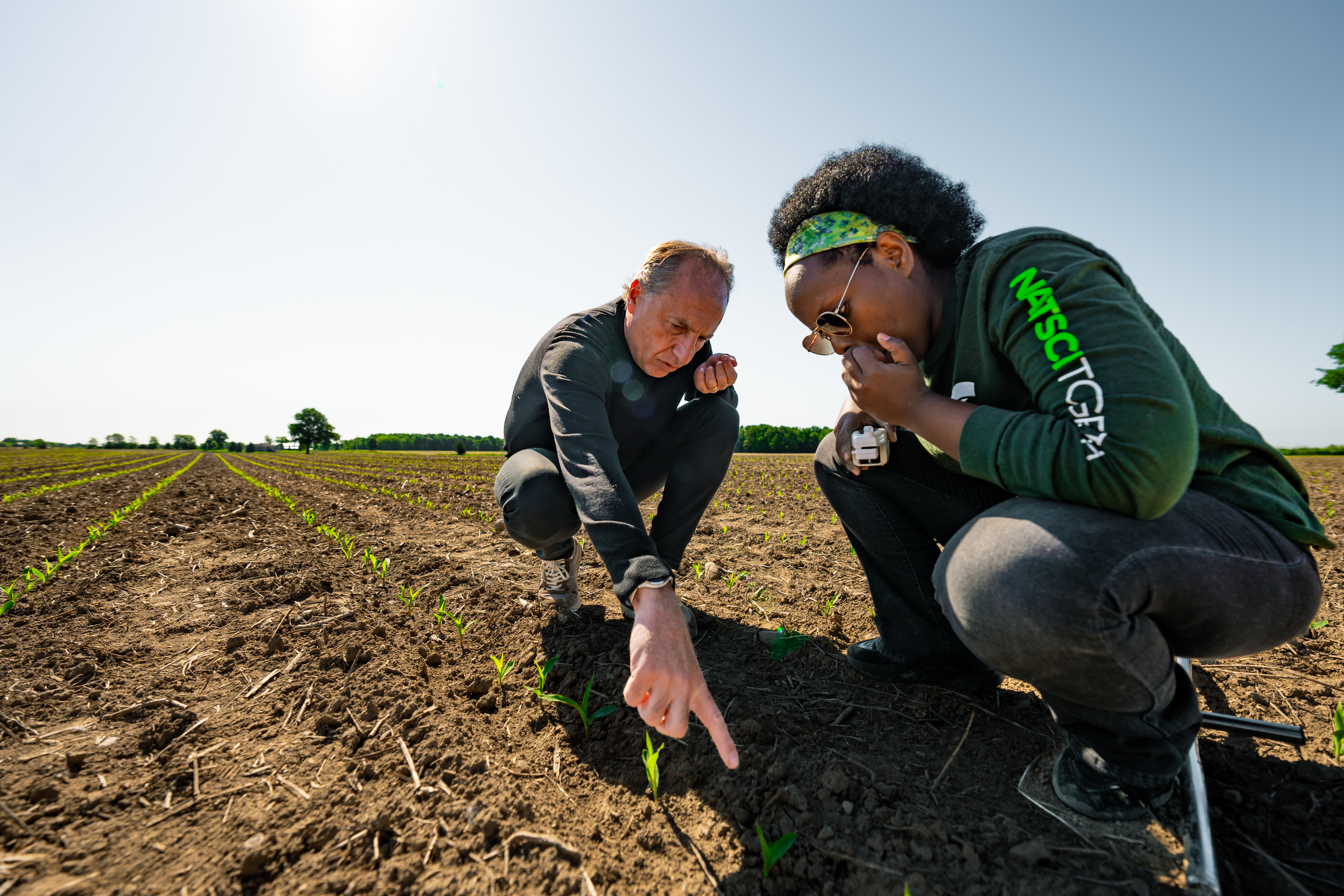
Basso’s other pioneering approaches include the Systems Approach to Land Use Sustainability, which uses data on plant size, nutrients, temperature and soil to model the effectiveness of various management techniques over multiple years and future environmental scenarios.
To quantify soil health, Basso’s team has also created an analysis metric known as yield stability zones. For most farmers, regular soil sampling is prohibitively expensive. By combining soil samples with historical crop yield information and modeling, the team was able to successfully identify in-field variability based on relative soil organic carbon and relative soil health. This gives farmers information on how to best manage nutrients and water, avoiding over-applications while maintaining profitability and reducing harmful environmental impacts.
Recently, Basso’s team developed a novel machine learning system that predicts U.S. cropland nitrous oxide emissions more accurately, which helps to better understand emissions and form mitigation strategies.
“Our research is focused on developing solutions to some of the most important issues facing agriculture, and those solutions must be sustainable long term for both the farmer and the environment,” Basso said. “We want to help farmers understand how our findings are beneficial now and in the future, while also emphasizing to the public how essential our farmers are. I’m fortunate to work with great teams that are passionate about science and helping people.”
Michigan State University AgBioResearch scientists discover dynamic solutions for food systems and the environment. More than 300 MSU faculty conduct leading-edge research on a variety of topics, from health and agriculture to natural resources. Originally formed in 1888 as the Michigan Agricultural Experiment Station, MSU AgBioResearch oversees numerous on-campus research facilities, as well as 15 outlying centers throughout Michigan. To learn more, visit agbioresearch.msu.edu.