New Michigan gardening calendar resources support home gardeners statewide
 Print
Print Email
EmailRegion‑specific gardening calendars help Michigan gardeners schedule planting dates using local frost timing and soil temperature guidance.
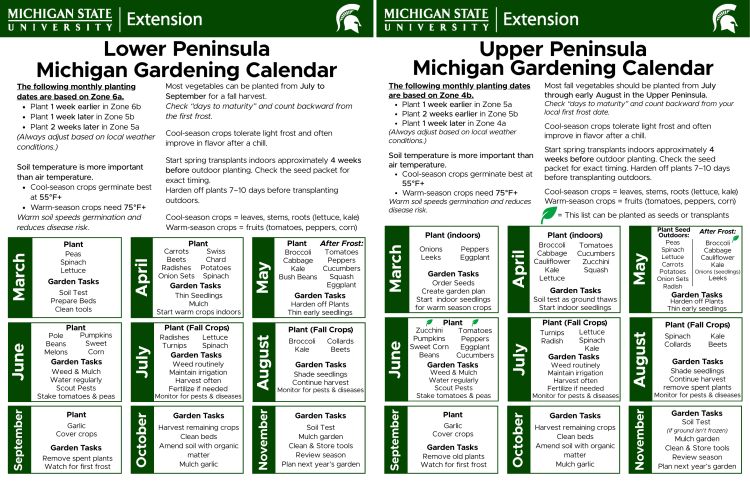
Michigan gardeners now have access to region‑specific gardening calendars designed for planning successful vegetable gardens across the state. Michigan State University Extension has developed separate gardening calendars for the Lower Peninsula and Upper Peninsula, recognizing that Michigan’s growing conditions vary widely depending on location.
Rather than relying on a single statewide planting schedule, the new gardening calendars provide month‑by‑month guidance based on local frost dates, soil temperature thresholds and regional growing conditions.
Why two gardening calendars?
Michigan spans multiple U.S. Department of Agriculture (USDA) plant hardiness zones, and differences in latitude, elevation, and Great Lakes influence can shift planting dates by several weeks. These differences are especially noticeable between the Lower Peninsula and the Upper Peninsula.
The Lower Peninsula Michigan Gardening Calendar is based on Zone 6a, with planting‑time adjustments included for Zones 5a, 5b and 6b. This calendar reflects the earlier soil warming and longer growing season experienced across much of the Lower Peninsula.
The Upper Peninsula Michigan Gardening Calendar was created specifically for gardeners facing a shorter growing season. Based on Zone 4b, with guidance for Zones 4a, 5a and 5b, the calendar reflects later spring frosts and earlier fall frosts common throughout the Upper Peninsula.
Upper Peninsula calendar reflects short‑season realities
Gardeners in the Upper Peninsula often cannot plant warm‑season crops until early to mid‑June. The new Upper Peninsula calendar separates crops that can be planted before frost, crops that should only be planted after frost, and crops suited for late‑summer and fall harvests.
Fall planting guidance is also adjusted for the Upper Peninsula’s early first frost. Rather than planting fall crops into September, as may be possible farther south, the Upper Peninsula calendar emphasizes that most fall vegetables should be planted in July through early August. Gardeners are encouraged to check seed packets for “days to maturity” and count backward from their local first frost date.
Soil temperature plays a key role in planting success
Both calendars emphasize that soil temperature is more important than air temperature when determining planting success. Cool‑season crops such as lettuce, spinach, kale, carrots and onions germinate best once soil temperatures reach 55 degrees Fahrenheit or warmer. Warm‑season crops, including tomatoes, peppers, squash, cucumbers and corn, require soil temperatures of 75 F or warmer to establish properly. Planting into warm soil promotes faster germination, stronger root development and reduced risk of early‑season disease. Cool soil can damage roots and cause nutrient deficiencies, leading to stunted warm season crops. Gardeners can monitor current soil temperatures and weather conditions using MSU Enviroweather.
What gardeners will find in each calendar
The calendars are designed to be practical, easy tools for home gardeners across Michigan.
Both the Lower Peninsula and Upper Peninsula gardening calendars provide:
- Monthly planting recommendations
- Seasonal garden task reminders, such as soil testing, thinning, mulching and hardening off transplants
- Average spring and fall frost dates by USDA Hardiness Zone
- Definitions of cool‑season and warm‑season vegetables
- Links to additional Michigan State University (MSU) resources, including the Michigan Plant Hardiness Zone Map, MSU Enviroweather and MSU Extension’s Gardening in Michigan website.
Where to access the gardening calendars
The Lower Peninsula Michigan Gardening Calendar and the Upper Peninsula Michigan Gardening Calendar are now available to help gardeners plan planting dates using region‑specific guidance.
To learn more about growing vegetables, visit MSU Extension’s Gardening in Michigan.