New PNAS Study Maps Global SDG Progress - Uneven SDG Gains and Challenges Ahead
 Print
Print Email
EmailAn international team, including CSIS member and Alumni, maps global progress toward Sustainable Development Goals by analysis 117 SDG indicators across 167 countries.
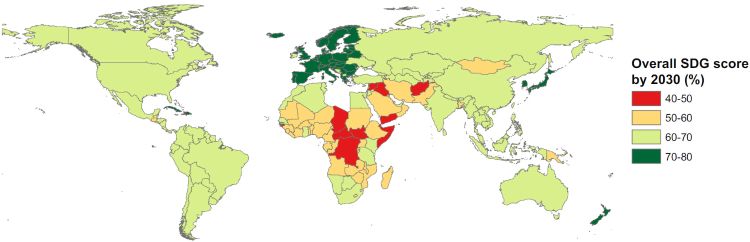
A new international study provides one of the most comprehensive country-by-country views yet of SDG progress—looking backward, assessing the present, and projecting prospects to 2030. Using long time-series data for 117 SDG indicators across 167 countries, the researchers find that overall advancement remains uneven, fragile, and insufficient to meet the 2030 targets. It projected that the global SDG achievement will reach about 63% by 2030.
The research paper, published in December 2025 in the Proceedings of the National Academy of Sciences (PNAS), brings together scientists from eight countries across four continents — including Jianguo “Jack” Liu, Rachel Carson Chair in Sustainability and director of MSU’s Center for Systems Integration and Sustainability and two CSIS previous Ph.D. students, Zhenci Xu and Yingjie Li — to provide a comprehensive assessment of how far countries have come since the SDGs were adopted in 2015 and what lies ahead.
The paper, “Country-specific progress toward the Sustainable Development Goals: Past, present, and prospects”, synthesizes long-term SDG indicator data for 167 countries and 117 global indicators drawn from the SDG Index/SDSN database and additional public and satellite-based sources, then compared average annual change rates before vs. after SDG adoption of 2015 to classify trends as advancement, regression, or stagnation, and projected country-specific outcomes to 2030 using a neural network time-series forecasting approach at the indicator level. The study evaluates past trends, current conditions, and future prospects for achieving the SDGs, which were adopted by all UN member states in 2015.
“Our analysis shows that progress toward the SDGs is real, but it is highly variable across countries and goals,” said Liu, Rachel Carson Chair in Sustainability and director of MSU’s Center for Systems Integration and Sustainability. “Some nations have improved rapidly, especially those starting from lower baselines, while others have slowed or even reversed progress in key areas.”
The study reveals that countries with lower initial SDG performance often show faster improvement, whereas countries with higher baseline scores tend to experience slower gains or stagnation. Progress also varies sharply among goals.
Indicators related to infrastructure development, industrial modernization, and scientific capacity have improved in many regions, while goals tied to health systems, disease prevention, and social protection continue to lag — including in some high-income countries.
Using historical trends to project future outcomes, the researchers estimate that global SDG achievement will reach only about two-thirds of the 2030 targets if current trajectories continue.
Liu has long emphasized that SDG progress can’t be understood only in aggregates. “These results underscore that progress on one goal does not guarantee progress on others,” Liu said. “Sustainable development requires coordinated action across sectors rather than isolated advances”.
The findings highlight the need for targeted, country-specific strategies that reflect different starting points, capacities, and challenges. They also emphasize the importance of international cooperation, particularly in addressing systemic barriers such as data gaps, unequal resource access, and cross-border spillover effects. As Liu put it in the release for the paper published in Nature Communications this year on SDG measurement tools, “Achieving the SDGs by 2030 will require targeted, coordinated action to address lagging areas”.
As the world approaches the final years of the 2030 Agenda, understanding where progress is lagging — and why — becomes increasingly urgent. This study provides evidence to help governments, organizations, and institutions focus efforts where they can have the greatest impact.
The study was led by China’s International Research Center of Big Data for Sustainable Development Goals and conducted by international team from China (including Hong Kong SAR), United States, Netherlands, Germany, Australia, Luxembourg, Singapore, and Norway.