Strawberry root weevils: An uninvited late season guest that shouldn’t alarm you
 Print
Print Email
EmailStrawberry root weevils are an outdoor insect looking for a safe space.

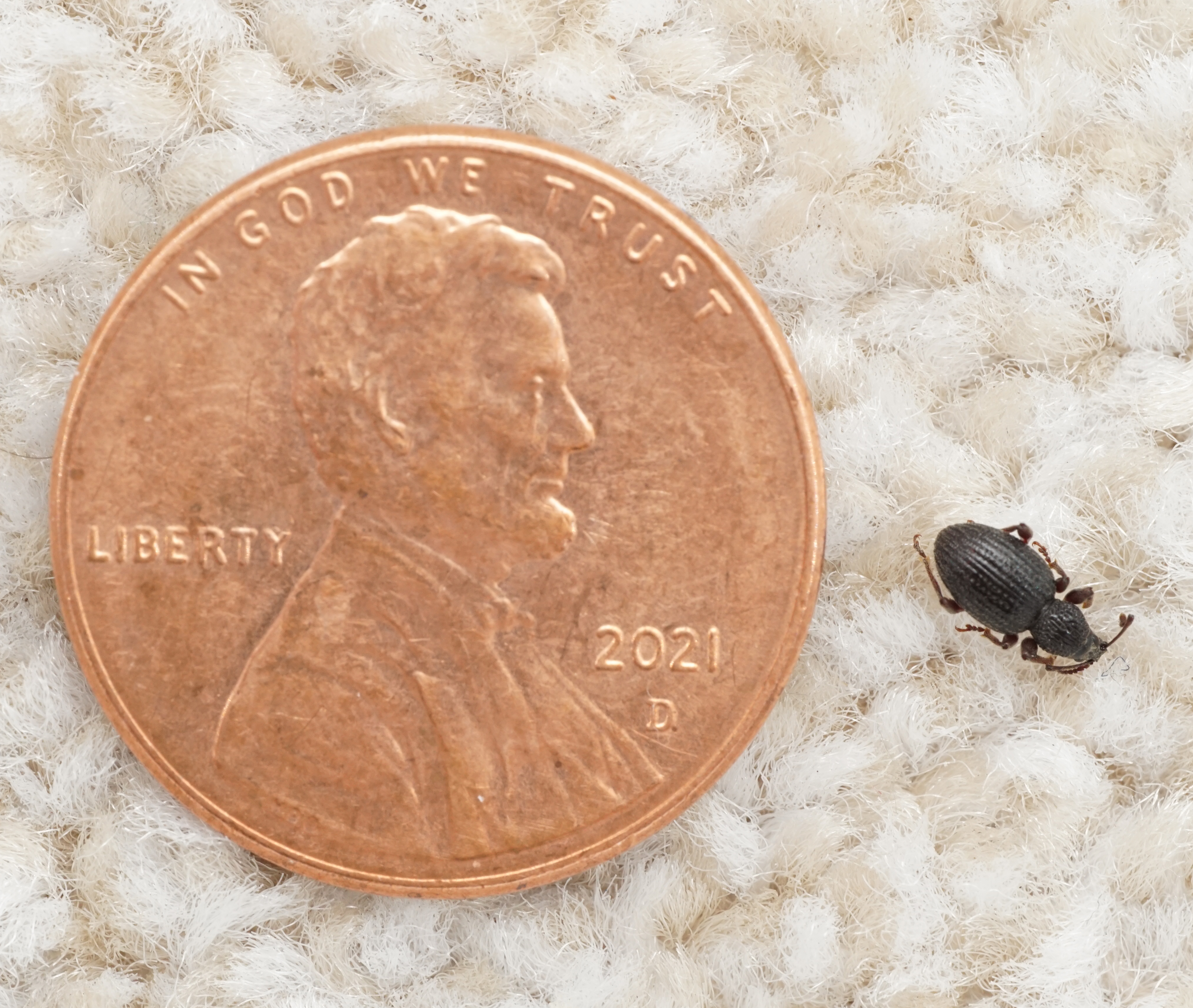
Strawberry root weevils (Otiorhynchus ovatus) are a common insect invader that can be found in late summer and early fall walking on walls, cruising across the ceiling and wandering on the floors. This small, ¼ inch, dark brown or black beetle is pear-shaped and has small, longitudinal grooves on its back that look like a series of tiny, indented spots (Photos 1 and 2). The antennae may appear bent when viewed from above.
What brings them indoors?
This insect’s larval life stage normally feeds on the roots of small fruits including strawberries and brambles as well as other ornamental plants. Most strawberry plants are not damaged by minor to moderate root feeding from strawberry root weevil. The adults also nibble on the edges of leaves and conifer needles, making small notches (Photo 3). The damage can be distinguished from leafcutter bees, which create neatly semi-circular cuts along the edges. As the weevil’s host plant reaches maturity, they begin the search for another place to live.
The adults are the life stage that comes into the home. As poor fliers, they will climb through exposed gaps, screens, or even enter directly through doors and windows. They are also attracted to moisture and may be found in rooms with plumbing or leaks. Their reasons for a visit are simple and to the point: conditions outside are not comfortable or pleasant. While inside, strawberry root weevils do not damage the home, pets, food or people. Ordinarily, they overwinter as larvae in the soil but can sometimes survive the winter indoors as adults.
What do weevils do anyway?
Hundreds of weevil species are found outdoors in Michigan. All are herbivores, feeding on plant leaves, fruits or roots. Some, such as plum curculio, are economically important pests of tree fruit while others feed on wildflowers and trees.
A small number of weevils have been released as biological control agents to control invasive plants. Examples of these include the mile a minute weevil and the thistle head weevil.
Many weevils appear in appearance to strawberry root weevil. Do not assume that the weevil you’ve found outdoors is the strawberry root weevil. Weevils often specialize on particular plant families or genera, and the host plant they are discovered on can be a clue to the insect’s identity.
How do you manage strawberry root weevil?
Strawberry root weevils are not guaranteed to be a yearly visitor, but if they can get into the house, so can multiple other six- and eight-legged critters. Michigan State University Extension suggests taking a close look at caulking around windows, seeing how tightly screens fit and deciding whether you have good door sweeps—the rubbery strips at the bottom of doors that block out light along with insects. A crack or opening as wide as the thickness of a credit card is enough for weevils to find their way inside.
Insecticide treatment of the exterior of the structure for control of root weevils is unnecessary and can be detrimental to beneficial insects such as pollinators. When strawberry root weevils do find their way indoors, they can easily be removed by hand or with a vacuum cleaner.
This work is supported by the Crop Protection and Pest Management Program (grant no 2024-70006-43569) from the USDA National Institute of Food and Agriculture. Any opinions, findings, conclusions, or recommendations expressed in this publication are those of the author(s) and do not necessarily reflect the view of the U.S. Department of Agriculture.