The state of Michigan’s county planning commissions in 2026
 Print
Print Email
EmailThe MSU Extension Citizen Planner team recently took an inventory of county planning commissions across Michigan and presented the findings during a May 2026 webinar.
The Michigan Planning Enabling Act (MPEA) (MCL 125.3801 et seq.) authorizes local units of government in Michigan, including counties, to create planning commissions (PCs) and create and adopt plans. Called master plans, they establish the long-term visions and goals of the community and guide development.
The Michigan Zoning Enabling Act (MZEA) requires a zoning ordinance to be based upon a plan (MCL 125.3203). The Michigan State University Extension article, “A planning commission is much more than zoning,” goes into more detail on the duties of PCs.
The MPEA authorizes local units of government, like counties, to create a planning commission, but it does not require it. Having a county planning commission is a county decision to be made. So, with the ability for local choice and variation, what do county PCs look like across the state?
The state of Michigan’s county planning commissions
As of May 2026, 59% — 49 of Michigan’s 83 counties — had a county planning commission (see Map 1: County Planning Commissions in Michigan). Among those 49 county PCs, the majority have either 7 (21 counties) or 9 members (11 counties). Among the 49 counties with a county planning commission, 20 have used their authority granted by the MZEA to adopt a zoning ordinance that is in effect in townships without their own local zoning ordinances.
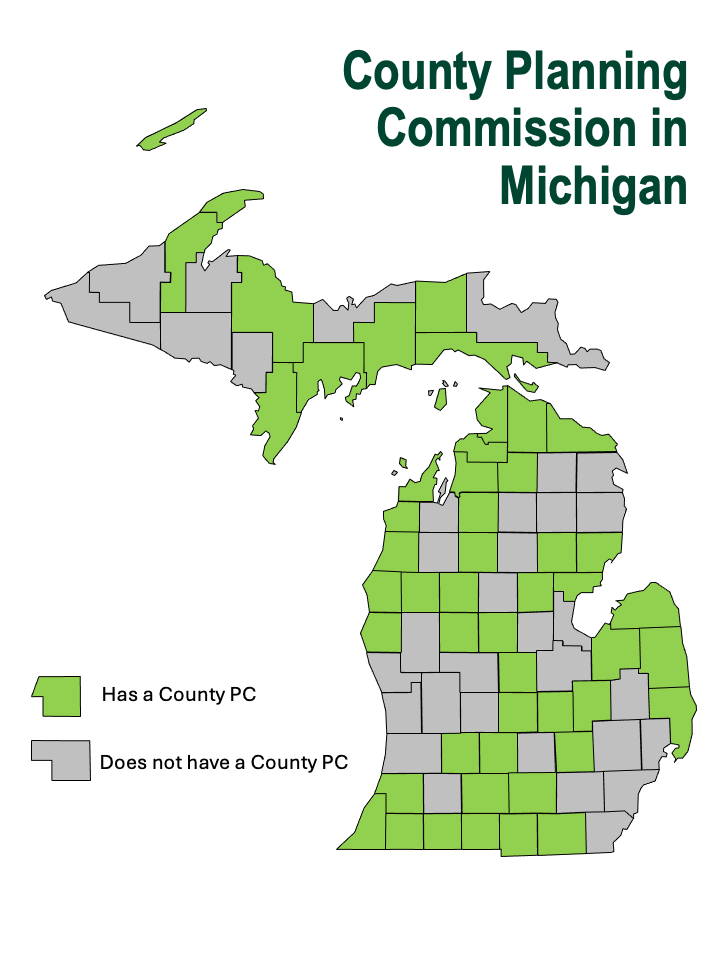
The remaining 34 counties did not have a county planning commission. In counties without a county planning commission, the responsibilities that would fall to the county planning commission described above are either waived or taken over by another body, such as the regional planning commission for plan reviews (MCL 125.3841(2)(d)), or a coordinating zoning committee for township zoning reviews (MCL 125.3307(2))).
This information was gathered through a combination of county government website searches, calling county governments, and existing sources like the University of Michigan’s Center for Empowering Communities Energy Zoning Database.
What do county planning commissions do?
The MPEA and MZEA gives some additional responsibilities and special considerations to county planning commissions.
These county-specific provisions are:
- County PCs can be 5, 7, 9, or 11 members (The 11-member planning commission is unique to counties (MCL 125.3815(2)))
- The county shall make every reasonable effort to include a school board member or administrative employee of a school district in the county when appointing new members (MCL 125.3815(6))
- Reviewing county projects to acquire land, erect structures, or build, improve or extend public facilities (MCL 125.3861(2))
- The county PC receives notice or draft from local units within it when:
- A local unit adopts an ordinance to create a PC (MCL 125.3811(2))
- A municipality intends to prepare a master plan (MCL 125.3839(2)(e))
- A copy of a proposed master plan for review and comment with statement that draft was distributed to other municipalities required (MCL 125.3841(2)(e))
- Final draft of master plan adopted by a local unit (MCL 125.3843(5))
- County PCs can also request copies of municipal zoning ordinances and amendments (MCL 125.3869)
For more about county planning commissions, the MSU Extension resource, “County Planning: Its Legal Authority and Coordinated Planning,” provides a good overview.
For more information on counties generally in Michigan, check out the MSU Extension Guide to County Government, 5th Edition, or resources available from the Michigan Association of Counties like the MI County Matters website.
The MSU Extension Center for Local Government Finance and Policy has also done research on the various services that county governments provide to local governments, including planning and economic development. Read more about that research in the Michigan County Government Survey: Services Provided to Local Government Summary Report.
This work was part of the 2026 Master Citizen Planner (MCP) Webinar Series. Each year this series of 6 webinars explores land use issues relevant to local communities. Visit the Events section of the Citizen Planner website for upcoming webinars in the series.