Thinking about managing white mold with biologicals?
 Print
Print Email
EmailReducing the number of overwintering structures is key to managing white mold, and one biological product has been shown to be effective in this strategy.
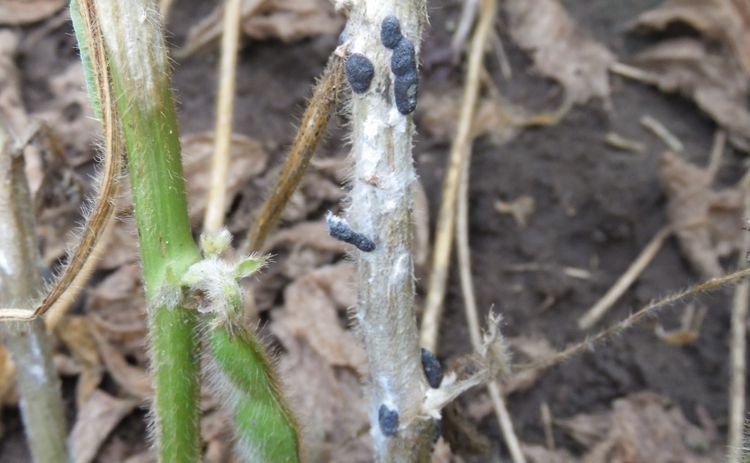
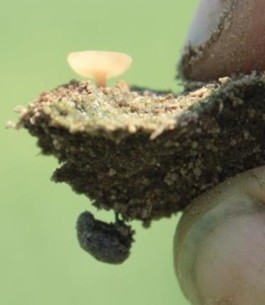
Sclerotinia stem rot, a.k.a. white mold, is caused by the fungus Sclerotinia sclerotiorum and can be a devastating foliar disease of soybean in Michigan. The fungal spores infect soybean flowers, and the disease develops in the plant, eventually forming white mycelial mats on the stem with dark sclerotia (overwintering structures). White mold sclerotia can survive for up to 10 years when buried in the soil. The sclerotia will produce apothecia (mushrooms) that will produce spores in subsequent years. White mold outbreaks tend to be less impactful when sclerotia are left on the soil surface (no-till) within the rotation. Michigan State University Extension staff have written several informative articles on the topic of managing for white mold over the years: Begin managing white mold in soybeans this spring, Stay ahead of white mold: Mid-season management tactics, Is it too late to apply fungicides to control white mold in soybeans?
There are several effective fungicides that can be used to manage white mold when applied at the proper timing. These chemicals prevent infection of aboveground plant parts but will not stop infection once it has occurred, and they do not affect sclerotia in the soil. There are also commercially available biological products that contain Trichoderma (fungi) or Bacillus (bacteria) that are reported to protect against white mold. However, the most widely-known biological product is called Contans.
Contans (Coniothyrium minitans) is a naturally occurring fungus that attacks white mold sclerotia. Although previously manufactured and distributed by different companies, it is currently distributed in the U.S. by Lallemand Plant Care as LALSTOP Contans WG. Each gram of the wettable granular product contains a minimum of 1.0 x 10⁹ CFU (colony forming units).
Research of Contans in soybean production is relatively limited; however, a study conducted at Purdue University by Conrad and Telenko, in 2023 in controlled environments showed a 54% reduction in S. sclerotiorum growth when C. minitans was applied.
According to the product label, Contans can be applied pre-plant, at planting, after crop emergence, or postharvest. However, results of a recent study at UW-Madison by Sharma et al., in 2026 showed the treatment effects were not significant when Contans was applied from 0.5 to 4.0 lbs./A at planting. It was believed there was not enough time for the C. minitans to colonize the sclerotia, and an earlier application was recommended.
Although the product label specifies application rates of 1–4 lbs./A, applications are commonly made at 1–2 lbs./A with the higher rate used in higher-risk situations (e.g., history of severe disease, more than one susceptible crop grown in the rotation, environmental conditions favor disease development). Applications can be made immediately following soybean harvest, the fall after corn harvest, or the spring of soybean planting, although heavy corn residue covering the soil surface may restrict C. minitans from contacting sclerotia. Splitting applications (e.g., 1 lb./A in the fall followed by 1 lb./A in early spring) can also be effective. Depending on pricing (bulk discount, regional pricing, etc.), Contans costs $25–$30/lb., or $625–$750 per 25 lb. bag.
The optimum soil temperature for maximum activity ranges from 50–81 F, but C. minitans will also survive over the winter in Michigan. Contans should be incorporated uniformly in the top two inches of soil either with light mechanical cultivation or water immediately after application. Tillage deeper than two inches should be avoided to prevent dilution of the Contans and bringing up sclerotia from deeper in the soil. If irrigating, aim for 0.5 inch of water for sandier soils or 1.0 inch for heavier clay soils. However, a study conducted at North Dakota State University by Wunsch et al., in 2012 found no statistical yield advantage with mechanical or water incorporation over no incorporation when the soil was moist and sclerotia were primarily on the soil surface. The authors noted that different results may occur with dry soils or when sclerotia are uniformly distributed in the soil profile.
Here are a few additional considerations with Contans:
- Store at cool temperatures, particularly when storing for extended periods. 2 years at 39 Degrees F, 3 weeks at 59 F, 3 days at 86 F
- Sequential applications over several years will likely be needed in fields with a history of high white mold pressure
- Do not tank mix an application of Contans with other fungicides. Application of other fungicides can be made beginning three weeks after the Contans application.
- Contans can be applied via chemigation with appropriate equipment to prevent backflow to the water source
If you are interested in conducting an on-farm trial with Contans, please contact Eric Anderson at eander32@msu.edu to learn more about our Soybean On-Farm Research Program.
This article was produced by a partnership between MSU Extension and the Michigan Soybean Committee. The article was first published in the Michigan Soybean News magazine.