Tips for honey bees and beekeepers in hot weather
 Print
Print Email
EmailLearn what beekeepers can do to help their colonies tolerate hot weather conditions and deal with the heat when beekeeping.
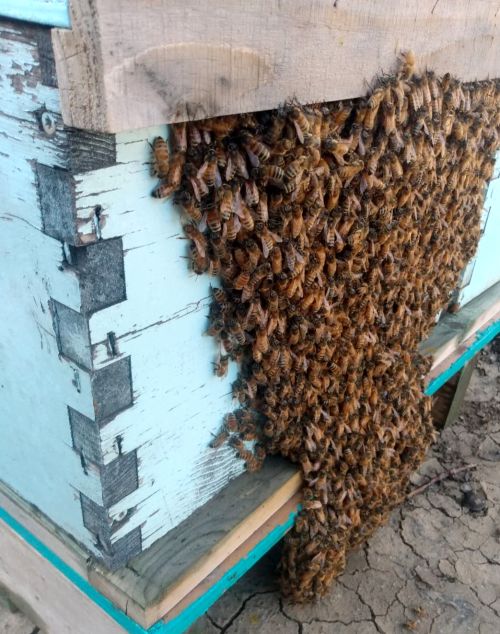
Honey bees are generally able to thermoregulate to keep the broodnest at a consistent temperature in a wide range of outside temperatures. A review of short-term weather impacts on honey production states that honey bees often fly at 10–40 degrees Celsius (50–104 degrees Fahrenheit). At higher temperatures, workers increasingly shift from nectar collection to water foraging.
“Honeybee Colony Thermoregulation – Regulatory Mechanisms and Contribution of Individuals in Dependence on Age, Location and Thermal Stress” explains that if the colony is at risk of overheating, honey bees spread water on the combs and fan their wings to evaporate the water, which can cool the temperature inside of the hive. The study “Tolerance and response of two honeybee species Apis cerana and Apis mellifera to high temperature and relative humidity” found that for Apis mellifera, the species of honey bees managed in the U.S., workers become intolerant or unable to turn over when placed on their dorsal, or back, side at 48 C (118 F).
Beekeepers often refer to days with warm weather as "honey-making days," and warm weather can make for good conditions for crop pollination. The optimum temperature for nectar production is highly dependent on the type of plant. Many nectar-producing plants show high nectar secretion under warm, but not extreme, temperatures at roughly 16–32 C (61–90 F) when adequate soil moisture is available.
A review of short-term weather impacts on honey production states that optimal temperatures for honey bees to forage are 20–30 C (68–86 F). It also summarized that nectar production is often optional when temperatures are in the range of 20–30 C (68–86 F) and there is moist midday weather, but these factors vary on the plant species and its phenological stage. At warmer temperatures, especially during hot, dry conditions, nectar secretion often declines even if flowers remain open.
In addition to considering the effects of hot weather on honey bees, beekeepers should also consider the effects of hot weather on themselves. Keep reading to learn what beekeepers can do for their bees and themselves in hot weather.
Tips for keeping honey bees healthy in hot weather
1. Maintain a consistent water source
During hot weather, honey bees cool the hive by collecting water and evaporating it inside the hive. The U.S. Department of Agriculture Agricultural Research Service affirms that water is important to honey bees in hot and humid conditions. Beekeepers can maintain water sources close to the apiary, starting early in the spring when bees begin flying.
Providing a water source close to the apiary is an important part of following the Care of Farm Animals Generally Accepted Agricultural and Management Practices (GAAMPs) for honey bees. It may also reduce the likelihood of honey bees becoming a nuisance by visiting swimming pools, animal water troughs, or other water sources on neighboring properties.
2. Give colonies plenty of space
Provide colonies with space, meaning boxes above the brood nest. Colonies that are crowded with lots of bees and not enough space in the hive may have a more difficult time thermoregulating. Beekeepers can add additional honey supers onto a hive during summer to provide the colony with more space.
3. Keep the hive entrance open
During periods of hot weather, keep the hive entrance open and avoid using entrance reducers. Beekeepers who want to cover hive entrances in anticipation of a pesticide application risk their colonies overheating if the bees cannot leave the hive.
4. Expect bearding
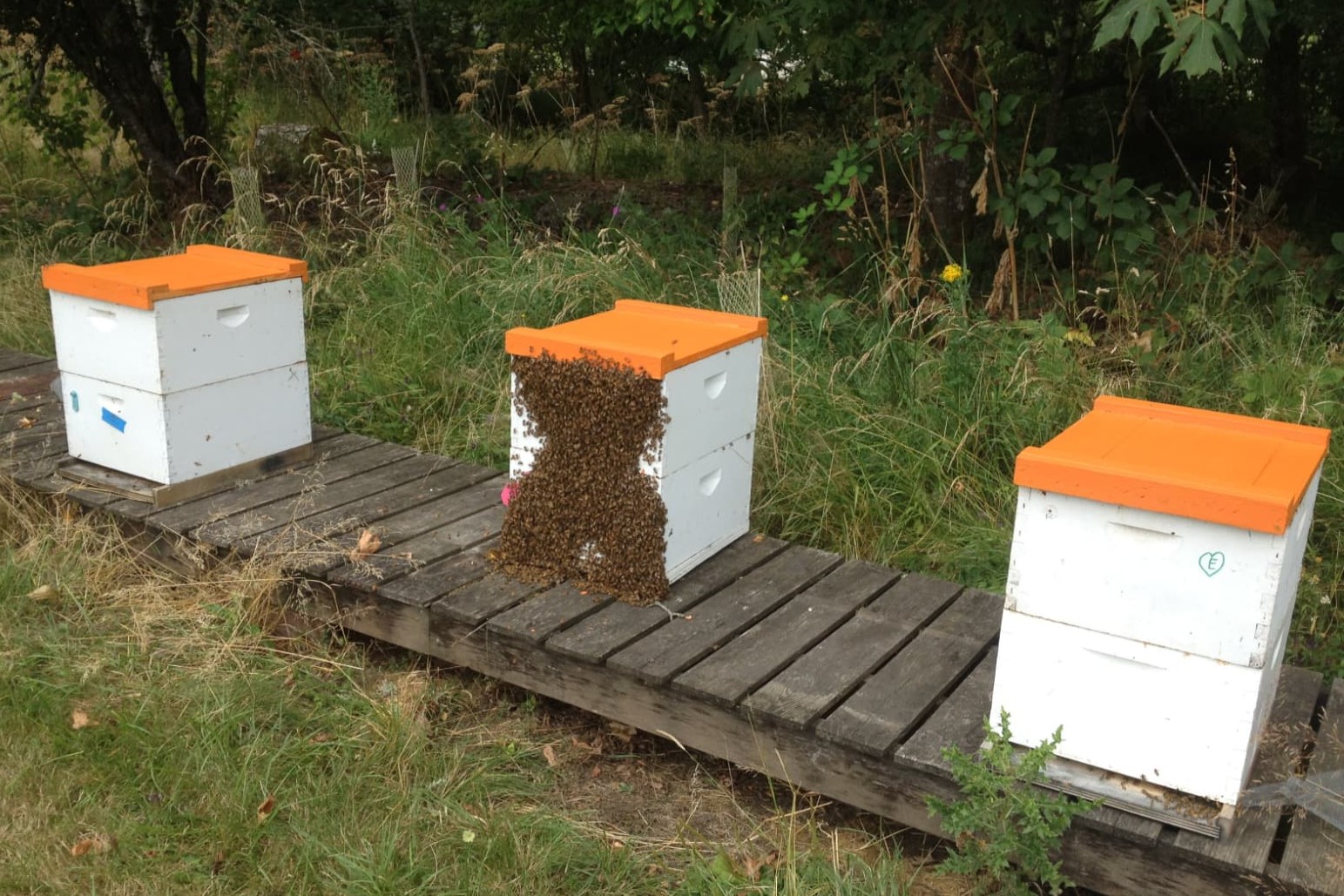
Honey bees can cool the hive through bearding, which is a behavior where the adult bees congregate on the outside of the hive. Beekeepers who haven’t seen thousands of bees on the front of their hive may be surprised, but it is normal behavior in hot weather. Bearding is not a sign that the colony will swarm. It’s common to see bearding behavior from some but not all colonies in an apiary.
5. Check varroa mite treatments for temperature restrictions
Some varroa mite treatments cannot be applied under certain temperatures. Read and follow the pesticide label and review labels for temperature restrictions.
Varroa mite treatments registered by the U.S. Environmental Protection Agency (EPA) are listed in the table at EPA-Registered Pesticide Products Approved for Use Against Varroa Mites in Bee Hives. Click on a treatment’s EPA registration number in the table to see labels for a treatment.
The Honey Bee Health Coalition’s Tools for Varroa Management Guide summarizes varroa treatment options. Pesticide users must always follow the label version that comes with the product they are using.
Tips for beekeepers in hot weather
1. Understand the challenges of beekeeping in hot weather
Hot temperatures may be intensified by beekeeping conditions. Beekeepers may experience additional heat from wearing a beekeeping jacket or suit. Many apiaries are positioned in full sun, sheltered from the wind, or otherwise positioned in a hot location like on a rooftop. Lifting hive bodies, especially boxes that are full of honey, can lead to physical exertion. Understand the challenges of beekeeping in hot weather and take steps to avoid heat stress or injury.
2. Consider delaying beekeeping work until temperatures cool down
Beekeepers may be able to delay regular inspections until temperatures cool down. Many colony inspections in the summer are not time sensitive and can wait a few days or even a week or two.
3. Know the signs of heat stroke
Ready.gov says signs of a heat stroke include extremely high body temperature (above 103 F); red, hot and dry skin with no sweat; rapid, strong pulse; and dizziness, confusion or unconsciousness.
Ready.gov also says, “If you suspect heat stroke, call 911 or take the person to a hospital immediately. If possible, move the person suffering from heat stroke into a cool, shaded area. Remove any outer clothing. Place a cold, wet cloth or ice pack on the head, neck, armpits and groin. Alternatively, soak the person’s clothing with cool water. Elevate their feet.”
4. Do beekeeping work with a buddy
Inspecting colonies with a beekeeping buddy can help in the event you need medical care or attention. A buddy in the bee yard can also help with lifting hive bodies to prevent injury or overexertion. Beekeepers can connect with nearby beekeepers through a Michigan beekeeping club.
5. Inspect colonies at times when temperatures are cooler
Consider checking honey bee colonies at times of the day when it is cooler, like the evening or early morning. If hives are shaded part of the day, check colonies when the hives are shaded, or consider a pop-up tent for shade during inspections.
6. Take steps to avoid overheating
Stay hydrated while beekeeping in hot weather. Use a squirt water bottle to squirt water through the beekeeping veil into your mouth. Some beekeepers wear ice or cooling vests to keep cool while doing inspections. Beekeepers who wear a full, vented beekeeping suit can wear lighter clothes or even a swimsuit under the suit. You can also park a vehicle with air conditioning close to the apiary and use its air conditioning to cool down as needed.
Acknowledgements
This work is supported by Michigan Department of Agriculture and Rural Development with funding secured from the U.S. Environmental Protection Agency for Michigan State University to implement strategies in the Managed Pollinator Protection Plan.
This work is supported by the Crop Protection and Pest Management Program (grant no 2024-70006-4356) from the USDA National Institute of Food and Agriculture.
Any opinions, findings, conclusions, or recommendations expressed in this publication are those of the authors and do not necessarily reflect the view of the U.S. Department of Agriculture.