Understanding the risk factors and treatment strategies for parasite infection
 Print
Print Email
EmailRecognizing the factors that determine parasite infection risk is critical in developing an effective and sustainable parasite control program.
A central concept in the development of a sustainable parasite management plan is the maintenance of a refugia parasite population within a given farm. A refugia population is one less exposed to anthelmintic drugs (dewormers). This refugia population acts as a reservoir of parasites that contain resistance alleles at a lower gene frequency than those that survive dewormer treatment. These populations (refugia and non-refugia) then mix and mate, effectively diluting the resistance genes within a particular parasite population. This dilution effect helps to maintain dewormer efficacy. A major challenge faced in modern parasite management is how to maintain refugia without compromising flock/herd health and well-being. This requires an understanding of which animals are most susceptible as well as where the parasite populations are living within the farm (in the animals vs. on pasture).
The good news is that host susceptibility to parasite infection, which is a key factor in maintaining this balance, can be predicted relatively accurately by examining both the physiological state of the animal (stage of production) and its plane of nutrition (how well an animal is fed). Both of these characteristics impact host susceptibility separately, but they can also have profound additive effects. By taking host susceptibility into account, one can target animal classes of greatest susceptibility for anthelmintic treatment while maintaining refugia in those classes with lower susceptibility. This is a central concept of selective treatment, or smart drenching, which is especially important when parasitic contamination of pasture is low and therefore most of the parasite population is in the sheep potentially receiving treatment. When parasite contamination of a pasture is high, the need for selective treatment is far less, as the large population of parasites present in the pasture will act as refugia. Treatments given during periods of high pasture contamination are known as targeted treatments, and in these instances the entire flock, or a high proportion, can be treated without compromising refugia of the farm’s parasitic population.
Production or physiological state of the host animal
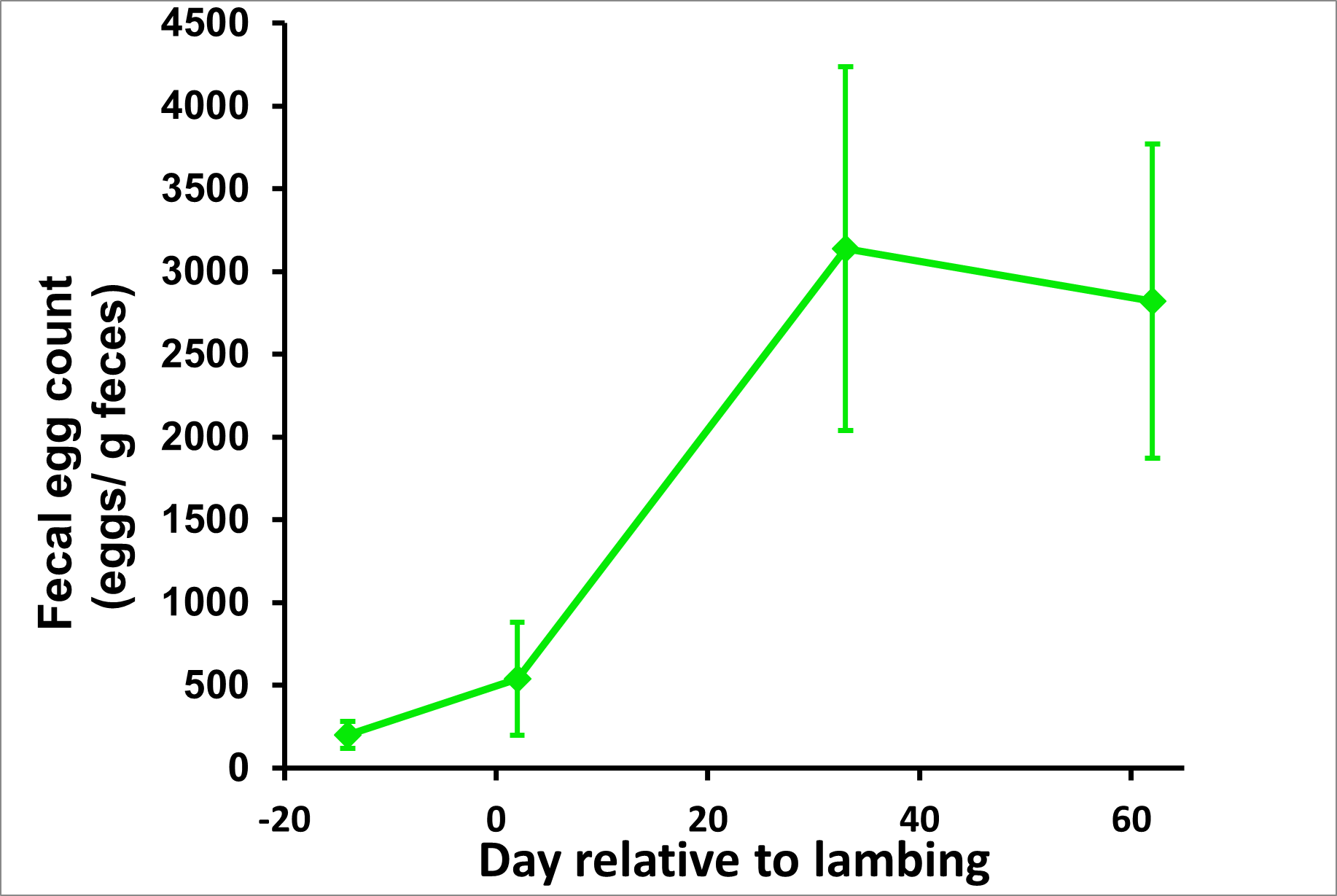
The productive or physiological state of the animal is a key consideration in infection susceptibility. Immunity to gastrointestinal nematode infection starts to decline just prior to parturition, reaches a peak in early lactation (day 15-40), then becomes increasingly re-established as lactation wanes. This results in a rise in fecal egg count especially evident during early lactation (see Figure 1), which creates a dangerous situation on these pastures for their highly susceptible offspring.
This effect is undoubtedly exacerbated by undernutrition during lactation and is also related to age of the dam. Generally speaking, ewes or does in their first lactation and especially those under 2 years of age will be especially vulnerable to infection. So, collectively, an ewe or doe giving birth at 12 months of age and raising twins or more without access to a grazing diet rich in energy and protein will be at high risk for infection. This animal will deposit a lot of eggs on pasture as the adult worms thrive in her gut, resulting in a highly contaminated pasture that will place lambs/kids in the mob at even higher risk for infection as they start to graze around 4-5 weeks of age.
Animal age and previous exposure to parasites are also key factors affecting immunity. A best management concept in young animals is allowing them a “safe” exposure to parasites so they can build immunity. The balance between safe and unsafe exposure, however, can be tricky to manage in the field. Michigan State University Extension recommends careful monitoring of preweaning animals on pasture along with more aggressive treatment schedules than those used in adults with relatively high immunity (well-fed, dry ewes/does).
Plane of nutrition
Another major determinant of parasite susceptibility is the animal’s plane of nutrition. Animals that are fed below their nutrient requirements have lower immunity to infection when everything else is equal. Plane of nutrition and productive or physiological state are separate factors influencing parasite infection susceptibility, but they commonly interact in the field, thus compounding infection risk.
It is very challenging to meet the nutritional needs of young, prolific, lactating sheep and goats on pasture. These animals will be in a state of nutritional deficit in most pasture rearing conditions, and when they are grazed on pasture highly contaminated with parasitic larvae, the combination often results in a high degree of infection. These animals, therefore, must be a target for more aggressive monitoring and anthelmintic treatment. Older dams raising singles will be at far lower risk.
.png?language_id=1)
Selective treatment
Selective treatment is the drug treatment strategy we recommend when most of the population of parasites within a farm is within the animals, with little on the pastures they are about to graze. In this strategy, a select portion of the population is treated with dewormers and the rest remain untreated. This allows for a large refugia population of parasites to remain within the untreated sheep to dilute the small population of resistant parasites that survive within the treated animals. It is ideal to have the population of untreated parasites over 100 times greater than the number surviving treatment. Unfortunately, it is hard to know how many parasites are in either population, so rather than focusing on estimating this ratio, we recommend establishing a set of treatment selection guidelines to determine which animals to treat.
There are several excellent monitoring methods to use together when determining which animals to treat. FAMACHA is a method that requires observation of the intensity of red color within the capillary bed in the conjunctiva of the lower eyelid. The intensity of color is highly correlated with the animals’ red blood cell count or anemia status. An animal that appears paler in color than their cohorts should be treated. Body condition score can also provide an indicator for treatment, with animals that are thin being selected for treatment. In addition, it is important to consider the susceptibility for infection in this selection criteria. Young animals and those in heavy lactation (such as rearing multiples) may also be candidates for selective treatment. Selective treatment therefore can be based on an aggregate of selection factors (FAMACHA score, body condition and susceptibility to infection). Selective treatment is necessary at spring turnout, during fall, and any time you put animals on clean pastures. Besides spring and fall, this includes turnout onto parasite-free grazing opportunities in summer, such as hay fields and annual pastures.
Targeted treatment
Targeted treatment is a drug treatment strategy to target treatments to control infections when pasture contamination is high and when there is high risk for infection in highly susceptible animal groups. In Michigan, this would be from early summer to early fall (when the first hard frost occurs) when returning to the same contaminated pastures to graze again. The precise timing of this period varies from farm to farm and climatic region. In my region of southcentral Michigan, it is the last week of June until around Oct 1. When grazing highly susceptible animals such as ewes/does with their lambs/kids on contaminated pastures during this period, it is okay to treat most animals in these grazing groups, as the population of parasites on pasture is much higher than that in the animals. A grazing management program should also seek to create or reserve pasture that is lower in contamination risk for these susceptible animals. However, if these highly susceptible groups are placed on clean pasture during this season, then selective treatment procedures described above should be used instead.
Maintenance of a refugia population of parasites is an important aspect of any sustainable parasite management plan. The practices to maintain refugia differ depending on the degree of pasture contamination, with selective treatment used when pastures are clean and targeted treatment used when pastures are highly contaminated. Recognizing the factors that determine parasite infection risk is critical in developing an effective and sustainable parasite control program. Infection monitoring must be more frequent in animals with greater susceptibility. Finally, in many small ruminant grazing programs, a more aggressive treatment program using an effective drug treatment regimen (often a combination of drugs) will need to be implemented on susceptible animals to maintain infection control.