


Hatem Rouached
Contact Me
Associate Professor; Plant Mineral nutrition: sensing, signaling, and transport
Plant & Soil Sciences Building
Phone:
517-353-0157
Email:
rouached@msu.edu
Degrees:
Ph. D. Montpellier II University (France)
- Dr. Hatem Rouached website.
- Publications on Google Scholar.
- Dr Hatem Rouached on Twitter.
Overview of current program:
Vision
It takes more than light, CO2, and water to grow a plant--mineral nutrients are essential, too. In fact, plants require 16 essential mineral nutrients for healthy growth and development. The study of plant mineral nutrition began in the 17th–18th centuries, when European naturalists provided the first experimental evidence for what had been empirically known for millennia. In the 20th century, the Green Revolution heavily relied on synthetic fertilizers to boost yields. But today, this approach is unsustainable--phosphorus rock is depleting, and fertilizer overuse has serious environmental consequences.
As global agriculture faces increasing resource constraints, a pressing question arises: How do plants maintain their biological functions under nutrient-limited conditions? At the Rouached Lab, we are working to unravel this puzzle—at the molecular, physiological, and ecological levels—with the goal of developing nutrient-efficient crops for a sustainable future.
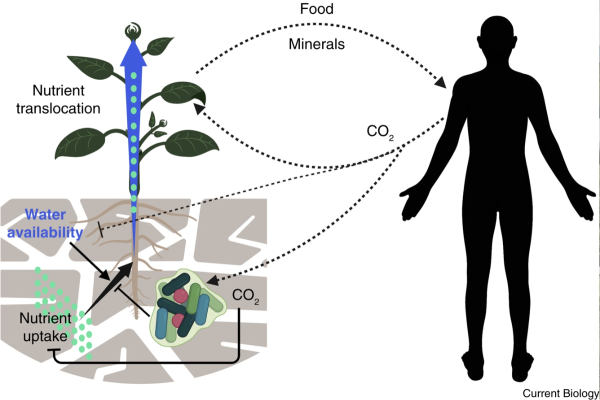
Mineral nutrients don’t enter the plant as a package deal; each is absorbed as a distinct ion. For decades, plant scientists have studied these ions individually. While this reductionist approach has been essential, it is no longer enough. We now know that nutrient homeostasis is interconnected, and these interactions shape the plant's ionome—its total elemental composition.
To truly understand and improve plant nutrition, we must adopt a systems perspective. This means developing tools that model integrated gene networks, account for macro- and micronutrient interactions, and capture dynamic nutrient availability in real time.
Our long-term vision is to decode how plants perceive, integrate, and respond to nutrient signals—and to translate this knowledge into solutions for food security and agricultural sustainability.
Research
The Rouached Lab is built around three interconnected research pillars:
- Pillar 1: Nutrient Signaling and Plant Growth
We investigate how plants integrate diverse nutritional cues to regulate growth, root architecture, and developmental transitions. - Pillar 2: Adaptation to Nutrient Stress
We study how plants fine-tune physiological processes to thrive under conditions of multiple nutrient limitations. - Pillar 3: Plant-Microbiome-Ionome Interactions
We explore how root exudates and soil microbes influence nutrient uptake and redistribution, focusing on molecular and chemical signals.
Progress in the lab is only possible because of a gifted and motivated team of undergraduate researchers, graduate students, and postdoctoral fellows. I am deeply committed to recruiting and empowering driven individuals who can advance the frontiers of plant mineral nutrition.
Mentoring
Mentorship is at the heart of everything we do. I believe that research becomes transformative when it’s paired with purposeful mentoring and professional development. My mentoring philosophy has been shaped by years at INRAe (France) and now at MSU, and draws inspiration from Radical Candor by Kim Scott.
Each mentee is treated as a collaborator, not just a trainee. I offer personalized, hands-on mentorship with regular 1:1 meetings, clear performance goals, and structured feedback sessions. We prioritize open dialogue, curiosity, and intellectual ownership.
My lab fosters a culture of:
- Scientific honesty and humility
- Collegial support over competition
- Balance between academic ambitions and personal wellbeing
- Inclusivity and global exchange—our lab regularly hosts scholars from France, the UK, Thailand, Tunisia, India, and beyond.
I also maintain a mentorship “reverse flow”—believing, like Thomas Jefferson, that we are all learners at different stages. Whether it’s a senior postdoc or an undergrad on their first project, every member contributes to the lab’s progress and spirit.
Related Work
-
MSU AgBioResearch adds four faculty to Administrative Fellows Program
Published on December 9, 2025
-
Caputo, Rouached honored with 2025 CANR Established Mid-Career Researcher Awards
Published on April 22, 2025
-
MSU formalizes International Associated Laboratory partnership with INRAE
Published on June 19, 2023
-
Creating sustainable crops in a changing climate
Published on July 15, 2022
-
New MSU research shows photosynthesis controlled by nutrient signaling in plants
Published on December 13, 2021



 Print
Print Email
Email