Action Steps for Child Care Providers: Meeting Best Practices in Physical Activity
DOWNLOADApril 30, 2026 - Leena Abouzahr, Michigan State University Extension
 Print
Print Email
EmailReady to access the full Action Steps for Child Care Providers: Meeting Best Practices in Physical Activity? Click on the download button above to view the full version. You can also read below (accessible by screen reader) to find out if this guide is right for you.
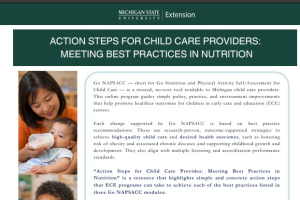
Go NAPSACC — short for Go Nutrition and Physical Activity Self-Assessment for Child Care — is a trusted, no-cost tool available to Michigan child care providers. This online program guides simple policy, practice, and environment improvements that help promote healthier outcomes for children in early care and education (ECE) centers.
Each change supported by Go NAPSACC is based on best practice recommendations. These are research-proven, outcome-supported strategies to achieve high-quality child care and desired health outcomes, such as lowering risk of obesity and associated chronic diseases and supporting childhood growth and development. They also align with multiple licensing and accreditation performance standards.
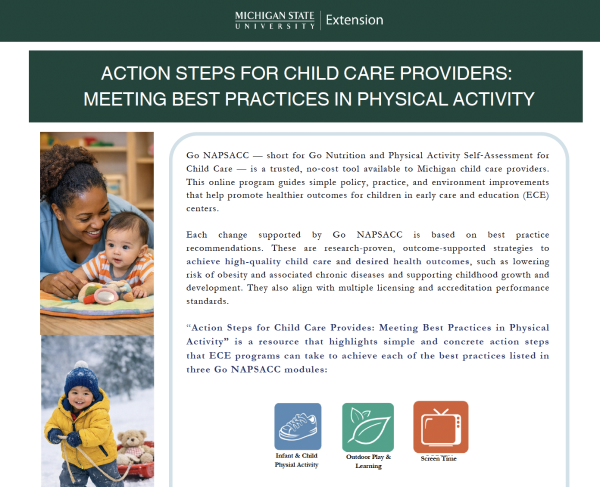
“Actionable Steps for Child Care Provides: Meeting Best Practices in Physical Activity” is a resource that highlights simple and concrete action steps that ECE programs can take to achieve each of the best practices listed in three Go NAPSACC modules:
- Infant and Child Physical Activity
- Outdoor Play and Learning
- Screen Time
This resource is not meant to replace any part of Go NAPSACC. Rather, it can be used as a brainstorming tool and companion to Go NAPSACC’s planning guide. Before using this resource, make sure you:
- Read MSU Extension’s Go NAPSACC Starter Guide.
- Contact a MI Go NAPSACC consultant to set up your free account.
- Complete the online self-assessments to identify where your program is meeting best practices and where it still has room for improvement.
Using the outcomes of your self-assessment(s), you are ready to start using this resource to identify concrete, practical steps your ECE program can take to promote the physical activity of children in your care.
Who is this resource for?
Anyone at a child care program can work to follow recommended practices in order to support the health of the infants, toddlers, and preschoolers in their care. Change champions may be:
- Directors
- Teachers
- Food service staff
- Family (home-based) child care providers
- Center-based child care providers
Tips for using this resource
- Read one section at a time, starting with the topic introduction and “Key Best Practice Changes” highlighted at the beginning of the section.
- Circle 1–2 “Key Best Practice Changes.” These are high-impact changes that can help you meet more than one best practice at a time.
- Find more details and practical action steps in the “Best Practice” boxes related to the “Key Best Practice Changes” of your choice.
How to navigate this guide
There are four sections to this guide:
- Section 1 of 3: Infant and Child Physical Activity
- Section 2 of 3: Outdoor Play and Learning
- Section 3 of 3: Screen Time
Each section includes:
- A title that indicates the section and/or subsection
- High impact “Key Best Practice Changes” for each subsection
- “Best Practice” boxes with more detailed action items specific to them for each subsection
Beyond this resource
The action ideas proposed here are only a few of the possibilities you can try. You might find additional ideas and innovations that are good fits for your program. Find more resources on these topics from MSU Extension and other trusted sources to help you make healthy changes in the Healthier Child Care Environments Toolkit. It lists free, practical resources for providers, children, and families and touches upon topics of nutrition, physical activity, and social emotional health.