Action Steps for Child Care Providers: Meeting Best Practices in Nutrition
DOWNLOADApril 30, 2026 - Leena Abouzahr, Michigan State University Extension
 Print
Print Email
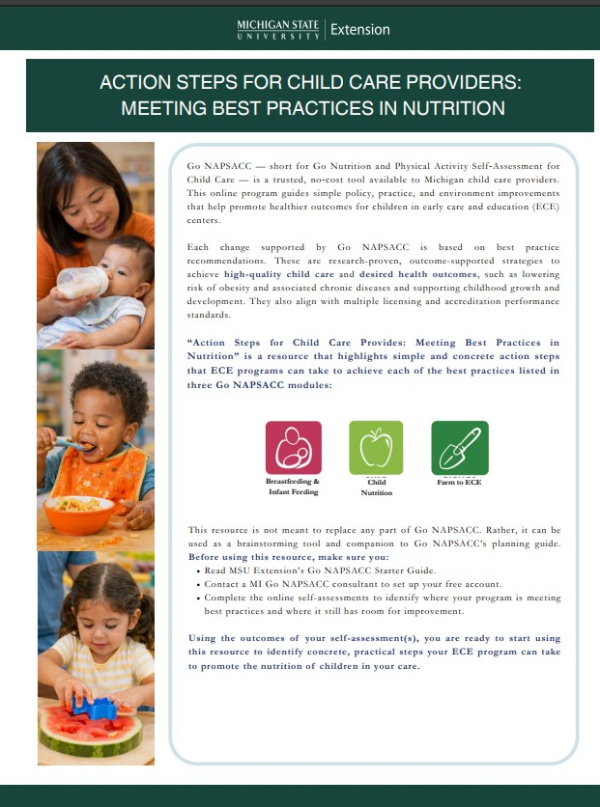
EmailGo NAPSACC — short for Go Nutrition and Physical Activity Self-Assessment for Child Care — is a trusted, no-cost tool available to Michigan child care providers. This online program guides simple policy, practice, and environment improvements that help promote healthier outcomes for children in early care and education (ECE) centers.
Each change supported by Go NAPSACC is based on best practice recommendations. These are research-proven, outcome-supported strategies to achieve high-quality child care and desired health outcomes, such as lowering risk of obesity and associated chronic diseases and supporting childhood growth and development. They also align with multiple licensing and accreditation performance standards.
“Actionable Steps for Child Care Provides: Meeting Best Practices in Nutrition” is a resource that highlights simple and concrete action steps that ECE programs can take to achieve each of the best practices listed in three Go NAPSACC modules:
- Breastfeeding and Infant Feeding
- Child Nutrition
- Farm to ECE
This resource is not meant to replace any part of Go NAPSACC. Rather, it can be used as a brainstorming tool and companion to Go NAPSACC’s planning guide. Before using this resource, make sure you:
- Read MSU Extension’s Go NAPSACC Starter Guide.
- Contact a MI Go NAPSACC consultant to set up your free account.
- Complete the online self-assessments to identify where your program is meeting best practices and where it still has room for improvement.
Using the outcomes of your self-assessment(s), you are ready to start using this resource to identify concrete, practical steps your ECE program can take to promote the physical activity of children in your care.
Who is this resource for?
Anyone at a child care program can work to follow recommended practices in order to support the health of the infants, toddlers, and preschoolers in their care. Change champions may be:
- Directors
- Teachers
- Food service staff
- Family (home-based) child care providers
- Center-based child care providers
Tips for using this resource
- Read one section at a time, starting with the topic introduction and “Key Best Practice Changes” highlighted at the beginning of the section.
- Circle 1–2 “Key Best Practice Changes.” These are high-impact changes that can help you meet more than one best practice at a time.
- Find more details and practical action steps in the “Best Practice” boxes related to the “Key Best Practice Changes” of your choice.
How to navigate this guide
There are four sections to this guide:
- Section 1 of 4: Breastfeeding
- Section 2 of 4: Infant Feeding
- Section 3 of 4: Child Nutrition
- Section 4 of 4: Farm to ECE
Each section includes:
- A title that indicates the section and/or subsection
- High impact “Key Best Practice Changes” for each subsection
- “Best Practice” boxes with more detailed action items specific to each best practice
Beyond this resource
The action ideas proposed here are only a few of the possibilities you can try. You might find additional ideas and innovations that are good fits for your program. Find more resources on these topics from MSU Extension and other trusted sources to help you make healthy changes in the Healthier Child Care Environments Toolkit. It lists free, practical resources for providers, children, and families and touches upon topics of nutrition, physical activity, and social emotional health.
Section 1: Breastfeeding
This section outlines comprehensive best practices for creating a supportive breastfeeding culture within a program or facility. It emphasizes:
- providing a dedicated, private, and comfortable breastfeeding or milk-expression space with necessary amenities
- ensuring safe storage for expressed breast milk
- displaying materials that normalize and encourage breastfeeding
It also highlights the importance of actively supportive attitudes and practices from teachers and staff, ongoing professional development on breastfeeding knowledge and support strategies, and offering breastfeeding education to current and prospective families. Best practices underscore the need for a written breastfeeding policy that clearly defines expectations and practices related to environment, education, and support for families and staff.
Key “Breastfeeding Environment” Best Practice Changes:
- A quiet, comfortable, and private non-bathroom space is always available for mothers to breastfeed or express milk.
- Adequate refrigerator and/or freezer space is available to safely store expressed breast milk for all families.
- Breastfeeding is visibly supported throughout the building.
- Children’s books and learning materials normalize and promote breastfeeding as healthy and natural.
Best Practices and Specific Action Items
- A quiet and comfortable space, other than a bathroom, is always available for mothers to breastfeed or express breast milk.
- Designate a specific room or screened off area for breastfeeding or milk expression during all program hours.
- Do not use the space for other purposes that might block its use as a lactation space.
- Post a visible sign such as “Breastfeeding/Expressing Space Available” so families know it exists.
- Communicate the location to families during enrollment and orientation.
- The space set aside for mothers to breastfeed or express breast milk offers privacy, an electrical outlet, comfortable seating, and a sink with running water in the room or nearby.
- Use a lockable room or install curtains, privacy screens, or partitions.
- Provide a comfortable chair with back support and a small side table.
- Ensure access to an electrical outlet for breast pumps and a sink with running water in the room or nearby hallway.
- Keep the space private, clean, calm, and free from interruptions.
- Enough refrigerator and/or freezer space is always available for all breastfeeding mothers to store expressed breast milk.
- Reserve a clearly labeled section of the refrigerator/freezer for expressed breast milk only.
- Provide individual, labeled storage bins for each family.
- Create and share written guidelines for labeling milk (with a child’s name and the date) and safe storage and handling procedures
- Monitor storage space weekly to ensure capacity meets family needs.
- Posters, brochures, children’s books, and other materials that support breastfeeding are displayed throughout the building.
- Display posters and brochures that normalize and support breastfeeding in classrooms, family bulletin boards, hallways, and parent resource areas.
- Choose children’s books that show breastfeeding as normal.
- Rotate materials periodically to keep them fresh, seasonally relevant, and culturally inclusive.
- Ensure materials reflect positive, non-stigmatizing images of diverse families.
- Key “Breastfeeding Support Practices” Best Practice Changes:
- Teachers and staff actively support breastfeeding by sharing information, showing positive attitudes, and responding respectfully to families.
Best Practices and Specific Action Items
- Teachers and staff use a variety of strategies to promote and support breastfeeding, including sharing information and showing positive attitudes.
- Speak positively and respectfully about breastfeeding when talking with families.
- Share basic breastfeeding information with families when appropriate regarding storage, comfort, and policies.
- Offer encouragement and avoid judgment about feeding choices.
- Ensure staff know where breastfeeding spaces and stored milk are located.
Key “Education & Professional Development” Best Practice Changes:
- Staff receive professional development on breastfeeding at least twice per year. Training covers multiple topics, including benefits of breastfeeding, safe handling of expressed breast milk, and ways to support breastfeeding families.
- Enrolled and prospective families receive breastfeeding information, both upon request and at least once during the year.
Best Practices and Specific Action Items
- Teachers and staff receive professional development on promoting and supporting breastfeeding 2 times per year or more.
- Schedule two or more annual trainings focused on breastfeeding support.
- Include breastfeeding topics in staff meetings, in‑service days, and online learning modules.
- Track training completion as part of staff professional development records.
- Professional development on promoting and supporting breastfeeding covers a variety of topics related to the benefits of breastfeeding, working with expressed breast milk, and ways to support breastfeeding mothers.
- Ensure trainings include benefits of breastfeeding, safe handling and storage of expressed milk, respectful communication with breastfeeding families, and ways staff can support breastfeeding at pickup, drop‑off, and during the day.
- Update training content regularly to reflect best practices. Use a mix of videos, guest speakers, written resources, and discussion.
- Enroll staff in MiLEAP/MI-Registry-approved courses.
- Enrolled expectant families and families with infants are offered educational materials on breastfeeding upon request and at 1 set time during the year, and prospective families are informed of the program’s breastfeeding policies and practices.
- Inform prospective families about breastfeeding policies during enrollment or tours.
- Provide breastfeeding educational materials at least one scheduled time each year (e.g. at an annual family meeting) or upon family request.
- Use culturally sensitive, multi-language formats.
- Share information in family handbooks, newsletters, or parent bulletin boards.
- Key “Policy” Best Practice Changes:
- The program has a written breastfeeding policy that addresses the environment, staff roles, training, and family education.
Best Practices and Specific Action Items
- There is a written policy on promoting and supporting breastfeeding that includes a variety of topics related to the breastfeeding environment and support and education for families, teachers, and staff.
- Develop a written policy that includes breastfeeding spaces and accommodations, safe handling and storage of expressed breast milk, staff roles and expectations, professional development requirements, and family education and communication.
- Review the policy annually and update as needed.
- Include the policy in staff manuals, family handbooks, and onboarding materials.
For more free ideas, tools, and materials, check out the corresponding sections of the Healthier Child Care Environments Toolkit.
Section 2: Infant Feeding
This section focuses on providing infants with healthy, age‑appropriate foods that support growth and development. Programs can choose iron‑rich cereals and formulas and avoid foods with added salt or sugar, especially baby food desserts. This helps ensure infants are introduced to and are used to nutritious foods that support good eating habits from the start.
The best practices also emphasize responsive feeding practices that follow each infant’s hunger and fullness cues. Teachers should feed infants when they show they are hungry, stop when they show they are full, and use caring, hands‑on support as older infants learn to feed themselves. Clear communication with families is a priority, with regular written and verbal updates about what, when, and how much infants eat, along with individualized feeding plans that can support age-appropriate full or partial breastfeeding.
Lastly, best practices highlight the importance of ongoing education and clear policies. Teachers and staff should receive regular training on infant feeding and nutrition, and families should be offered education at key times as their child grows. All of this is best guided by a written infant feeding policy that ensures consistent, safe, and developmentally appropriate feeding practices for infants and clear communication with families.
Key “Infant Foods” Best Practice Changes:
- Only iron-rich infant cereal and iron-fortified formula are purchased and used.
- Staff are trained to read labels carefully to avoid added salt, sugar, syrups, or sweeteners in infant foods.
- Written infant feeding practices guide purchasing and preparation to support healthy infant nutrition.
Best Practices and Specific Action Items
- When cereal or formula is purchased for infants, it is always iron-rich.
- Purchase only iron‑fortified infant cereal (check labels for “iron‑fortified”).
- Use iron‑fortified infant formula unless a medical exception is documented.
- Create a purchasing checklist so staff verify iron content before ordering.
- Train staff to recognize approved iron‑rich brands and products.
- When mashed or pureed meats or vegetables are purchased or prepared by the program, these foods rarely or never contain added salt.
- Prepare infant foods from scratch based on approved recipes only that use plain meats and vegetables with no added salt.
- When purchasing jarred or packaged baby foods, select products labeled “no added salt”.
- Keep salt, bouillon, and seasoned blends out of infant food prep areas.
- Document infant food preparation standards in kitchen procedures.
- Baby food desserts that contain added sugar are rarely or never purchased for infants.
- Avoid purchasing baby food desserts (e.g. fruit cobblers, puddings, or cookies in jars).
- Choose plain fruits and vegetables instead of mixed dessert-style foods.
- Educate staff that infants do not need foods with added sugar.
- Decline donated baby foods that contain added sugar or dessert labeling.
Key “Infant Feeding Practices” Best Practice Changes:
- With family permission, infant feeding times are flexible, based on infants’ hunger cues.
- Responsive feeding techniques are always used, including watching for and responding to infant hunger and fullness cues, feeding slowly, and engaging warmly.
- Older infants are encouraged and supported with praise and hands‑on help in self‑feeding.
- Families receive both written and verbal daily reports about what, when, and how much their infant eats.
- A written infant feeding plan guides care, including feeding routines and support for breastfeeding families.
Best Practices and Specific Action Items
- With permission from families, the timing of infant feedings is fully flexible to infants showing they are hungry.
- Ask families at enrollment for permission to use on‑demand feeding based on hunger cues.
- Train staff to recognize hunger signals (fussing, rooting, sucking hands, leaning forward).
- Avoid rigid feeding schedules; allow feeding times to vary by infant.
- Coordinate communication across staff so infants are fed when hungry, not by the clock.
- Teachers end infant feedings based on infants showing they are full.
- Watch for fullness cues such as turning away, slowing sucking, pushing food away, or closing the mouth.
- Never encourage infants to “finish the bottle” or “take one more bite” if they are full. Stop feeding promptly when signs of fullness appear, even if food remains.
- Emphasize that infants (not adults) control how much they eat in communication with staff and families.
- Teachers always use responsive feeding techniques when feeding infants.
- Hold infants during bottle feeding and engage in eye contact and interaction.
- Feed slowly, allowing infants to set the pace.
- Talk calmly and reassuringly during feeding.
- Follow infants’ cues for hunger, pace, and fullness at all times.
- At meal times, teachers always praise and give hands-on help to guide older infants as they learn to feed themselves.
- Encourage self-feeding with finger foods and child-sized utensils.
- Sit close and offer hands on help as needed (e.g. guiding hands, stabilizing bowls).
- Praise effort and exploration (e.g. “You’re doing a great job feeding yourself!”).
- Expect messiness as a normal part of learning. Do not reprimand or punish infants for it.
- Both a written and verbal report are provided to families about what, when, and how much their infants eat.
- Provide daily written reports that include what an infant ate, when they ate, and how much they ate.
- Share verbal updates at pick up whenever possible.
- Use consistent reporting tools so families receive clear, reliable information.
- The written infant feeding plan includes guidance on how, when, and what infants are fed, and how the program can support breastfeeding mothers.
- Maintain a written feeding plan for each infant that includes what and how the infant is fed, preferred feeding routines, hunger and fullness cues, and support for breastfeeding and expressed breast milk.
- Review and update individual plans regularly with families, according to scheduled times, infant development, and family request.
- Ensure all caregivers have access to the documented plan and follow it consistently.
Key “Education & Professional Development” Best Practice Changes:
- Staff receive training in infant feeding and nutrition at least twice per year, covering multiple, practical topic areas, such as responsive feeding, safe food handling, developmental readiness, and age‑appropriate foods.
- Families are offered infant feeding education upon request, at least once yearly, and when infants reach new developmental milestones. Education covers key feeding topics, including what, when, and how to feed infants in developmentally appropriate ways.
- Policies and education are consistently shared with both staff and families to ensure alignment.
Best Practices and Specific Action Items
- Teachers and staff receive professional development on infant feeding and nutrition 2 times per year or more.
- When planning annual training schedules, include two or more trainings focused on infant feeding and nutrition.
- Include infant feeding topics in in-service days, staff meetings, online or self-paced trainings.
- Track staff participation to ensure all infant caregivers receive required training.
- Professional development on infant feeding and nutrition covers a variety of topics related to how, when, and what to feed infants.
- Ensure trainings address a variety of topics, such as responsive feeding, recognizing hunger/fullness cues, age‑appropriate foods and textures, sensory sensitivities, feeding schedules vs. on‑demand feeding, and safe food preparation and feeding practices.
- Refresh content regularly as best practices evolve. Use multiple training formats (videos, discussions, case examples).
- Enroll staff in MiLEAP/MI-Registry-approved courses.
- Families are offered education on infant feeding and nutrition upon request, at 1 set time during the year, and at other times as infants reach developmental milestones.
- Prepare or procure materials from trusted sources before enrollment periods begin.
- Offer education at one planned time each year (e.g. enrollment, annual family meeting), as infants reach developmental milestones (such as starting solids and self-feeding), and upon parent request.
- Share information during conferences or workshops, and over newsletters or parent-staff communication portals.
- Education for families on infant feeding and nutrition covers a variety of topics related to how, when, and what to feed infants.
- Provide education on topics such as recognizing readiness for solids, appropriate foods and portion sizes, responsive feeding at home, and supporting breastfeeding or bottle feeding.
- Offer materials in multiple formats (handouts, videos, conversations).
- Ensure materials are culturally responsive and inclusive.
Key “Policy” Best Practice Changes:
- The program maintains a written infant feeding and nutrition policy outlining feeding practices and how information is communicated to staff and families.
Best Practices and Specific Action Items
- There is a written policy on infant feeding and nutrition that includes a variety of topics related to how, when, and what infants are fed, and how this information is communicated to teachers and families.
- Develop a written policy that includes how infants are fed, when and what infants are fed, alignment between home and program practices, and how information is shared with families and staff.
- Review and update the policy annually.
- Include the policy in staff manuals and family handbooks.
For more free ideas, tools, and materials, check out the corresponding sections of the Healthier Child Care Environments Toolkit.
Child Nutrition
This section focuses on creating a healthy, supportive food environment that helps children develop strong eating habits. Programs should offer a variety of nutritious foods each day, including fruits, vegetables, whole grains, lean proteins, and dairy, while limiting foods high in sugar, salt, and unhealthy fats. Water should always be available, sugary drinks are avoided, and juice and fried foods are offered only rarely. Menus are planned to provide balance, variety, and seasonal foods.
The best practices also emphasize positive mealtime environments and feeding behaviors. Children are encouraged to serve themselves, listen to their hunger and fullness cues, and try new foods without pressure. Teachers should eat with children, model healthy choices, avoid using food as a reward or punishment, and provide calm, supportive guidance during meals and snacks. Digital screens should not be used during eating, and there should be learning materials throughout the setting promote healthy foods.
The importance of education, training, and clear policies is also highlighted. Children receive regular nutrition education, families are offered ongoing learning about healthy eating, and teachers and staff participate in professional development to support healthy habits. All of this is guided by a written child nutrition policy that clearly explains what foods and beverages are served, how meals are handled, and how nutrition information is shared with families and staff.
- Key “Foods Provided” Best Practice Changes:
- Offer fruits and vegetables multiple times daily, including at least one dark-colored vegetable each day
- Use healthy preparation methods — no frying, and avoid adding fats like butter, margarine, or meat drippings.
- Limit unhealthy foods such as fried items, high‑fat meats, sugary treats, and salty snacks to less than once per week.
- Serve lean proteins (like turkey, beans, tofu, or chicken) every time a protein is included.
- Choose whole grains and offer high‑fiber, whole‑grain foods at least twice per day.
- Written policies and practices reflect these food recommendations and are shared with all staff and families.
Best Practices and Specific Action Items
- Fruit (not including juice) is offered 2 times per day or more. (Half-day: 1 time per day or more).
- Add fruit to both breakfast and snack automatically, and automatically or optionally to other meals.
- Keep a rotation list (e.g., apples, bananas, oranges, grapes, melon) to make planning easy.
- Prep fruit in bulk early in the week so it’s ready to serve.
- Fruit that is fresh, frozen, or canned in its own juice is offered every time fruit is served.
- When shopping, check labels for “in 100% juice” or “no added sugar.”
- Avoid canned fruit in heavy or light syrup.
- Keep cost effective frozen fruit on hand for use with yogurt, oatmeal, or smoothies.
- Vegetables (not including French fries, tater tots, hash browns, or dried beans) are offered 2 times per day or more. (Half-day: 1 time per day or more)
- Add a vegetable (e.g., carrot sticks, cucumbers, cherry tomatoes). to both lunch or snack automatically, and automatically or optionally to other meals.
- Use pre-cut raw or frozen options for easy prep.
- Pre-portion at the beginning of the week for daily “veggie trays” for quick grab-and-serve options.
- Include vegetables in mixed dishes, such as pasta with steamed broccoli or rice with peas.
- Children are offered dark green, orange, red, or deep yellow vegetables (not including corn) 1 time per day or more.
- Know your “dark” vegetables! Check out trusted resources like Montana State University Extension’s “Dark Green, Red, & Orange Vegetables” fact sheet.
- Add at least one “color vegetable” to daily lunch.
- Create a weekly color rotation (e.g., Monday = orange vegetable, Tuesday = leafy green).
- Use pre-cut raw or frozen options for easy prep.
- Explore local vegetable options.
- Vegetables are rarely or never cooked or flavored with meat fat, margarine, or butter.
- Serve more raw vegetables, planning for that as part of weekly menu templates/plans.
- For cooked vegetables, steam or roast them with a healthy fat such as olive oil.
- Flavor with herbs (garlic powder, parsley, paprika) instead of fats.
- Fried or pre-fried potatoes are offered less than 1 time per week or never.
- Replace fries or tater tots with other potato recipes such as roasted potatoes, baked wedges, or mashed potatoes (without added butter).
- Label your menu planning chart with your policy. For example: “Fried potatoes allowed only once per month.”
- Fried or pre-fried meats or fish are offered less than 1 time per week or never.
- Choose baked chicken strips, chicken nuggets, or fish instead of fried versions.
- Use a no fry cooking policy in the kitchen.
- Schedule fried or pre-fried meats or fish only on special menu days, if at all, to limit serving them.
- High-fat meats are offered less than 1 time per week or never.
- Avoid processed meat products such as sausages (including salami or bologna), hotdogs, or bacon.
- Replace high fat meats with healthier protein options such as lean turkey, chicken, fish, beans, or tofu.
- Schedule high fat meats only on special menu days, if at all, to limit serving them.
- Lean or low-fat meats or meat alternatives are offered every time meats or meat alternatives are served.
- Make lean proteins your go-to, such as ground turkey, shredded chicken, canned or frozen beans, lentils, or tofu.
- Include a planned lean “protein of the day” with each meal.
- Highlight healthy menu options for parents to pay special attention to.
- High-fiber, whole grain foods are offered 2 times per day or more. (Half-day: 1 time per day or more).
- Make at least one grain at breakfast and one at lunch whole grain by using foods such as whole grain toast, whole wheat pasta, brown rice, burghul, and oatmeal.
- Buy whole grain versions of commonly used products (crackers, tortillas, bread, etc.).
- High-sugar, high-fat snacks are offered less than 1 time per week or never.
- Avoid high-salt, high-fat snacks such as donuts, pastries, cookies, etc.
- Remove desserts from everyday menus.
- Celebrate birthdays with non-food alternatives (stickers, special seats, dance parties).
- Replace sweet treats with fruit-based options like baked apples.
- High-salt, high-fat foods are offered less than 1 time per week or never.
- Avoid foods such as chips, cheese puffs, and some kinds of cracker snacks.
- Offer nutrient-dense snacks such as veggies with hummus, whole grain crackers with or without peanut butter or cream cheese and topped with a vegetable, or air popped popcorn (low salt).
- Use a simple snack checklist (“Is it whole grain? Fruit? Vegetable?”) to help guide menu planning.
- Children are given sweet or salty snacks outside of meal and snack times less than 1 time per week or never.
- Keep non nutritious snacks out of classrooms.
- Avoid using treats like lollipops, chocolate, or candies as rewards. Use alternative, non-food rewards like stickers or stamps instead.
- Offer water only between meals.
- Set a policy: “All eating happens during structured meal or scheduled snack times” with foods offered according to other guidelines.
Key “Beverages Provided” Best Practice Changes:
- Water is the main beverage of choice at a program. It is always available and easy for children to access both indoors and outdoors.
- 100% fruit juice is limited to 4–6 ounces and served no more than twice per week.
- Children ages 2 and above receive only fat‑free/skim milk, unless a medical/allergy exception applies.
- Sugary drinks and flavored milk are not offered under any circumstances.
- Written policies and practices reflect these beverage recommendations.
- Families and staff are asked to support healthy beverage choices by avoiding sending or offering restricted drinks.
Best Practices and Specific Action Items
- Drinking water is always visible and freely available to children, both indoors and outdoors.
- Set up water stations both indoors and out.
- Spouts or pitchers must be at children’s height and appropriate for children’s strength and grip, and cups always available.
- Use clear, labeled containers so water is visible.
- Teach children how to independently access water.
- Put, “Check water levels” on a daily staff checklist.
- Assign a “water monitor” job to a child helper to remind the class to drink.
- Children are offered a 4–6 oz. serving of 100% fruit juice 2 times per week or less.
- Put 100% juice on the menu only on designated days or as part of special menus.
- Pre pour 100% juice into 4–6 oz. cups to prevent over serving.
- Replace juice with whole fruit on all other days.
- Sugary drinks are never offered.
- Remove all sugary beverages (“fruit drinks,” punch, lemonade, soda, flavored waters, and sports drinks) from the facility.
- Do not accept donated beverages unless they meet standards.
- Train staff and volunteers to offer only water, milk, and juice, according to other guidelines.
- Use visual reminders like a “Healthy Drinks Only” sign near the drink prep area.
- Only fat-free or skim milk is offered to children ages 2 years and older (excluding those with milk allergies).
- When milk is served, avoid high-fat options.
- Train staff to double check milk labels before pouring.
- Keep alternative milks (for allergies) separately labeled with the names of the children they are designated for.
- Update milk orders to ensure the correct type is delivered consistently.
- Flavored milk is never offered.
- Remove chocolate, strawberry, vanilla, or other flavored milks from all purchasing lists.
- If milk is delivered in bulk, request plain milk only from suppliers.
- Educate families so they don’t send flavored milk in lunchboxes.
- Do not accept donated flavored milk.
Key “Feeding Environment” Best Practice Changes:
- Children serve themselves at meals and snacks using family‑style dining, with support only as necessary.
- Meal and snack times are screen‑free, with no TV, videos, or digital media.
- Teachers eat and drink the same healthy foods as children during meals and snacks.
- Staff model healthy eating behaviors and avoid unhealthy foods or drinks in front of children.
- Classrooms promote healthy eating through books, posters, and learning materials that are rotated seasonally.
- The environment supports healthy choices, with no unhealthy food marketing or vending machines on site.
Best Practices and Specific Action Items
- In general, preschool children always choose and serve all foods themselves at meal and snack times.
- Set up family‑style dining with bowls, tongs, and ladles that children can easily handle.
- Use child‑height tables and easy-to-reach serving dishes.
- Use serving utensils that allow for child-sized portions.
- Train children on portioning basics (e.g. “One scoop to start”).
- Allow extra time during meals so children can serve themselves without rush.
- Television and videos are never on during meal or snack times.
- Keep eating and media-use areas separate, if possible.
- If using screens for instruction, power them down before meals and/or store them away during eating periods.
- Post visual reminders such as a “Mealtime = Screen Free Time” sign.
- When in classrooms during meal and snack times, teachers and staff always eat and drink the same foods and beverages as children.
- Staff use the same program food as children or prepare personal meals/snacks that match the menu.
- Beverages or food like coffee, energy drinks, pastries, etc. are not consumed by staff when they are in the classroom with children during mealtimes.
- Teachers and staff rarely or never eat or drink unhealthy foods or beverages in front of children.
- Create a staff-only eating area for consumption of personal beverages or foods that don’t meet guidelines.
- Store sugary drinks, candy, and fast food in a closed, staff-only space, not on classroom counters or fridges.
- Remind all staff, including substitute staff, of this policy.
- Teachers enthusiastically role model eating healthy foods at every meal and snack time.
- Verbally model enjoyment with statements like, “Mmm, these carrots are crunchy!” or “I enjoy how fresh these strawberries are!”
- Sit with children at the table during meals, not at a separate desk.
- Try new foods with children and celebrate positive tasting behaviors, which can include tasting even small amounts, smelling, or touching.
- There is a large variety of posters, books, and other learning materials that promote healthy eating, with items added or rotated seasonally.
- Create rotation bins with different posters and books, some on general healthy eating and others season-specific (e.g., fall apples, spring gardens).
- Add nutrition-themed dramatic play items to the classroom (e.g. pretend farmers’ market or garden center).
- Include food related storybooks with healthy messages on classroom shelves and rotate monthly.
- There are few or no posters, books, or other learning materials that promote unhealthy foods.
- Remove books or posters featuring candy, soda, or fast food branding.
- Check new donations for commercial food marketing before accepting.
- Replace items with materials showing fruits, vegetables, farms, or healthy cooking.
- Choose ad-free media options if projecting online media.
- There are no soda or other vending machines on site.
- Request removal or relocation of vending machines
- If vending machines are present (such as in a shared building):
- Ensure that children cannot access the machines.
- Create a policy and remind staff that children are not allowed to purchase from vending machines, nor should staff purchase “treats” for the children from them.
Key “Feeding Practices” Best Practice Changes:
- Toddlers receive praise and hands‑on support as they develop self‑feeding skills.
- Teachers use responsive, authoritative feeding by letting children decide when they are full, praising children for trying new foods, checking hunger/fullness before clearing plates or offering seconds, and never pressuring children to eat more after they have expressed fullness.
- Preferred foods are never used as rewards or incentives. Teachers avoid using food to manage emotions or behavior, relying instead on non‑food comfort and guidance strategies.
- Teachers remind children to drink water during every indoor and outdoor play period, supporting hydration through routine prompts, with beverages offered in small open cups when developmentally ready.
Best Practices and Specific Action Items
- Teachers always praise children for trying new and less-preferred foods.
- Use positive, specific, and objective comments (e.g. “You tried the broccoli!”).
- Praise effort, not amount eaten.
- Praise other forms of engagement with new foods such as smelling, touching, and licking.
- Model curiosity by tasting foods alongside children.
- When children eat less than half of a meal or snack, teachers always ask them if they are full before removing their plates.
- When a child eats less than half, ask something like, “Are you still hungry?” or “Is your tummy full?”
- Wait for the child’s response before removing the plate.
- Respect the child’s answer without pressure or persuasion.
- When children request seconds, teachers always ask them if they are still hungry before serving more food.
- When children ask for more, respond with something like, “Are you still hungry, or does your tummy feel full?”
- Encourage children to listen to their bodies.
- Serve additional food based on the child’s hunger cues, not expectations.
- Teachers rarely or never require that children sit at the table until they clean their plates.
- Allow children to leave the table when they indicate they are finished.
- Do not use phrases like “one more bite” or “finish your food first.”
- Keep mealtimes calm and time-limited, not forcing children to sit for extended times to finish plates after they indicate they are done.
- Teachers use an authoritative feeding style during every meal and snack time.
- Teachers choose healthy, nutritious meals to serve to children at specific times and specific places.
- Let children decide whether and how much to eat from what is offered.
- Support children with warmth, guidance, and clear structure—without control or pressure.
- Teachers never use children’s preferred foods to encourage them to eat new or less-preferred foods.
- Avoid statements like, “Eat your vegetables and then you can go play.”
- Serve all foods together, including new and familiar items.
- Treat all foods neutrally to avoid creating “reward” foods
- Teachers rarely or never use food to calm upset children or encourage appropriate behavior.
- Do not offer food to calm, distract, or reward children.
- Use non-food strategies for comfort and behavior support, such as verbal reassurance, deep breathing, quiet spaces, problem-solving conversations, and more.
- Teachers always praise and give hands-on help during meal and snack times to guide toddlers as they learn to feed themselves.
- Offer praise for effort (e.g. “You’re scooping your food all by yourself!”).
- Provide hands on help when needed (guiding hands, steadying bowls).
- Expect messes as part of learning and avoid reprimanding or rushing.
- Beverages are always offered in an open, child-sized cup to toddlers who are developmentally ready.
- Provide small-sized (4-6 oz.) open cups to toddlers who are developmentally ready.
- Assist as needed but allow toddlers to practice independence.
- Avoid default use of sippy cups unless required for safety or development.
- Teachers remind children to drink water at least 1 time during each indoor and outdoor play period.
- Prompt water breaks at least once during each indoor and outdoor play period.
- Model drinking water yourself.
- Place water stations where children can easily see and access them.
- Assign a teacher to be the “water monitor” and help remind the class to drink water.
Key “Menus and Variety” Best Practice Changes:
- A seasonal menu cycle of at least 3 weeks is created and updated regularly to provide variety across the year.
- Weekly menus include a diverse range of healthy foods, offering balanced meals that rotate fruits, vegetables, whole grains, and lean proteins.
- Menu planning follows clear standards to ensure consistency, cultural inclusivity, and minimal repetition.
Best Practices and Specific Action Items
- The program’s menu cycle is 3 weeks long or longer and changes with the season.
- Create a 3–4‑week rotating menu and update it every season (fall, winter, spring, summer).
- Plan menus using seasonal produce to keep costs down, variety high, and freshness more assured.
- Schedule reviews with staff to adjust menus for children’s preferences and CACFP alignment.
- Weekly menus always include a variety of healthy foods.
- Ensure each week includes different fruits, vegetables, whole grains, and lean proteins—never repeating the same entrée.
- Use a simple weekly checklist (colorful vegetables, whole grains, fruit daily, low fat dairy, lean protein).
- Include culturally diverse foods to broaden flavor exposure and increase menu variety.
- Unhealthy foods (high in fats, sugars, and salts) should not be part of weekly menus.
Key “Education & Professional Development” Best Practice Changes:
- Children receive planned nutrition education weekly, and teachers reinforce concepts informally throughout the day.
- Staff receive child‑nutrition training twice per year, covering healthy foods, beverages, and strategies for building lifelong healthy eating habits.
- Families receive nutrition education at least twice per year, with practical guidance they can use at home and aligning with what children learn at school.
- A written child nutrition policy guides all practices, detailing what children eat, how meals run, and how nutrition information is shared with staff and families.
Best Practices and Specific Action Items
- Children participate in planned nutrition education 1 time per week or more.
- Schedule a weekly nutrition lesson (e.g. tasting activity, food group game, cooking demo).
- Use simple materials like picture cards, books, or hands‑on food exploration.
- Incorporate nutrition themes into existing routines (circle time, small groups).
- Use a tested curriculum from a trusted source as a teaching guide
- Teachers talk with children informally about healthy eating each time they see an opportunity.
- Comment positively during meals/snacks (e.g. “Carrots help our eyes see well!” or “Yum, this food looks healthy”).
- Connect foods to learning (e.g. “These berries are full of color—let’s count them”).
- Model healthy choices by talking about your own food in simple, friendly ways.
- Teachers and staff receive professional development on child nutrition 2 times per year or more. Professional development on child nutrition covers a variety of topics about healthy foods and beverages for children and ways to help children build healthy eating habits.
- Provide training during staff meetings, in service days, or short online modules.
- Use real classroom scenarios to practice applying nutrition guidance.
- Track completion to ensure all staff attend twice yearly.
- Include assistant teachers, cooks, and floaters for consistency across classrooms.
- Families are offered education on child nutrition 2 times per year or more.
- Share information via newsletters, emails, parent nights, take home activities, and in-person or virtual presentations/workshops.
- Use real, relevant scenarios to help families understand how to apply nutrition guidance.
- Education for families on child nutrition covers a variety of topics about healthy foods and beverages for children and ways to help children build healthy eating habits.
- Include topics such as food groups, beverage guidelines, portion sizes, and CACFP basics.
- Include strategies for responsive feeding, helping children try new foods, and guidance on routines that support healthy eating (such as family meals and role modeling).
- Share simple, low-cost recipes or meal ideas.
- There is a written policy on child nutrition that includes a variety of topics related to what children eat during the day, how mealtimes run, and education for children, staff, teachers, and families on healthy eating.
- Create a clear policy covering what, when, and how children are fed, plus how the program communicates nutrition information.
- Include expectations for staff training, family education, and meal routines.
- Share the policy in staff handbooks, family handbooks, and during enrollment.
Key “Policy” Best Practice Changes:
- The program maintains a comprehensive written child nutrition policy that explains how, when, and what children are fed, and how information is shared with staff and families.
Best Practices and Specific Action Items
- There is a written policy on child nutrition that includes a variety of topics related to how, when, and what children are fed, and how this information is communicated to teachers and families.
- Identify and include all key components such as how children are fed (responsive feeding, self-feeding support); when they are fed (meal/snack schedule, flexibility for infants); what they are fed (nutrition standards alignment, beverage rules), and how information is communicated.
- Draft the policy in clear, family friendly language and add it to staff handbooks, family handbooks, and enrollment packets.
- Review policies with staff and families yearly.
For more free ideas, tools, and materials, check out the corresponding sections of the Healthier Child Care Environments Toolkit.
Farm to ECE
This section focuses on helping children learn where food comes from by connecting meals, learning, and hands on experiences with local foods. Programs regularly:
- serve locally grown foods.
- share information about local produce used in the program with families.
- involve children in gardening activities where they help plant, care for, harvest, and taste fruits and vegetables.
Children can learn about farming through cooking activities, visits from farmers, and lessons that reflect diverse cultures and food traditions. Staff should receive training to support this work, families be invited to participate, and a written Farm to ECE policy guide efforts to use local foods and build strong connections between children, families, and the local food system.
Key “Local Foods Provided” Best Practice Changes:
- A wide variety of local foods (fruits, vegetables, herbs, grains, dairy, and/or proteins) are offered throughout the year.
- Local foods are included in meals or snacks at least once per week over the course of the year.
- During the growing season, local fruits and/or vegetables are served three or more times per week.
- The program actively communicates about local foods through menus, signs, recipes, farm information, and other family‑facing materials.
Best Practices and Specific Action Items
- A variety of local fruits, vegetables, herbs, grains, dairy products, and/or protein foods are offered over the course of the year.
- Work with local farms, cooperatives, or distributors to source fruits, vegetables, herbs, grains, dairy products, and protein foods (beans, eggs, meat, fish).
- Rotate local items seasonally to increase variety.
- Use frozen or stored local foods (e.g. frozen berries, winter squash) outside the growing season.
- Over the course of the year, local foods are offered as part of meals or snacks 1 time per week or more.
- Plan menus to include one weekly “local item” (e.g. local apples, milk, beans).
- Start small by sourcing one or two consistent local products.
- Clearly label menus items with a symbol or icon (such a star) or a label (such as “Locally Grown”) to highlight local foods.
- During the growing season, local fruits and/or vegetables are offered as part of meals or snacks 3 times per week or more.
- During peak growing months, plan 3 or more meals/snacks per week that include local produce.
- Align menus with harvest availability (e.g. tomatoes in summer, squash in fall).
- Use simple preparations (fresh slices, roasted vegetables, salads) to reduce prep time.
- The program communicates about local foods included in meals or snacks through menus, farm information, recipes, signs, marketing materials, and/or other strategies.
- Highlight local foods on menus using farm names or “locally grown” labels.
- Display posters, signs, or photos of farms or farmers in dining and common areas.
- Share healthy recipes featuring local ingredients.
- Include Farm to ECE stories in newsletters, emails, or social media.
- Invite families to participate in tastings or farm related events when possible.
Key “Gardening” Best Practice Changes:
- The program maintains a garden that supports learning and produces fruits and/or vegetables used in children’s meals or snacks.
- At least seven different fruits and/or vegetables are grown over the year, using seasonal planting practices to ensure variety.
- The garden includes culturally diverse herbs, fruits, and vegetables that reflect enrolled families’ food traditions and spark children’s interest.
- Children are involved in all stages of gardening, including planning, planting, caring for, harvesting, and learning from the garden.
Best Practices and Specific Action Items
- The program has a garden that helps children learn how food grows and produces enough fruits and/or vegetables to be part of preschoolers’ meals or snacks.
- Start small indoors or out in containers, raised beds, or in-ground plots sized for preschool use.
- Grow easy, high-yield crops (e.g. cherry tomatoes, lettuce, green beans, zucchini).
- Coordinate with food service staff to safely use harvested produce in snacks or meals.
- Use the garden as a hands-on learning space during science, nutrition, and literacy activities.
- Over the course of the year, 7 or more different fruits and/or vegetables grow in the program's garden.
- Plan a seasonal planting calendar (spring, summer, fall crops).
- Choose fast growing and staggered plantings to increase variety.
- Track what is planted each season to ensure at least 7 different items annually.
- Supplement with cold-weather crops (kale, spinach) or warm weather favorites as appropriate.
- The program’s garden grows a variety of herbs, fruits, and/or vegetables to reflect the diverse food traditions of enrolled children, spark children's interest in the garden, and help them learn about how and when plants grow.
- Ask families about foods and herbs important to their cultures.
- Plant culturally meaningful items (e.g. cilantro, basil, peppers, collards).
- Use the garden to spark conversations about food traditions and plant origins.
- Connect garden harvests to meals or classroom activities featuring those foods.
- During the growing season, structured gardening time is provided to preschool children 2 times per week or more. (family child care home: 1 time per week or more).
- Include gardening as a scheduled “class” session two times per week during the growing season (or one time per week for family child care homes).
- Plan gardening time just like other lessons so it happens consistently and for intentional learning.
- Keep activities short (10-20 minutes) and age appropriate.
- Adjust frequency based on weather and growing needs.
- Children do a variety of activities to help plan, plant, care for, harvest, and learn from the garden.
- Involve children in planning what to grow, planting seeds or seedlings, watering, weeding, harvesting, and tasting, cooking, or observing produce.
- Provide child-sized tools and allow hands-on participation.
- Encourage observation, questions, and reflection about how plants grow and what they do for our bodies.
- Plan garden activities that are accessible for all abilities.
Key “Education & Professional Development” Best Practice Changes:
- Children receive regular learning experiences about food and where it comes from, including weekly lessons, informal conversations, and hands‑on cooking or taste tests during the growing season.
- Classroom materials reflect diversity and inclusion, using books, posters, images, and props that represent different cultures, foods, and farmers/farmworkers of color.
- All staff participate in annual Farm to ECE professional development, covering local food purchasing, use, and education for children and families.
- Families are actively engaged in Farm to ECE efforts, through shared information, tastings, gardening opportunities, and menu planning that reflects cultural and family food traditions.
Best Practices and Specific Action Items
- Teachers offer planned education on food and where it comes from 1 time per week or more.
- Schedule at least one planned lesson per week focused on food sources (farms, gardens, markets).
- Use simple activities such as sorting foods by plant/animal source, matching foods to farms, or reading books about farms and farming.
- Integrate discussions about food origins into existing lessons (science, literacy, social studies).
- During the growing season, preschool children do cooking or taste test activities with fresh fruits or vegetables 1 time per week or more.
- Plan weekly tasting or cooking experiences using fresh fruits or vegetables when in season.
- Keep activities simple (washing, peeling, chopping with safe tools, mixing, tasting).
- Use produce from the program garden or local farms whenever possible.
- Allow children to explore foods through sight, smell, and touch—tasting is encouraged but optional.
- Preschool children have the opportunity to meet a farmer 1 time per year or more and families are invited to attend. (Not applicable to family child care homes)
- Host a farmer visit at least once per year (in-person or virtual).
- Invite families to attend the event to strengthen home-to-school connections.
- Schedule farmer visits during harvest season or special Farm to ECE events.
- Teachers talk with children informally about where foods come from or how they grow each time they see an opportunity.
- Use everyday moments to discuss where foods come from (mealtime, gardening, cooking).
- Make comments such as, “Milk comes from cows on farms” or “Carrots grow under the ground.”
- Encourage children’s questions and observations during play and routines.
- All staff participate in Farm to ECE professional development related to their jobs 1 time per year or more.
- Ensure all staff participate in Farm to ECE training at least once per year, based on their roles.
- Include Farm to ECE topics in staff meetings, in service days, or online modules.
- Include Farm to ECE topics in trainings that discuss nutrition in general.
- Track participation to maintain consistency across the program.
- Professional development on Farm to ECE covers a variety of topics about buying and using local foods and educating children and their families about local foods.
- Include training on the importance and impact of Farm to ECE; buying and using local foods; safe food handling and seasonal produce; teaching children about farms, food systems, and cultures; and communicating Farm to ECE efforts to families.
- Provide practical classroom and kitchen examples.
- The program connects families to local foods in a variety of ways, including offering information, tastings, and opportunities to get involved with gardening and food education activities.
- Share information about local foods through menus, newsletters, and bulletin boards.
- Offer tastings, recipes, or take-home activities featuring local ingredients.
- Invite families to participate in gardening days, tastings, or Farm to ECE events.
- Share information about farmers markets, CSAs, or community food resources.
- Input from families is used in menu planning so that menus regularly include meals and/or snacks that reflect the cultural, ethnic, and/or religious food traditions of enrolled children.
- Ask families about cultural, ethnic, or religious food traditions during enrollment or through surveys.
- Incorporate family-identified foods into menus regularly.
- Reflect family input in both meals and snacks.
- Communicate menu updates so families see their input represented.
- The materials used to help preschool children learn about food and where it comes from include a variety of posters, pictures, books, and props that reflect the diversity of the program's children, families, and staff; expose children to people, foods, and cultures different from their own; and tell the stories of farmers and farmworkers of color.
- Display posters, books, photos, and props representing farmers and farmworkers of color, a variety of foods and cultural food traditions, and people and communities both the same and different from children’s own.
- Rotate materials seasonally and throughout the year.
- Include real world items (baskets, tools, seed packets) to support hands-on learning.
Key “Policy” Best Practice Changes:
- The program has a written Farm to ECE policy that outlines local foods served and efforts to educate children and families and connect them to local foods.
Best Practices and Specific Action Items
- There is a written policy on Farm to ECE that includes a variety of topics related to the local foods that the program serves and other efforts to educate children and families and connect them to local foods.
- Develop a policy that describes what local foods the program aims to serve, how often local foods are offered, how children and families are educated about local foods, and connections to farms, gardens, farmers markets, or distributors.
- Include the policy in staff and family handbooks.
- Review and update the policy annually, especially before the growing season.
For more free ideas, tools, and materials, check out the corresponding sections of the Healthier Child Care Environments Toolkit.