Best Practices for Peach Orchards with Reduced Crop Load
June 9, 2026 - Dan Dick and Derek Plotkowski, Michigan State University Extension
 Print
Print Email
EmailDormancy, Hardiness and Cold Injury
Peaches are set the year before harvest, when floral buds are formed on one-year-old shoots during the previous growing season. These buds remain dormant through summer, fall, and winter before resuming development the following spring. In Michigan, peach trees typically enter dormancy and harden off during November as decreasing temperatures and shorter daylengths slow growth and prepare tissues for winter conditions. Dormancy is eventually broken once sufficient chilling and warming temperatures accumulate and internal hormonal signals shift back toward active growth, allowing buds to resume development in spring.
In fall and through winter, peach buds gain the ability to withstand cold temperatures much greater than during the spring and summer and fall. In most years, peach buds accumulate adequate abilities to prevent freezing and cell death in winter, and these accumulations protect the crop through cold cycles.
However, peach flower buds do not maintain the same level of cold hardiness throughout the year. During midwinter, after trees have fully acclimated, peach buds may tolerate temperatures near -13°F at maximum hardiness. Temperatures below this threshold during winter are likely to cause significant injury to flower buds and, in severe cases, damage to shoots and scaffold tissues.
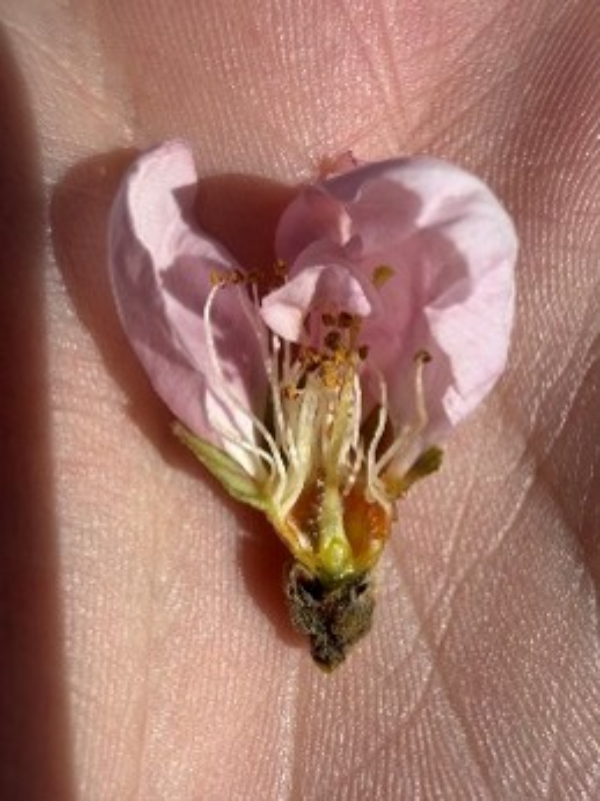
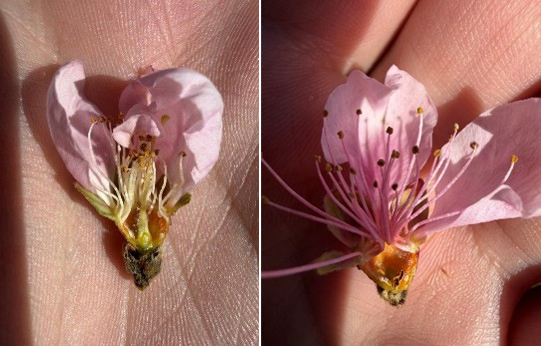
As trees transition out of dormancy and buds begin to swell, cold hardiness declines rapidly. This is due to the plant “waking up”, losing the ability to supercool. By the bud swell stage, temperatures near 1°F may result in approximately 90% fruit bud mortality, while at full bloom, temperatures below 25°F can destroy most open flowers. A table was put together using these principles to determine the temperature fruit buds can survive at different stages of growth.
Crop Management in Low Crop Years
Crop Assessment - Fruit set and Yield
After bloom and early fruit drop, estimating the remaining crop becomes important for making management decisions throughout the rest of the season. Fertility programs, pruning intensity, irrigation scheduling, labor planning, and pest management all depend on understanding whether the orchard is carrying a near-normal crop, a partial crop, or almost no crop at all.
In reduced crop years, visual impressions can be misleading. Trees with scattered fruit may initially appear to have “enough” peaches, but large gaps throughout the canopy often become much more obvious as fruit enlarges. The opposite can also occur, where heavily damaged blocks retain enough surviving fruit to still produce a commercially meaningful crop.
The most reliable approach is to perform simple fruit counts across representative areas of the orchard. Select multiple trees across different soil types, elevations, and varieties within a block. Count the number of fruit on several representative scaffolds or on the entire tree depending on tree size and training system. Avoid selecting only strong or weak trees, as this can quickly skew estimates.
Fruit counts should also be interpreted alongside tree spacing and historical production records. In many mature Michigan peach orchards, a full crop may require only a few hundred well-spaced fruit per tree rather than thousands of fruitlets. Even orchards with significant visible frost injury may still produce a moderate commercial crop if surviving fruit are distributed evenly and achieve large final size.
Reduced crop years also change the economics of fruit size. With fewer peaches competing for carbohydrates, surviving fruit often size aggressively. In many situations, orchards with even a 50% crop load can still produce profitable yields due to improved fruit size, color development, and reduced thinning costs. However, extremely light crops may create separate management challenges including excessive vegetative growth, blind wood development, and increased risk of winter injury the following season.
Yield estimates should remain flexible through June. Additional fruit loss can still occur from delayed cold injury, poor pollination, bacterial spot damage, split pits, or natural June drop. Blocks that appeared acceptable immediately after bloom may continue thinning themselves over the following weeks, particularly in areas where woody tissue injury reduced vascular function.
For growers trying to prioritize labor and management expenses, orchards generally fall into three broad categories:
- Near-normal/Commercial crop: Enough surviving fruit to justify a standard management program with only moderate adjustments.
- Light/Partial crop: Significant gaps in fruit set, but enough remaining fruit to maintain commercial production potential.
- Near crop failure: Minimal fruit remaining, where management priorities shift toward preserving tree health, controlling excessive vigor, and preparing for the 2027 season rather than maximizing current-year production.
Crop Assessment – Twigs and branches
In reduced crop years, evaluating the health of twigs, scaffold limbs, and trunks becomes just as important as evaluating surviving flower buds. Trees that retain a light crop but suffer significant wood injury may struggle for multiple seasons afterward, while trees with minimal bud loss but healthy vascular tissue often recover quickly the following year.
To assess damage, cut into one-year shoots, scaffold limbs, or trunks and examine the tissue just beneath the bark. Healthy cambium and young xylem tissue should appear cream-colored to light green. Damaged tissue may appear tan or water-soaked, while severely injured tissue often turns dark cinnamon brown. Injury is frequently uneven throughout the tree, so multiple cuts should be examined across different limbs and heights in the canopy. Photographs and additional scouting information for cold injury on peach trunks and limbs can be found in a MSU Extension article from 2019.
Partial Crop
Fertilization and Horticultural Management
When peach trees carry a light crop, less of the tree’s energy is directed into fruit growth. As a result, trees often respond with stronger shoot growth and increased canopy vigor. If this growth becomes excessive, growers may need to manage it with summer pruning, selective limb removal, root pruning, or plant growth regulators where appropriate.
Nitrogen fertilizer should also be adjusted to match the reduced crop load. Trees with little fruit do not need to be pushed as hard vegetatively, and excessive nitrogen can make canopy density, shading, disease pressure, and winter hardiness problems worse. However, fertilizer should not be eliminated entirely. The goal is to maintain tree health and support return bloom for the following season, not to stimulate unnecessary shoot growth.
A reduced crop year can also be used as an opportunity to improve tree structure. With fewer fruit to protect, growers can spend more time correcting poor limb angles, opening dense canopies, removing damaged wood, and training young scaffolds. In blocks with limited economic return from the current crop, management should shift toward preparing the tree for better production in future seasons.
Pest and Disease Management
Blocks carrying a partial crop should generally continue to receive a near-normal pest and disease management program. Even with reduced fruit numbers, the remaining crop still represents all of the block’s economic value, and protecting fruit quality remains important.
In addition, many diseases and insect pests affect not only the current crop, but also long-term tree health and future production. Reduced fungicide or insecticide coverage can allow inoculum and pest populations to build going into the following season. Maintaining control of foliar diseases is especially important in light crop years because healthy leaves are needed to rebuild carbohydrate reserves and support return bloom.
Disease management priorities may shift depending on crop load. Fruit-targeting diseases such as brown rot and peach scab may become less economically important in severely damaged blocks with little remaining fruit. However, diseases that affect leaves and shoots, including bacterial spot, peach rust, and other causes of premature defoliation, should continue to be managed to preserve canopy health and maintain tree productivity. Heavy defoliation during the summer can reduce return bloom potential and weaken trees entering winter.
Similarly, insect pests such as oriental fruit moth, borers, scale insects, aphids, and mites can damage shoots, scaffolds, and foliage regardless of crop load. Allowing populations to build during a light-crop year may increase management challenges and costs the following season.
Management programs can still be adjusted where appropriate. For example, spray intervals may sometimes be extended during periods of low disease pressure, and thinning-related sprays or fruit-targeted inputs may no longer be necessary in heavily damaged blocks. However, growers should avoid abandoning season-long IPM programs solely because crop load is reduced.
No Crop
Fertilization and Horticultural Management
Without a fruit crop, the tree has more energy to direct towards vegetative growth and we expect vigor to increase. You may need to control this with root pruning, PGRs, or summer pruning, or plan to prune more next spring.
This vigor can also be limited by reducing the rate of nitrogen fertilization. Some fertilization is still important to help the tree stay healthy for the following season.
The lack of fruit provides an opportunity for growers to prune and train the trees to optimize the structure of the canopy for future seasons.
Pest and Disease Management
Pest and disease programs can be reduced in blocks with no crop, but management should not be abandoned entirely to protect next year’s crop and the health and longevity of the trees. The goal shifts from protecting fruit quality to maintaining healthy foliage, healthy wood, and low pest pressure going into the next season.
Some diseases, such as bacterial spot, should still be managed similarly to a normal year because infections can continue to damage leaves and shoots even in the absence of fruit. In no-crop blocks, the reduced concern for fruit russeting may also allow greater flexibility in the use of copper-containing products within the disease management program. Often, a program that includes lower cost products like sulfur and Captan is sufficient to keep fungal diseases at bay.
Diseases that primarily affect fruit, such as brown rot, generally require far less management in blocks with no harvestable crop. With no fruit, there will be little concern for brown rot.
Several insect pests also become less important without fruit present. Plum curculio, for example, requires fruit for larval development and is unlikely to successfully reproduce in blocks with complete crop failure. Oriental fruit moth, however, can continue developing in succulent shoots even when fruit are absent, meaning control may still be necessary to prevent shoot flagging and maintain low populations for the following season. This is especially important for young orchards. First generation OFM enters tip shoots of new growth, killing the terminal bud, causing unwanted vegetative growth. In an unmanaged orchard, OFM can kill the majority of new shoot tips, making training difficult.
Growers should also continue managing pests that affect leaves, shoots, trunks, or scaffold limbs, including borers, scale insects, leafrollers, mites, and aphids. Even in a no-crop year, maintaining healthy canopy function and protecting the long-term condition of the orchard remains important.
See also: Managing Orchards in a No Crop Year: Protecting Tree Health for Next Season
Economics of a Reduced Crop
The Michigan Peach Cost of Production Guide (2024) can help estimate the economic impact of reduced crop levels following freeze injury or tree decline. Using the reference yield of 300 bushels per acre for a mature orchard from the study, crop levels can be broadly grouped into three practical categories shown in Figure 1: less than 100 bu/acre represents near crop failure, 100–200 bu/acre represents a light to partial crop, and greater than 200 bu/acre represents a commercially productive crop.
Because orchard yield depends on both tree density and crop load per tree, these yield categories can also be translated into approximate fruit counts under the study assumptions of 270 trees per acre and 110 peaches per 50-lb bushel. Under these assumptions, fewer than 40 peaches per tree corresponds roughly to near crop failure, 40-110 peaches per tree corresponds to a light or partial crop, and greater than 110 peaches per tree corresponds to a commercial crop level.
However, orchards do not all contain the same number of trees per acre. Tree loss from decline, replanting gaps, or differences in planting density can substantially change yield potential even when remaining trees appear heavily cropped. Likewise, years with lighter crop loads often produce larger fruit, reducing the number of peaches needed to fill a bushel.
To adjust yield estimates for different orchard densities or expected fruit size, use the following relationship:
Yield (bu/ac) = (fruit per tree) x (trees per acre) / peaches per bushel
For example, consider an orchard averaging 70 fruit per tree with 200 trees per acre. If fruit size is expected to be approximately 10% larger than average due to lower fruit set, the estimated number of peaches per bushel decreases from 110 to roughly 100 peaches per bushel. The estimated yield would therefore be:
Yield = (70 x 200) / 100 = 140 bu/ac
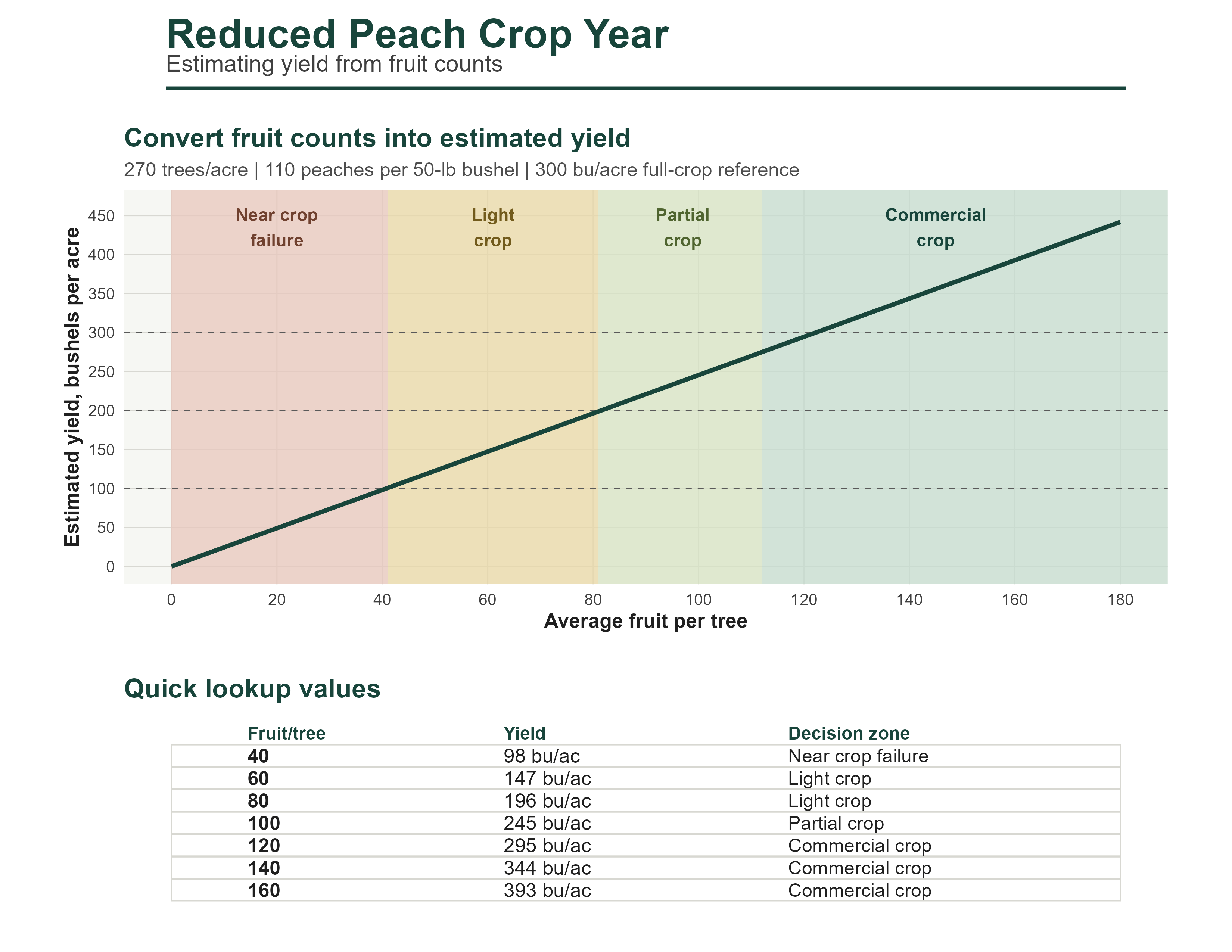
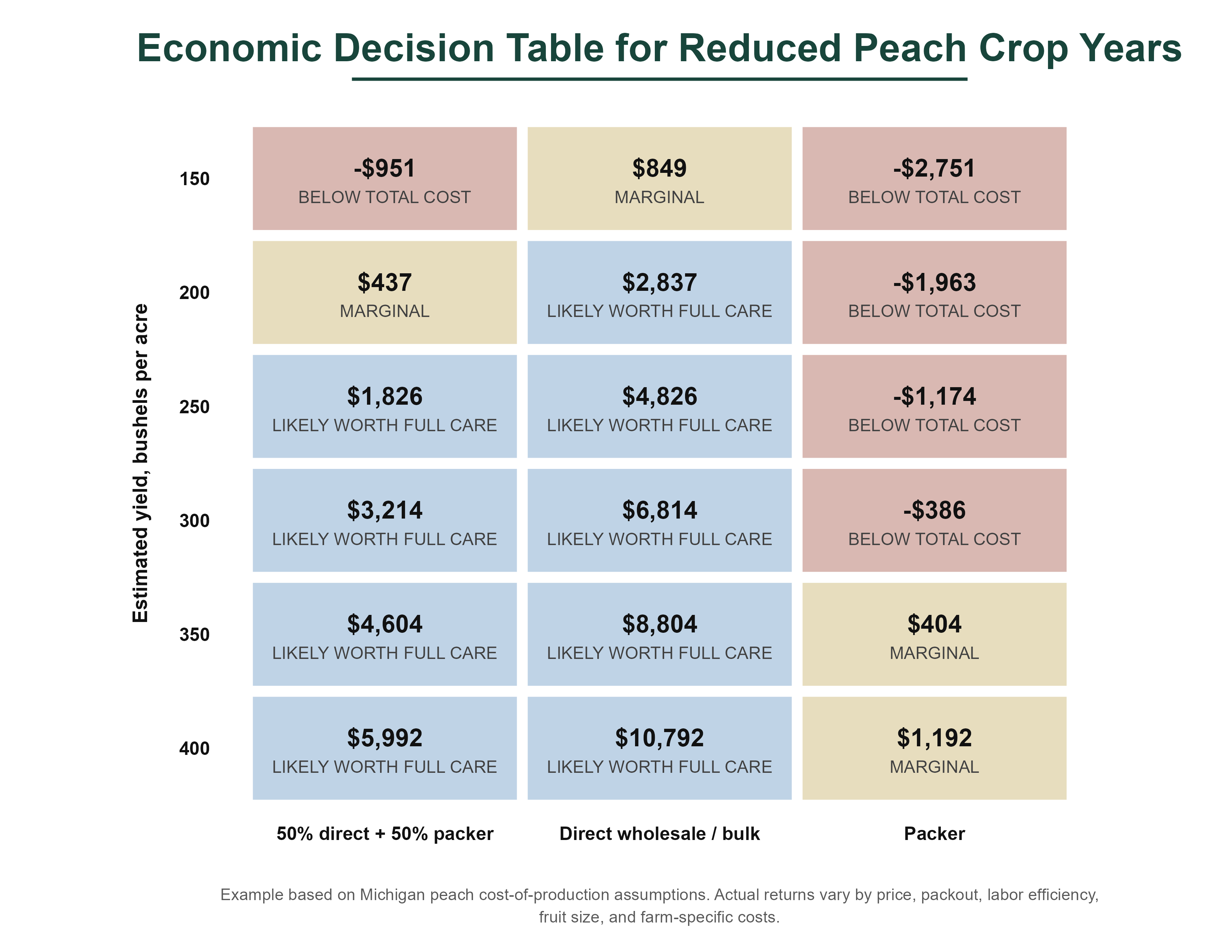
Figure 2 illustrates how estimated annual returns over operating and harvesting costs can change across yield levels and marketing strategies for fresh-market peaches. Returns are generally highest for fruit sold through direct wholesale or retail channels, where growers capture a larger share of the final market value. Fruit sold through packers typically receives a lower return per bushel due to packing, handling, and marketing costs, while operations using a combination of direct sales and packer channels often fall between these two extremes.
By combining estimated yield from the previous equation with expected marketing channel, growers can better evaluate whether continued investment in fungicides, insecticides, thinning, irrigation, hand labor, and harvest operations is economically justified. In reduced-crop years, this framework can help identify the point at which maintaining full management remains profitable, becomes marginal, or may no longer cover total production costs.
The estimates shown in Figure 2 are based on example prices of approximately $48 per bushel for direct wholesale or retail-marketed fruit and approximately $24 per bushel for fruit marketed through a packer. These values are intended only as generalized reference points and will vary substantially depending on fruit size, quality, timing, regional supply, and individual marketing arrangements, but these values give an “average” for price received in 2024, the year of the study.
In reduced-crop years, market prices may increase if regional production losses reduce overall supply. However, price response following freeze events is often difficult to predict because market conditions are influenced by multiple factors beyond local crop loss, including imports, competing production regions, consumer demand, and fruit quality.